UGC NET Commerce September 2024 Question PaperPaper 2 with Answer Key
The complete UGC NET September 2024 question paper for Commerce, covering Paper 2 (Commerce). Every question below is shown with its options and the correct answer, and a detailed explanation you can unlock by signing in. All 200 questions are free to practise.
UGC NET September 2024 at a glance
| Exam | UGC NET September 2024 |
|---|---|
| Papers | Paper 2 (Commerce) |
| Exam date(s) | September 3, 2024 |
| Shift(s) | Shift 1 · Shift 2 |
| Paper 2 questions | 200 questions · 120 minutes · 200 marks |
| Total | 200 questions |
| Marking scheme | +2 per correct answer · No negative marking |
Paper 2 — Commerce · Shift 1
Attempt this paper100 questions with the answer key and explanations.
Question 1
What is the correct sequence to be followed for the following while computing income under the head Capital Gains?
A. Deduction of indexed cost of acquisition
B. Determination of full value of consideration
C. Determination whether the asset is a capital asset or not
D. Determination whether the transaction is regarded as transfer or not
E. Exemption under section 54EC in respect of investment in the long-term specified assetChoose the correct answer from the options given below:
- AB, A, C, E, D
- BE, A, D, C, B
- CD, B, C, A, E
- DC, D, B, A, E
Answer: (D) C, D, B, A, E
Explanation
Sign in to read the full explanationQuestion 2
Which one of the following selection tests answers the question "Does this test measure what it's supposed to measure"?
- AContent validity
- BCriterion validity
- CContruct validity
- DTest validity
Answer: (D) Test validity
Explanation
Sign in to read the full explanationQuestion 3
Which among the following is the correct value of Income Elasticity of Petrol consumption from the following information?
The Government announces a 10 per cent dearness allowance to its employees. As a result, average monthly salary of Government employees increases from ₹20,000 to ₹22,000. Following the pay hike, monthly petrol consumption of government employees increased from 150 litres per month to 165 litres per month:
- A0.5
- B1
- C2
- D0.1
Answer: (B) 1
Explanation
Sign in to read the full explanationQuestion 4
Where there is an unconditional contract for the sale of specific goods in a deliverable state, the property (ownership) in goods passes to the buyer when
- Athe contract is made
- Bthe payment is made
- Cthe goods are delivered
- Dthe goods are dispatched
Answer: (A) the contract is made
Explanation
Sign in to read the full explanationQuestion 5
Which one of the following is a correct assumption of Law of Diminishing Returns to a variable Input ?
- ALabour and Capital are the only variable inputs
- BThe units of Labour and Capital are homogeneous
- CThe state and technology is not given
- DInput prices are given
Answer: (D) Input prices are given
Explanation
Sign in to read the full explanationQuestion 6
Match List-I with List-II.
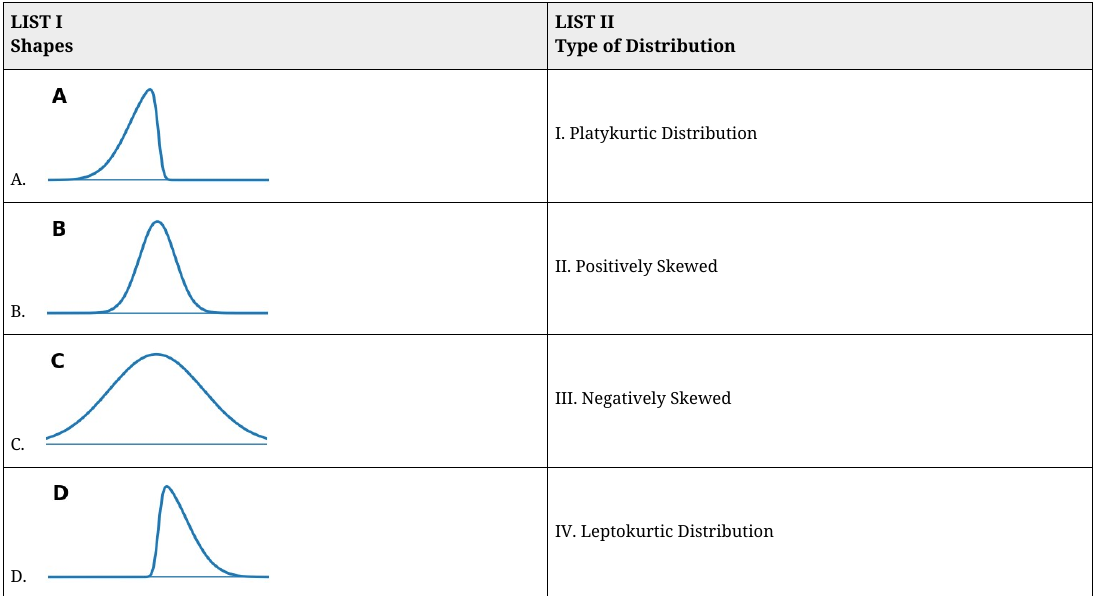
Distribution curve shapes for List-I matched with distribution types in List-II.
- AA-III, B-IV, C-I, D-II
- BA-II, B-IV, C-I, D-III
- CA-III, B-I, C-IV, D-II
- DA-IV, B-I, C-III, D-II
Answer: (A) A-III, B-IV, C-I, D-II
Explanation
Sign in to read the full explanationQuestion 7
Which of the following factors constitute the Economic Environment of a country?
A. Financial System
B. Socio-cultural environment
C. Economic Policies
D. Educational environment
E. Structural EquilibriumChoose the correct answer from the options given below:
- AA, B & C only
- BA, C & E only
- CB, D & E only
- DC, D & E only
Answer: (B) A, C & E only
Explanation
Sign in to read the full explanationQuestion 8
Which of the following are the assumptions of Gordon's dividend-capitalization model?
A. No taxes
B. Cost of capital is less than the growth rate
C. No internal financing
D. Constant retention
E. Constant cost of capitalChoose the correct answer from the options given below:
- AA, B & D only
- BB, C & E only
- CA, C & D only
- DA, D & E only
Answer: (D) A, D & E only
Explanation
Sign in to read the full explanationQuestion 9
Arrange the following theories of Profit in order of time when these were propounded from oldest to latest -
A. Hawley's Risk Theory of profit
B. Walker's Theory of Profit: Profit as Rent of Ability
C. Clerk's Dynamic Theory of Profit
D. Schumpeter's Innovation Theory of Profit
E. Knight's Theory of ProfitChoose the correct answer from the options given below:
- AA, C, D, B, E
- BB, C, A, D, E
- CE, B, C, D, A
- DB, C, A, E, D
Answer: (B) B, C, A, D, E
Explanation
Sign in to read the full explanationQuestion 10
Which one of the following is standard deviation of first 7 (1 to 7) natural numbers?
- A4
- B3
- C2
- D6
Answer: (C) 2
Explanation
Sign in to read the full explanationQuestion 11
Which of the following methods have been prescribed by the Central Board of Direct Taxes (CBDT) for computation of Arm's Length Price required to compute income arising from an International transaction under Chapter X of the Income-tax Act, 1961?
A. Transactional Net Margin Method
B. Uncomparable Controlled Price Method
C. Profit Split Method
D. Resale Price Method
E. Cost Minus MethodChoose the correct answer from the options given below:
- AB, D & E Only
- BA, B & D Only
- CC, D & E Only
- DA, C & D Only
Answer: (D) A, C & D Only
Explanation
Sign in to read the full explanationQuestion 12
In WTO terminology, subsidies in general are identified by "boxes". Domestic support measure considered to distort production and trade, which is defined in Article 6 of the Agriculture Agreement falls into which box?
- AAmber Box
- BJumbo Box
- CGreenfield Box
- DBlack Box
Answer: (A) Amber Box
Explanation
Sign in to read the full explanationQuestion 13
If two regression lines are : 8x-10y+66=0 and 40x-18y=214, then x̄ & Ȳ are respectively
- A13, 14
- B16, 15
- C14, 13
- D13, 17
Answer: (D) 13, 17
Explanation
Sign in to read the full explanationQuestion 14
The rate of diffusion of any innovation depends upon the following factors:
A. The relative advantage of the innovation over previous solutions
B. The compatibility of the innovation with existing values and norms
C. A lack of complexity in using the innovation
D. The divisibility of the innovation facilitating low-risk trial
E. The communicability of the advantages of the innovationChoose the correct answer from the options given below:
- AA, C & E Only
- BA, B, C & E only
- CA, B, C, D & E
- DB & D Only
Answer: (C) A, B, C, D & E
Explanation
Sign in to read the full explanationQuestion 15
Import of service means:
A. Supplier of service is located in India
B. Supplier of service is located outside India
C. Recipient of service is located in India
D. Recipient of service is located outside India
E. Place of Supply of service is in IndiaChoose the correct answer from the options given below:
- AA, B & E only
- BA, D & E only
- CB, D & E only
- DB, C & E only
Answer: (D) B, C & E only
Explanation
Sign in to read the full explanationQuestion 16
Arrange the following content theories of work motivation in the increasing order of their development -
A. Herzberg-motivation and hygiene factors
B. Alderfer ERG Needs
C. Maslow-Hierarchy of Needs
D. Scientific Management
E. Human RelationsChoose the correct answer from the options given below:
- AD, C, E, A, B
- BD, E, C, A, B
- CB, C, A, D, E
- DD, E, A, C, B
Answer: (B) D, E, C, A, B
Explanation
Sign in to read the full explanationQuestion 17
Which of the following condition is NOT required to be satisfied by an individual for the purpose of claiming unilateral relief under section 91(1) of the Income-tax Act, 1961, in a previous year?
- AHe must be resident in India in that previous year
- BHis total income exceeds ₹10,00,000 during that previous year
- CHe has earned an income during that previous year from another country and that income has accrued or arose outside India
- DHe has paid income-tax in that country on the income earned in that country and no Double Taxation Avoidance Agreement (DTAA) exists between India and that country
Answer: (B) His total income exceeds ₹10,00,000 during that previous year
Explanation
Sign in to read the full explanationQuestion 18
Which one of the following theory of capital structure discusses Arbitrage Process?
- ATraditional Approach
- BModigliani and Miller (MM) Approach
- CNet Operating Income (NOI) Approach
- DNet Income (NI) Approach
Answer: (B) Modigliani and Miller (MM) Approach
Explanation
Sign in to read the full explanationQuestion 19
Match List-I with List-II.
List-I (Personality Traits) List-II (Descriptive Characteristics) A. Conscientiousness I. Outgoing B. Agreeableness II. Caring C. Extraversion III. Creative D. Openness to experience IV. Dependable - AA-III, B-II, C-I, D-IV
- BA-IV, B-II, C-III, D-I
- CA-IV, B-II, C-I, D-III
- DA-I, B-II, C-III, D-IV
Answer: (C) A-IV, B-II, C-I, D-III
Explanation
Sign in to read the full explanationQuestion 20
Match List-I with List-II.
List-I (Ind AS) List-II (Related) A. Ind AS-12 I. Leases B. Ind AS-17 II. Borrowing Costs C. Ind AS-19 III. Employee Benefits D. Ind AS-23 IV. Income Taxes - AA-IV, B-I, C-III, D-II
- BA-III, B-II, C-IV, D-I
- CA-I, B-IV, C-III, D-II
- DA-IV, B-III, C-I, D-II
Answer: (A) A-IV, B-I, C-III, D-II
Explanation
Sign in to read the full explanationQuestion 21
Match List-I with List-II.
List-I (Macro Level Organizational Stressors) List-II (Examples) A. Administrative Policies and Strategies I. Crowded work area B. Organizational Structure and Design II. Merit Pay Plans C. Organizational Processes III. No opportunity for advancement D. Working Conditions IV. Lack of participation in decisions - AA-II, B-III, C-IV, D-I
- BA-III, B-II, C-IV, D-I
- CA-II, B-IV, C-III, D-I
- DA-IV, B-I, C-II, D-III
Answer: (A) A-II, B-III, C-IV, D-I
Explanation
Sign in to read the full explanationQuestion 22
Which one of the following is NOT an issue (to be tackled) of conceptual component of a CRM programme?
- AChoosing the technology
- BSetting out the objectives in clear terms
- CProcessing all customer requests coming in through multiple channels
- DPutting customers first
Answer: (A) Choosing the technology
Explanation
Sign in to read the full explanationQuestion 23
In international trade, factoring is widely used in short-term transactions as a continuous arrangement. Arrange the steps of export factoring operations in sequence -
A. The export factor transfers the invoice to the import factor, who, in return, assumes credit risk and undertakes administration of receivable.
B. The export factor pays cash in advance to the exporter against receivables until the payment is received from the importer.
C. The importer and exporter enter into a sales contract and agree on the terms of sale.
D. The import factor presents invoice to importer, take payment and pays to the export factor.
E. The exporter ships the goods to the importer and submits the invoice to the export factor.Choose the correct answer from the options given below:
- AE, A, B, D, C
- BE, B, A, D, C
- CC, B, E, D, A
- DC, E, B, A, D
Answer: (D) C, E, B, A, D
Explanation
Sign in to read the full explanationQuestion 24
Compute the after-tax cost of capital of a company in case a perpetual bond (face value is ₹100) is sold as well as redeemed at par having coupon rate of interest being 7% and corporate tax rate is 30%.
- A2.1%
- B4.9%
- C7%
- D10%
Answer: (B) 4.9%
Explanation
Sign in to read the full explanationQuestion 25
Arrange the steps of Sampling Design in a form of questions that are to be answered in securing a sample -
A. What is the appropriate sampling method?
B. What are the parameters of interest?
C. What size sample is needed?
D. What is the target population?
E. What is the sampling frame?Choose the correct answer from the options given below:
- AE, D, B, A, C
- BB, E, A, C, D
- CC, B, A, E, D
- DD, B, E, A, C
Answer: (D) D, B, E, A, C
Explanation
Sign in to read the full explanationQuestion 26
The Narasimhan Committee 1991 recommended the reforms with respect to the banking sector. These reforms are also known as:
- AFirst generation reforms
- BSecond generation reforms
- CFinancial sector reforms
- DThird generation reforms
Answer: (A) First generation reforms
Explanation
Sign in to read the full explanationQuestion 27
Which one of the following is NOT a marketing principle?
- AFocus on customer
- BMarkets are homogeneous
- CCustomers do not buy products
- DMarketing is too important to leave to the marketing department
Answer: (B) Markets are homogeneous
Explanation
Sign in to read the full explanationQuestion 28
Match List-I with List-II.
List-I (Pricing Strategies) List-II (Their Explanation) A. Skimming Price Policy I. Where the nature of the products are non-storable B. Penetration Price Policy II. Where close substitutes of a new product are not available C. Peak Load Pricing Policy III. Exporting goods at a price lower than the domestic price D. Dumping Pricing Policy IV. Substitutes of new products are available - AA-III, B-II, C-I, D-IV
- BA-IV, B-III, C-II, D-I
- CA-I, B-III, C-II, D-IV
- DA-II, B-IV, C-I, D-III
Answer: (D) A-II, B-IV, C-I, D-III
Explanation
Sign in to read the full explanationQuestion 29
For the purpose of taking Capital Budgeting Decisions in respect of a company in India, following are taken into consideration in computing cash flows in the terminal year of the project:
A. Tax loss on short-term capital gains
B. Tax loss on short-term capital loss
C. Release of net working capital
D. Tax saving on short-term capital loss
E. Tax saving on short-term capital gainsChoose the correct answer from the options given below:
- AA, C & D only
- BB, C & E only
- CC & E only
- DB & E only
Answer: (A) A, C & D only
Explanation
Sign in to read the full explanationQuestion 30
For test hypothesis H₀: μ₁ ≤ μ₂ and H₁ : μ₁ > μ₂, the critical region (Z) at α = 0.10 and n > 30 will be
- AZ ≤ 1.96
- BZ > 1.96
- CZ > 1.645
- DZ ≤ -1.645
Answer: (C) Z > 1.645
Explanation
Sign in to read the full explanationQuestion 31
Arrange the following sequentially with respect to operating cycle of a manufacturing firm -
A. Payables Deferral Period
B. Finished Goods Conversion Period
C. Raw Material Conversion Period
D. Receivables Conversion Period
E. Work-in-progress Conversion PeriodChoose the correct answer from the options given below:
- AA, D, C, E, B
- BC, E, B, D, A
- CB, D, A, E, C
- DD, B, E, A, C
Answer: (B) C, E, B, D, A
Explanation
Sign in to read the full explanationQuestion 32
RBI permitted the issue of commercial papers within the framework of its guidelines. Which one of the following committee recommended these guidelines?
- AVaghul Committee
- BChakravarty Committee
- CPadmnabhan Committee
- DNarasimham Committee
Answer: (A) Vaghul Committee
Explanation
Sign in to read the full explanationQuestion 33
The price of a company's share is ₹80 and the value of growth opportunities is ₹20. If the company's capitalisation rate is 15%, how much is the EPS?
- A₹20
- B₹12
- C₹3
- D₹9
Answer: (D) ₹9
Explanation
Sign in to read the full explanationQuestion 34
What is the correct sequence to be followed for the following transactions undertaken by an individual while computing his gross total income as per the Income-tax Act, 1961?
A. Investment in own public provident fund
B. Investment in one residential house in India for exemption from capital gains
C. Interest on capital borrowed for purchasing a self-occupied house property
D. Tax on employment
E. Payment of Medical insurance premium on his own lifeChoose the correct answer from the options given below:
- AC, B, D, E, A
- BD, C, B, A, E
- CE, A, D, B, C
- DB, C, E, A, D
Answer: (B) D, C, B, A, E
Explanation
Sign in to read the full explanationQuestion 35
WTO in its 8th Ministerial conference adopted a decision allowing members to waive the provisions of Article II (most favored-National Treatment) of the GATS to allow the granting of preferential treatment to services and service supplies to which countries?
- AAdjacent Countries
- BNon-Nuclear Countries
- CLeast-Developed Countries
- DSAARC Countries
Answer: (C) Least-Developed Countries
Explanation
Sign in to read the full explanationQuestion 36
Arrange the following steps of Activity Based Costing (ABC) in proper sequence -
A. Staff Training and Review Follow up
B. Identify Main Activities
C. Process specification
D. Identify Non-value adding Activity and cost pools
E. Selection of Activity Cost Drivers and Tracing of Costs with objectsChoose the correct answer from the options given below:
- AC, B, D, E, A
- BB, C, D, E, A
- CD, B, C, A, E
- DE, D, B, C, A
Answer: (A) C, B, D, E, A
Explanation
Sign in to read the full explanationQuestion 37
Which of the following are the characteristics of a Leader?
A. Focuses on systems and structure
B. Eye on the horizon
C. Asks how and when
D. Does things right
E. OriginatesChoose the correct answer from the options given below:
- AA, B & D only
- BB & E only
- CB, C & D only
- DA, B, D & E only
Answer: (B) B & E only
Explanation
Sign in to read the full explanationQuestion 38
Which one of the following is Value Added Service of EXIM Bank?
- ALine of Credit
- BPre-shipment Credit
- CBuyers Credit
- DExport Marketing Services
Answer: (D) Export Marketing Services
Explanation
Sign in to read the full explanationQuestion 39
Which one of the following non-functional rewards does NOT fall under job design category?
- ACompliment of work progress
- BFlexible hours
- CParticipation in decisions
- DFlexible breaks
Answer: (A) Compliment of work progress
Explanation
Sign in to read the full explanationQuestion 40
If selling price per unit is ₹56.00. Variable cost per unit is ₹32.00 and total fixed cost is ₹60,000, what is the number of units that used to be sold in order to achieve a profit of ₹84,000?
- A6000 units
- B8400 units
- C5000 units
- D6500 units
Answer: (A) 6000 units
Explanation
Sign in to read the full explanationQuestion 41
Match List-I with List-II.
List-I (Institutions) List-II (Date of establishment) A. National Housing Bank I. 01-07-1964 B. Industrial Development Bank of India II. 01-07-1948 C. Small Industrial Development Bank of India III. 02-04-1990 D. Industrial Finance Corporation of India IV. 09-07-1988 - AA-I, B-II, C-III, D-IV
- BA-III, B-I, C-IV, D-II
- CA-I, B-IV, C-III, D-II
- DA-IV, B-I, C-III, D-II
Answer: (D) A-IV, B-I, C-III, D-II
Explanation
Sign in to read the full explanationQuestion 42
Which of the following are true in case of Internal Reconstruction?
A. The existing company is liquidated
B. No new company is formed
C. There is certain reduction of capital and sometime liabilities are also reduced
D. The new company issues fresh capital
E. It is done as per section 66 of the Companies Act, 2013Choose the correct answer from the options given below:
- AA, D & E only
- BA, C & E only
- CB, C & E only
- DB, C & D only
Answer: (C) B, C & E only
Explanation
Sign in to read the full explanationQuestion 43
X Ltd. incurred a capital expenditure of ₹5,00,000 for the purpose of promoting family planning amongst its employees during the assessment year 2024-25. How much deduction in respect of such expenditure can be claimed by X Ltd. during the assessment year 2024-25, while computing income under the head Profits and Gains of Business or Profession?
- A₹5,00,000
- B₹2,50,000
- C₹1,00,000
- D₹50,000
Answer: (C) ₹1,00,000
Explanation
Sign in to read the full explanationQuestion 44
Which one of the following is NOT good for bargainers while bargaining with employees?
- ADo not hurry
- BBuild a reputation for being fair but not firm
- CStrive to keep some flexibility in your position
- DRespect the importance of face saving for the other party
Answer: (B) Build a reputation for being fair but not firm
Explanation
Sign in to read the full explanationQuestion 45
How much per cent of income by way of interest received on compensation or enhanced compensation is allowed as deduction while computing Income from Other Sources under the Income-tax Act, 1961?
- A25%
- B50%
- C75%
- D100%
Answer: (B) 50%
Explanation
Sign in to read the full explanationQuestion 46
In which one of the following ratios, the share capital of RRBs is prescribed for the Central Government, State Government and Sponsoring bank?
- A50:30:20
- B50:35:15
- C60:20:20
- D50:15:35
Answer: (D) 50:15:35
Explanation
Sign in to read the full explanationQuestion 47
Match List-I with List-II.
List-I (Concept) List-II (Meaning) A. Profitability Index I. Rate that equates the investment outlay with the present value of cash inflow received after one period B. Accounting Rate of Return (ARR) II. Compound average annual rate that is calculated with a reinvestment rate different than the project's IRR C. Internal Rate of Return (IRR) III. Rate that is computed by dividing the average profit after tax with the average investment D. Modified Internal Rate of Return (MIRR) IV. Ratio of the present value of cash inflows, at the required rate of return, to the initial cash outflow of the investment - AA-IV, B-III, C-I, D-II
- BA-I, B-IV, C-II, D-III
- CA-II, B-I, C-III, D-IV
- DA-III, B-II, C-IV, D-I
Answer: (A) A-IV, B-III, C-I, D-II
Explanation
Sign in to read the full explanationQuestion 48
Which one of the following refers to the need on part of customer that gets satisfied by service?
- AService Benefits
- BService Expectations
- CService Offer
- DService Level
Answer: (A) Service Benefits
Explanation
Sign in to read the full explanationQuestion 49
Match List-I with List-II.
List-I (Classification of goods as per the Sales of Goods Act, 1932) List-II (Their Definition) A. Specific Goods I. The goods which are to be manufactured or produced or acquired by the seller after making the contract of sale B. Ascertained Goods II. The goods, which are not identified and agreed upon at the time of formation of contract of sale C. Unascertained Goods III. The goods, which are identified and agreed upon subsequent to the formation of contract of sale D. Future Goods IV. The goods, which are identified and agreed upon at the time of making the contract of sale - AA-IV, B-III, C-II, D-I
- BA-I, B-II, C-III, D-IV
- CA-IV, B-II, C-III, D-I
- DA-I, B-III, C-II, D-IV
Answer: (A) A-IV, B-III, C-II, D-I
Explanation
Sign in to read the full explanationQuestion 50
Which of the following are true about Digital Signature under Information Technology (IT) Act, 2000?
A. Digital Signature is an Electronic Signature
B. Digital Signatures are accepted Globally
C. Each vendor has to make his own standard to regulate Digital Signatures
D. The term Electronic Signature is broader than Digital Signature
E. Digital Signature is less secure than Electronic SignatureChoose the correct answer from the options given below:
- AA, D & E only
- BA, B & D only
- CC, B & E only
- DB, C & D only
Answer: (B) A, B & D only
Explanation
Sign in to read the full explanationQuestion 51
Arrange the following steps for the Incorporation of a new LLP (Limited Liability Partnership) in the correct order -
A. Drafting of LLP Agreement
B. Deciding the partners and designated partners
C. Electronic filing of documents with ROC & issuing of Certificate of Incorporation by ROC (Registrar of Companies)
D. Checking the availability of Name
E. Obtaining DPIN & Digital Signature CertificateChoose the correct answer from the options given below:
- AB, E, D, A, C
- BC, A, B, D, E
- CA, B, C, D, E
- DE, A, C, D, B
Answer: (A) B, E, D, A, C
Explanation
Sign in to read the full explanationQuestion 52
Which of the following are social factors influencing consumer buying behavior?
A. Culture
B. Reference groups
C. Social Class
D. Roles assumed
E. Sub-cultureChoose the correct answer from the options given below:
- AA, B & C Only
- BB & D Only
- CA, C & D Only
- DB, D & E Only
Answer: (B) B & D Only
Explanation
Sign in to read the full explanationQuestion 53
Which one of the following is known as backbone of auditing?
- AVerification of assets
- BInternal check
- CVouching
- DInternal audit
Answer: (C) Vouching
Explanation
Sign in to read the full explanationQuestion 54
Which of the following is NOT an assumption of Baumol's model of cash management?
- AThe firm is unable to forecast cash needs with certainty
- BOpportunity cost of holding cash is known
- CThe firm incurs the same transaction cost whenever it converts securities to cash
- DThe firm's cash payments occur uniformly over a period
Answer: (A) The firm is unable to forecast cash needs with certainty
Explanation
Sign in to read the full explanationQuestion 55
Arrange the given component tasks to be handled in positioning in the logical sequence -
A. Developing the value proposition
B. Analysing competitors' positioning: Is there a gap somewhere?
C. Communicating the value proposition to target consumers
D. Deciding the locus in consumers' mind: Where to lodge the product/brand?
E. Ensuring the infrastructure/competitive advantage for delivering the premiseChoose the correct answer from the options given below:
- AD, B, A, E, C
- BD, B, E, A, C
- CB, D, A, E, C
- DB, D, C, A, E
Answer: (C) B, D, A, E, C
Explanation
Sign in to read the full explanationQuestion 56
Which of the following subsidiaries are fully owned by the Reserve Bank of India ?
A. National Housing Bank
B. National Bank for Agriculture and Rural Development
C. Deposit Insurance and Credit Guarantee Corporation of India
D. Bhartiya Reserve Bank Note Mudran Private Limited
E. Securities Trading Corporation of IndiaChoose the correct answer from the options given below:
- AA, C & D Only
- BA, D & E Only
- CB, D & E Only
- DB, C & E Only
Answer: (A) A, C & D Only
Explanation
Sign in to read the full explanationQuestion 57
Which of the following item is included in the definition "Goods" as per Sales of Goods Act, 1930?
- APurchase of lottery tickets
- BThe decree of Court of Law
- CActionable claims
- DImmovable Property
Answer: (A) Purchase of lottery tickets
Explanation
Sign in to read the full explanationQuestion 58
Which of the following are cases of Funds Flow?
A. Payment to trade creditors by sale of Land
B. Cash collection from debtors
C. Purchase of Furniture by issue of bills payable
D. Payment of long term loan by cash
E. Payment of bills payable by cashChoose the correct answer from the options given below:
- AA, D & E only
- BB, C & D only
- CA, C & D only
- DB & E only
Answer: (C) A, C & D only
Explanation
Sign in to read the full explanationQuestion 59
A statistical statement in International business that shows at a point the value of financial assets of residents of an economy that are claims on non-residents or are gold bullion held as reserve assets and the liabilities of residents of an economy to non-residents is known as
- ACurrency Composition Table
- BSpecial Purpose Entities (SPEs)
- CCross Border Flows
- DThe Internation Investment Position (IIP)
Answer: (D) The Internation Investment Position (IIP)
Explanation
Sign in to read the full explanationQuestion 60
Match List-I with List-II.
List-I (Negotiable Instruments) List-II (Their Explanation) A. Inchoate Instrument I. When negotiable instrument is delivered conditionally or for a specific purpose as a collateral security or for safe custody only B. Ambiguous Instrument II. When the name of the drawer, or the payee, or both are fake in a bill C. Escrow III. When the instrument owing to its faulty drafting may be interpreted either as a promissory note or bill of exchange D. Fictitious Bill IV. An incomplete instrument in some respect, where a person signs & delivers to another a blank or incomplete paper - AA-II, B-III, C-I, D-IV
- BA-III, B-II, C-IV, D-I
- CA-IV, B-III, C-I, D-II
- DA-I, B-II, C-III, D-IV
Answer: (C) A-IV, B-III, C-I, D-II
Explanation
Sign in to read the full explanationQuestion 61
Which one of the following cost-value-price trio, a manufacturer would like to seek?
- AValue > Price > Costs
- BPrice > Value > Costs
- CPrice > Costs > Value
- DPrice = Value > Costs
Answer: (A) Value > Price > Costs
Explanation
Sign in to read the full explanationQuestion 62
Match List-I with List-II.
List-I (Purpose for which deduction is given under the Income-tax Act, 1961) List-II (Relevant Section) A. Contribution to Agnipath Scheme I. Section 80TTB B. Profits and gains from business collecting and processing of bio-degradable waste II. Section 80GGB C. Interest on deposits in case of senior citizens III. Section 80CCH D. Contributions given by companies to political parties IV. Section 80JJA - AA-III, B-IV, C-I, D-II
- BA-II, B-IV, C-III, D-I
- CA-IV, B-III, C-I, D-II
- DA-I, B-II, C-IV, D-III
Answer: (A) A-III, B-IV, C-I, D-II
Explanation
Sign in to read the full explanationQuestion 63
Match List-I with List-II.
List-I (Product) List-II (Description) A. Dinosaur I. Products that are beautiful but unsaleable B. Flamingo II. Products that are blind to the future C. Ostrich III. Products that are source of a profitable future D. Pearl IV. Products that have missed their niche - AA-IV, B-II, C-I, D-III
- BA-II, B-I, C-IV, D-III
- CA-I, B-II, C-IV, D-III
- DA-IV, B-I, C-II, D-III
Answer: (D) A-IV, B-I, C-II, D-III
Explanation
Sign in to read the full explanationQuestion 64
Data preparation needs to ensure the accuracy of the data and their conversion from raw form to reduced and classified forms for analysis. It includes which of the following:
A. Coding
B. Data Entry
C. Editing
D. Steming
E. AliasingChoose the correct answer from the options given below:
- AA & C only
- BB & D only
- CA, B & C only
- DC, D & E only
Answer: (C) A, B & C only
Explanation
Sign in to read the full explanationQuestion 65
Match List-I with List-II.
List-I (Concept) List-II (Meaning) A. Systematic risk I. Compensation for time B. Beta II. Increase in corporate tax rate C. Risk-free rate III. Sensitivity coefficient D. Unsystematic risk IV. Competitor enters market - AA-I, B-IV, C-III, D-II
- BA-IV, B-I, C-II, D-III
- CA-III, B-II, C-IV, D-I
- DA-II, B-III, C-I, D-IV
Answer: (D) A-II, B-III, C-I, D-IV
Explanation
Sign in to read the full explanationQuestion 66
The current ratio of a company is 2:1. Which one the following suggestions would improve the current ratio?
- APurchase stock for cash
- BCash collection from debtors
- CPay a current liability
- DPurchase fixed assets
Answer: (C) Pay a current liability
Explanation
Sign in to read the full explanationQuestion 67
Arrange the following banks in an increasing order of their year of formation-
A. State Bank of India
B. Imperial Bank of India
C. RBI
D. Regional Rural Banks
E. Small Finance BankChoose the correct answer from the options given below:
- AE, D, C, B, A
- BE, D, A, B, C
- CB, C, A, D, E
- DC, B, A, D, E
Answer: (C) B, C, A, D, E
Explanation
Sign in to read the full explanationQuestion 68
Arrange the following steps of decision making process in application of Economics in Business decision making from starting to end -
A. Selection and Implementation of Decision
B. Inventing, developing possible Course of Action
C. Collection and Analysis of Relevant Data
D. Identifying Business Related Issues
E. Determining and defining objectiveChoose the correct answer from the options given below:
- AD, C, E, B, A
- BC, D, B, E, A
- CB, C, D, E, A
- DE, D, C, B, A
Answer: (D) E, D, C, B, A
Explanation
Sign in to read the full explanationQuestion 69
The tool that International Development Association (IDA) uses to address the impact of severe natural disasters, public health emergencies by providing extra finances is known as
- AEmergency Response Fund (ERF)
- BLong term Lending system
- CCrisis Response Window (CRW)
- DMonetary Fund
Answer: (C) Crisis Response Window (CRW)
Explanation
Sign in to read the full explanationQuestion 70
Arrange the given steps involved in designing a channel system in the logical order -
A. Evaluating the distribution environment
B. Evaluating the short-listed alternative designs and selecting the one that suits the firm best
C. Matching the channel design to customer needs/characteristics
D. Choosing the channel intensity and number of tiers
E. Evaluating competitors channel designChoose the correct answer from the options given below:
- AA, C, E, B, D
- BC, A, E, D, B
- CC, E, D, A, B
- DC, A, E, B, D
Answer: (B) C, A, E, D, B
Explanation
Sign in to read the full explanationQuestion 71
Which of the following are primary functions of Commercial Banks?
A. Accepting Deposits
B. Agency Service
C. Discounting Trade Bills
D. Financing Foreign Trade
E. General Utility ServiceChoose the correct answer from the options given below:
- AA, C & E Only
- BA, B & D only
- CB, C & E only
- DA, C & D only
Answer: (D) A, C & D only
Explanation
Sign in to read the full explanationQuestion 72
An exploratory study is finished when the researcher has achieved the following:
A. Established the major dimensions of the research task
B. Defined a set of subsidiary investigative questions that can be used as guides to a detailed research design
C. Developed several hypotheses about possible causes of a management dilemma
D. Learned that certain other hypothesis are such remote possibilities that they can be safely ignored in any subsequent study
E. Concluded additional research is needed and it is feasibleChoose the correct answer from the options given below:
- AA & B Only
- BA, B & C Only
- CA, B, C & D only
- DB, C, D & E only
Answer: (C) A, B, C & D only
Explanation
Sign in to read the full explanationQuestion 73
Which one of the following sources of power of the supervisor is NOT true for the subordinates to comply?
- AReward
- BCoercive
- CExpert
- DMeans-ends-control
Answer: (D) Means-ends-control
Explanation
Sign in to read the full explanationQuestion 74
A person applies for a loan of ₹1,00,000. The bank informed him that over the years, it had received 2920 loan applications per year and the probability of approval was, on an average 0.85. The applicant wants to know the average number of loans approved per year by the bank. What can be that number?
- A1920
- B3250
- C1000
- D2482
Answer: (D) 2482
Explanation
Sign in to read the full explanationQuestion 75
Which of the following are true about the equilibrium of the Industry in long run under perfect competition?
A. The long-run supply and demand for the product of the industry should be in equilibrium
B. All firms in the industry should be in long run equilibrium by equating price with long-run marginal cost (P=LMC)
C. There should be tendency for the new firms to enter the industry, or for the existing firms to leave it
D. The firms are earning zero economic profits with price being equal to long-run minimum average cost (P=min. LAC)
E. The firms would not have adjusted their size of plants when there is long-run equilibrium (P=LMC)Choose the correct answer from the options given below:
- AA, B & C only
- BC, D & E only
- CA, B & D only
- DB, C & D only
Answer: (C) A, B & D only
Explanation
Sign in to read the full explanationQuestion 76
Under section 206C of the Income-tax Act, 1961, a seller is supposed to collect income tax from the buyer in respect of sale of the following goods:
A. Motor Vehicle of the value between ₹7,00,000 - ₹9,00,000
B. Alcoholic liquor for human consumption
C. Electronic items of the value between ₹10,00,000 - ₹15,00,000
D. Timber obtained under a forest lease
E. Minerals, being coal or lignite or iron oreChoose the correct answer from the options given below:
- AA, C & E only
- BB, D & E only
- CA & C only
- DB & E only
Answer: (B) B, D & E only
Explanation
Sign in to read the full explanationQuestion 77
Which one of the following is NOT true about the relationship between Average Cost (AC) and Marginal Cost (MC)?
- AWhen MC is falling, the rate of fall in MC is greater than that of AC
- BWhen MC increases, AC also increase but at a lower rate. However, there is a range of output where MC begins to increase while AC continue to decrease
- CWhen AC is constant, AC<MC
- DMC curve intersects AC curve at its minimum
Answer: (C) When AC is constant, AC<MC
Explanation
Sign in to read the full explanationQuestion 78
Match List-I with List-II.
List-I (Trade Agreement Types) List-II (Description) A. Early Harvest Scheme (EHS) I. Two or more parties give right of entry to certain products by reducing duties on an agreed number in tariff lines B. Comprehensive Economic Partnership Agreement (CEPA) II. In which two or more countries agree to provide trade terms, tariff concession to partner country/ies C. Preferential Trade Agreement III. A Precursor of CECA, thus a step towards enhanced engagement and confidence building D. Free Trade Agreement IV. Looks into the regulatory aspect of trade and encompasses an agreement on customs, competition & IPR - AA-III, B-IV, C-I, D-II
- BA-IV, B-III, C-II, D-I
- CA-I, B-III, C-II, D-IV
- DA-II, B-I, C-IV, D-III
Answer: (A) A-III, B-IV, C-I, D-II
Explanation
Sign in to read the full explanationQuestion 79
Which among the following are the key aspects/ determinants for an equilibrium under monopolistic competition?
A. The mobility of factors of production
B. The Price
C. Imperfect knowledge about the market
D. The Nature of the Product
E. The amount of advertising outlayChoose the correct answer from the options given below:
- AB, D & E only
- BA, B & C only
- CB, C & D only
- DC, D & E only
Answer: (A) B, D & E only
Explanation
Sign in to read the full explanationQuestion 80
Which of the following are the instruments of qualitative Credit Control Methods in India's Monetary Policy?
A. Cash Reserve Ratio
B. Consumer Credit Regulation
C. Altering Margin Requirements
D. Statutory Liquidity Ratio
E. Differential Rate of InterestChoose the correct answer from the options given below:
- AA, B & D only
- BB, C & E only
- CC, D & E only
- DD, E & A only
Answer: (B) B, C & E only
Explanation
Sign in to read the full explanationQuestion 81
Match List-I with List-II.
List-I (Theories of International Investment) List-II (Outline of Theory) A. Eclectic Theory I. FDI occurs largely in oligopolistic industries rather than in industries operating under near perfect competition B. Appropriability Theory II. Capital as an investment will move from countries where it is abundant to countries where it is scarce because the returns on investment opportunities are higher where capital is limited C. Market Imperfection Theory III. The firm should be able to keep the benefits resulting from its innovation & Research for its exclusive use D. Theory of Capital Movements IV. The framework follows three tiers-ownership, location and internalization, assuming that companies are not likely to follow through the FDI, if they can get the service or product internally and at lower costs - AA-IV, B-I, C-III, D-II
- BA-I, B-III, C-II, D-IV
- CA-III, B-IV, C-II, D-I
- DA-IV, B-III, C-I, D-II
Answer: (D) A-IV, B-III, C-I, D-II
Explanation
Sign in to read the full explanationQuestion 82
Under the Income-Tax-Act, 1961, the value of perquisite in respect of movable assets (other than the assets already specified in Rule 3 of the Income tax Rules, 1962) owned by the employer is calculated at the rate of :
- A10% per annum of the actual cost
- B20% per annum of the actual cost
- C10% per month of the actual cost
- D20% per month of the actual cost
Answer: (A) 10% per annum of the actual cost
Explanation
Sign in to read the full explanationQuestion 83
A company forfeits 100 shares of ₹10 each on which ₹ 300 has been received. 60 shares are reissued at ₹9 per share. Which one of the following amount is to be transferred to Capital Reserve Account?
- A₹200
- B₹180
- C₹120
- D₹60
Answer: (C) ₹120
Explanation
Sign in to read the full explanationQuestion 84
Match List-I with List-II.
List-I (Valuation of Human Resources approach) List-II (Developed by) A. Historical Cost approach I. Rensis Likert and Eric G Flamholtz B. Replacement Cost approach II. Hekimian and Jones C. Opportunity Cost approach III. David Watson D. Standard Cost approach IV. Brummet Flamholtz and Pyle - AA-I, B-II, C-III, D-IV
- BA-III, B-IV, C-I, D-II
- CA-I, B-IV, C-II, D-III
- DA-IV, B-I, C-II, D-III
Answer: (D) A-IV, B-I, C-II, D-III
Explanation
Sign in to read the full explanationQuestion 85
Which one of the following is not a basic property of Indifference curve?
- AIndifference curve slope downwards to right
- BIndifference curve of imperfect substitutes are convex to the origin
- CIndifference curve either intersect or are tangent to one another
- DUpper indifference curves indicate a higher level of satisfaction
Answer: (C) Indifference curve either intersect or are tangent to one another
Explanation
Sign in to read the full explanationQuestion 86
Arrange the following Financial Institution in the increasing order of their date of establishment-
A. NABARD
B. EXIM Bank
C. UTI
D. SIDBI
E. ECGCChoose the correct answer from the options given below:
- AA, B, C, D, E
- BC, B, A, D, E
- CC, A, B, E, D
- DE, C, B, A, D
Answer: (D) E, C, B, A, D
Explanation
Sign in to read the full explanationQuestion 87
Arrange the given Prefatory Information sub - modules into a sequence to form a Long Management Report -
A. Title Page
B. Executive Summary
C. Table of contents
D. Letter of transmittal
E. Authorization statementChoose the correct answer from the options given below:
- AB, C, D, A, E
- BE, D, B, C, A
- CD, A, E, B, C
- DC, A, D, E, B
Answer: (C) D, A, E, B, C
Explanation
Sign in to read the full explanationQuestion 88
The maximum number of Partners in a Limited Liability Partnership can be :
- ASeven
- BFifty
- CHundred
- DNo Limit
Answer: (D) No Limit
Explanation
Sign in to read the full explanationQuestion 89
Which of the following antecedent conditions explain intergroup conflict?
A. Personal differences
B. Competition for resources
C. Role incompatibility
D. Task independence
E. Jurisdictional ambiguityChoose the correct answer from the options given below:
- AA, B & C Only
- BA, B, D & E only
- CA, C & D Only
- DB, D & E Only
Answer: (A) A, B & C Only
Explanation
Sign in to read the full explanationQuestion 90
In which of the following cases, undue influence is presumed :
- ACreditor and debtor
- BLandlord and tenant
- CHusband and Wife
- DParent and Child
Answer: (D) Parent and Child
Explanation
Sign in to read the full explanationQuestion 91
Why there is an urgent need for a separate e-commerce export policy?
A. Reimport issues are being addressed by existing export policies
B. Cross-border e-commerce has gained significantly in last few years
C. Existing export centers have favorable business infrastructure
D. E-commerce export can be managed with existing logistic hubs
E. E-commerce exports need a combination of facilities including warehousing, processing returns, repackingChoose the correct answer from the options:
The export hubs are expected to act as a center for favourable business infrastructure and facilities for cross-border e-commerce, including facilitating faster customs clearance of cargo and also addressing the problem of reimportation because about 25 per cent of goods in e-commerce are reimported. Additionally, the hubs will offer warehousing facilities, processing returns, labelling, product, testing, repackaging items and dedicated logistics infrastructure for connecting to and leveraging the services of nearby logistics hubs, thereby achieving agglomeration benefits for exporters.
In an attempt to leverage e-commerce platforms to support local exporters, manufacturers and MSMEs in reaching potential international buyers, the DGFT signed a memorandum of understanding with global e-commerce firm Amazon last year to offer capacity-building sessions, training and workshops for MSMEs across districts identified by the DGFT as part of the “District as Exports Hub” initiative. Amazon surpassed $8 billion in cumulative exports from India in 2023 and aims to achieve its ambitious target of $20 billion by next year.
India’s exports through online platforms stood at $8-10 billion in 2022-23 compared to China’s staggering figure of more than $300 billion. A key reason for this gap is the cumbersome compliance process associated with exports, especially when it comes to payment reconciliation, which is particularly challenging for new or small exporters. At the same time, global cross-border e-commerce trade was $800 billion. With India’s cross-border e-commerce exports likely to increase to $200 billion over the next six to seven years, it can become a key strategy in achieving the $2 trillion overall exports target by 2030.
India’s services export increased by only $15.8 billion in 2023-24 over 2022-23, while merchandise export declined $14 billion in the same period. Overall, India’s combined value of exported goods and services registered a marginal increase of around $2 billion in 2023-24. At a time when export growth remains tepid and the overall trade deficit is around $78 billion, establishing a supportive e-commerce ecosystem can truly give a fillip to India’s export performance. Given the patchwork of rules and export provisions framed for exporters, there is an urgent need for a separate e-commerce export policy, which can ease the compliance burden on exporters.
- AA & C Only
- BB, C & D Only
- CB & E Only
- DC, D & E Only
Answer: (C) B & E Only
Explanation
Sign in to read the full explanationQuestion 92
E-commerce export hub can offer which of the following agglomeration benefits for exporters?
A. Repacking and labelling of products
B. Substantial decrease in upfront cost incurred in export
C. Interconnection of Logistics Custom clearance exemption
D. Custom clearance exemption
E. Assured export ordersChoose the correct answer from the options:
The export hubs are expected to act as a center for favourable business infrastructure and facilities for cross-border e-commerce, including facilitating faster customs clearance of cargo and also addressing the problem of reimportation because about 25 per cent of goods in e-commerce are reimported. Additionally, the hubs will offer warehousing facilities, processing returns, labelling, product, testing, repackaging items and dedicated logistics infrastructure for connecting to and leveraging the services of nearby logistics hubs, thereby achieving agglomeration benefits for exporters.
In an attempt to leverage e-commerce platforms to support local exporters, manufacturers and MSMEs in reaching potential international buyers, the DGFT signed a memorandum of understanding with global e-commerce firm Amazon last year to offer capacity-building sessions, training and workshops for MSMEs across districts identified by the DGFT as part of the “District as Exports Hub” initiative. Amazon surpassed $8 billion in cumulative exports from India in 2023 and aims to achieve its ambitious target of $20 billion by next year.
India’s exports through online platforms stood at $8-10 billion in 2022-23 compared to China’s staggering figure of more than $300 billion. A key reason for this gap is the cumbersome compliance process associated with exports, especially when it comes to payment reconciliation, which is particularly challenging for new or small exporters. At the same time, global cross-border e-commerce trade was $800 billion. With India’s cross-border e-commerce exports likely to increase to $200 billion over the next six to seven years, it can become a key strategy in achieving the $2 trillion overall exports target by 2030.
India’s services export increased by only $15.8 billion in 2023-24 over 2022-23, while merchandise export declined $14 billion in the same period. Overall, India’s combined value of exported goods and services registered a marginal increase of around $2 billion in 2023-24. At a time when export growth remains tepid and the overall trade deficit is around $78 billion, establishing a supportive e-commerce ecosystem can truly give a fillip to India’s export performance. Given the patchwork of rules and export provisions framed for exporters, there is an urgent need for a separate e-commerce export policy, which can ease the compliance burden on exporters.
- AA, B & C Only
- BB, C & D Only
- CA, B & E Only
- DC, D & E Only
Answer: (A) A, B & C Only
Explanation
Sign in to read the full explanationQuestion 93
India's export through online platforms in comparison to China in 2022-23 was-
The export hubs are expected to act as a center for favourable business infrastructure and facilities for cross-border e-commerce, including facilitating faster customs clearance of cargo and also addressing the problem of reimportation because about 25 per cent of goods in e-commerce are reimported. Additionally, the hubs will offer warehousing facilities, processing returns, labelling, product, testing, repackaging items and dedicated logistics infrastructure for connecting to and leveraging the services of nearby logistics hubs, thereby achieving agglomeration benefits for exporters.
In an attempt to leverage e-commerce platforms to support local exporters, manufacturers and MSMEs in reaching potential international buyers, the DGFT signed a memorandum of understanding with global e-commerce firm Amazon last year to offer capacity-building sessions, training and workshops for MSMEs across districts identified by the DGFT as part of the “District as Exports Hub” initiative. Amazon surpassed $8 billion in cumulative exports from India in 2023 and aims to achieve its ambitious target of $20 billion by next year.
India’s exports through online platforms stood at $8-10 billion in 2022-23 compared to China’s staggering figure of more than $300 billion. A key reason for this gap is the cumbersome compliance process associated with exports, especially when it comes to payment reconciliation, which is particularly challenging for new or small exporters. At the same time, global cross-border e-commerce trade was $800 billion. With India’s cross-border e-commerce exports likely to increase to $200 billion over the next six to seven years, it can become a key strategy in achieving the $2 trillion overall exports target by 2030.
India’s services export increased by only $15.8 billion in 2023-24 over 2022-23, while merchandise export declined $14 billion in the same period. Overall, India’s combined value of exported goods and services registered a marginal increase of around $2 billion in 2023-24. At a time when export growth remains tepid and the overall trade deficit is around $78 billion, establishing a supportive e-commerce ecosystem can truly give a fillip to India’s export performance. Given the patchwork of rules and export provisions framed for exporters, there is an urgent need for a separate e-commerce export policy, which can ease the compliance burden on exporters.
- A9%
- B6%
- C12%
- D3%
Answer: (D) 3%
Explanation
Sign in to read the full explanationQuestion 94
Which enterprise has been identified to mentor the MSMEs for boosting e-commerce exports?
The export hubs are expected to act as a center for favourable business infrastructure and facilities for cross-border e-commerce, including facilitating faster customs clearance of cargo and also addressing the problem of reimportation because about 25 per cent of goods in e-commerce are reimported. Additionally, the hubs will offer warehousing facilities, processing returns, labelling, product, testing, repackaging items and dedicated logistics infrastructure for connecting to and leveraging the services of nearby logistics hubs, thereby achieving agglomeration benefits for exporters.
In an attempt to leverage e-commerce platforms to support local exporters, manufacturers and MSMEs in reaching potential international buyers, the DGFT signed a memorandum of understanding with global e-commerce firm Amazon last year to offer capacity-building sessions, training and workshops for MSMEs across districts identified by the DGFT as part of the “District as Exports Hub” initiative. Amazon surpassed $8 billion in cumulative exports from India in 2023 and aims to achieve its ambitious target of $20 billion by next year.
India’s exports through online platforms stood at $8-10 billion in 2022-23 compared to China’s staggering figure of more than $300 billion. A key reason for this gap is the cumbersome compliance process associated with exports, especially when it comes to payment reconciliation, which is particularly challenging for new or small exporters. At the same time, global cross-border e-commerce trade was $800 billion. With India’s cross-border e-commerce exports likely to increase to $200 billion over the next six to seven years, it can become a key strategy in achieving the $2 trillion overall exports target by 2030.
India’s services export increased by only $15.8 billion in 2023-24 over 2022-23, while merchandise export declined $14 billion in the same period. Overall, India’s combined value of exported goods and services registered a marginal increase of around $2 billion in 2023-24. At a time when export growth remains tepid and the overall trade deficit is around $78 billion, establishing a supportive e-commerce ecosystem can truly give a fillip to India’s export performance. Given the patchwork of rules and export provisions framed for exporters, there is an urgent need for a separate e-commerce export policy, which can ease the compliance burden on exporters.
- ADGFT
- BWalmart
- CAmazon
- DDGCA
Answer: (C) Amazon
Explanation
Sign in to read the full explanationQuestion 95
Which of the following statements are correct based on export related details in the passage?
A. India's services export declined in 2023-24 over 2022-23
B. India's export through online platform is less than China in 2022-23
C. Amazon targets to double or more than double its exports from India in 2024-25
D. More than 20% of goods in e-commerce are reimported
E. India's merchandize exports increased in 2023-24 over 2022-23Choose the correct answer from the options:
The export hubs are expected to act as a center for favourable business infrastructure and facilities for cross-border e-commerce, including facilitating faster customs clearance of cargo and also addressing the problem of reimportation because about 25 per cent of goods in e-commerce are reimported. Additionally, the hubs will offer warehousing facilities, processing returns, labelling, product, testing, repackaging items and dedicated logistics infrastructure for connecting to and leveraging the services of nearby logistics hubs, thereby achieving agglomeration benefits for exporters.
In an attempt to leverage e-commerce platforms to support local exporters, manufacturers and MSMEs in reaching potential international buyers, the DGFT signed a memorandum of understanding with global e-commerce firm Amazon last year to offer capacity-building sessions, training and workshops for MSMEs across districts identified by the DGFT as part of the “District as Exports Hub” initiative. Amazon surpassed $8 billion in cumulative exports from India in 2023 and aims to achieve its ambitious target of $20 billion by next year.
India’s exports through online platforms stood at $8-10 billion in 2022-23 compared to China’s staggering figure of more than $300 billion. A key reason for this gap is the cumbersome compliance process associated with exports, especially when it comes to payment reconciliation, which is particularly challenging for new or small exporters. At the same time, global cross-border e-commerce trade was $800 billion. With India’s cross-border e-commerce exports likely to increase to $200 billion over the next six to seven years, it can become a key strategy in achieving the $2 trillion overall exports target by 2030.
India’s services export increased by only $15.8 billion in 2023-24 over 2022-23, while merchandise export declined $14 billion in the same period. Overall, India’s combined value of exported goods and services registered a marginal increase of around $2 billion in 2023-24. At a time when export growth remains tepid and the overall trade deficit is around $78 billion, establishing a supportive e-commerce ecosystem can truly give a fillip to India’s export performance. Given the patchwork of rules and export provisions framed for exporters, there is an urgent need for a separate e-commerce export policy, which can ease the compliance burden on exporters.
- AA, B & C Only
- BB, C & D only
- CC, D & E Only
- DA, B & E Only
Answer: (B) B, C & D only
Explanation
Sign in to read the full explanationQuestion 96
The availability of coal stock with power plants this year is approximately _____ more than it was 2 years ago.
National power demand in India has hit 250 Gw, 25 per cent more than last year and 71 per cent more than in 2022. The power ministry has rightly taken pride in ensuring that thermal power stations have adequate stocks of coal to keep the lights, fans and air-conditioning on. This has been a chronic problem in previous summers, leading to prolonged outages. This year, coal stocks have reached plants well on time. As on June 23, 2024 thermal power plants had 16 days of stocks as against 9.4 days on June 23, 2022 and 12.7 days on the same day in 2023.
The Government expects to add 15.4 Gw of coal-fired capacity in 2024-25, the highest in 9 years and 90 Gw by 2032. A programme of “Coal Reforms 3.0” is on the agenda to increase the availability of coal for industrial sectors, especially steel units, with the broad objective of reducing imports to zero in the next two financial years.
India has set a target to achieve 50 per cent cumulative installed capacity from non-fossil fuel-based energy resources by 2030 and has pledged to reduce the emission intensity of its gross domestic product by 45 per cent by 2030, based on 2005 levels. The installed capacity of non-fossil power in India is now 45.3 per cent of the total capacity, putting India on track to exceed its climate-change commitments. But this is illusory progress. The absence of viable storage technologies has limited grid offtake from renewable sources.
Encouraging industry to continue its dependence on coal is unhelpful. In this respect Coal Reforms 3.0 appears to be at odds with a scheme announced earlier this year for a pilot project for green hydrogen to replace coal both as a fuel and as feedstock (which is possible even in steel produced through the blast furnace route). Given that coal-based thermal plants are responsible for a disproportionately higher share of emission than the industrial sector, the government may do well to power India’s economy in the immediate future.
- A26%
- B52%
- C70%
- D100%
Answer: (C) 70%
Explanation
Sign in to read the full explanationQuestion 97
Which of the following statement is true?
National power demand in India has hit 250 Gw, 25 per cent more than last year and 71 per cent more than in 2022. The power ministry has rightly taken pride in ensuring that thermal power stations have adequate stocks of coal to keep the lights, fans and air-conditioning on. This has been a chronic problem in previous summers, leading to prolonged outages. This year, coal stocks have reached plants well on time. As on June 23, 2024 thermal power plants had 16 days of stocks as against 9.4 days on June 23, 2022 and 12.7 days on the same day in 2023.
The Government expects to add 15.4 Gw of coal-fired capacity in 2024-25, the highest in 9 years and 90 Gw by 2032. A programme of “Coal Reforms 3.0” is on the agenda to increase the availability of coal for industrial sectors, especially steel units, with the broad objective of reducing imports to zero in the next two financial years.
India has set a target to achieve 50 per cent cumulative installed capacity from non-fossil fuel-based energy resources by 2030 and has pledged to reduce the emission intensity of its gross domestic product by 45 per cent by 2030, based on 2005 levels. The installed capacity of non-fossil power in India is now 45.3 per cent of the total capacity, putting India on track to exceed its climate-change commitments. But this is illusory progress. The absence of viable storage technologies has limited grid offtake from renewable sources.
Encouraging industry to continue its dependence on coal is unhelpful. In this respect Coal Reforms 3.0 appears to be at odds with a scheme announced earlier this year for a pilot project for green hydrogen to replace coal both as a fuel and as feedstock (which is possible even in steel produced through the blast furnace route). Given that coal-based thermal plants are responsible for a disproportionately higher share of emission than the industrial sector, the government may do well to power India’s economy in the immediate future.
- AIndustrial sector pollute more than coal based thermal power plants
- BThe Chronic problem of coal shortage is likely to continue
- CCoal Reforms 3.0 is in synergy with green hydrogen pilot project
- DCoal Reforms 3.0 will bring down coal imports to zero in the coming two years
Answer: (D) Coal Reforms 3.0 will bring down coal imports to zero in the coming two years
Explanation
Sign in to read the full explanationQuestion 98
Out of the total installed Power capacity, the installed capacity of fossil power is:
National power demand in India has hit 250 Gw, 25 per cent more than last year and 71 per cent more than in 2022. The power ministry has rightly taken pride in ensuring that thermal power stations have adequate stocks of coal to keep the lights, fans and air-conditioning on. This has been a chronic problem in previous summers, leading to prolonged outages. This year, coal stocks have reached plants well on time. As on June 23, 2024 thermal power plants had 16 days of stocks as against 9.4 days on June 23, 2022 and 12.7 days on the same day in 2023.
The Government expects to add 15.4 Gw of coal-fired capacity in 2024-25, the highest in 9 years and 90 Gw by 2032. A programme of “Coal Reforms 3.0” is on the agenda to increase the availability of coal for industrial sectors, especially steel units, with the broad objective of reducing imports to zero in the next two financial years.
India has set a target to achieve 50 per cent cumulative installed capacity from non-fossil fuel-based energy resources by 2030 and has pledged to reduce the emission intensity of its gross domestic product by 45 per cent by 2030, based on 2005 levels. The installed capacity of non-fossil power in India is now 45.3 per cent of the total capacity, putting India on track to exceed its climate-change commitments. But this is illusory progress. The absence of viable storage technologies has limited grid offtake from renewable sources.
Encouraging industry to continue its dependence on coal is unhelpful. In this respect Coal Reforms 3.0 appears to be at odds with a scheme announced earlier this year for a pilot project for green hydrogen to replace coal both as a fuel and as feedstock (which is possible even in steel produced through the blast furnace route). Given that coal-based thermal plants are responsible for a disproportionately higher share of emission than the industrial sector, the government may do well to power India’s economy in the immediate future.
- A45.3%
- B50%
- C54.7%
- D45%
Answer: (C) 54.7%
Explanation
Sign in to read the full explanationQuestion 99
Which of the following power sources have limitation of storage capacity?
A. Wind
B. Solar
C. Thermal
D. Nuclear
E. HydralChoose the correct answer from the options:
National power demand in India has hit 250 Gw, 25 per cent more than last year and 71 per cent more than in 2022. The power ministry has rightly taken pride in ensuring that thermal power stations have adequate stocks of coal to keep the lights, fans and air-conditioning on. This has been a chronic problem in previous summers, leading to prolonged outages. This year, coal stocks have reached plants well on time. As on June 23, 2024 thermal power plants had 16 days of stocks as against 9.4 days on June 23, 2022 and 12.7 days on the same day in 2023.
The Government expects to add 15.4 Gw of coal-fired capacity in 2024-25, the highest in 9 years and 90 Gw by 2032. A programme of “Coal Reforms 3.0” is on the agenda to increase the availability of coal for industrial sectors, especially steel units, with the broad objective of reducing imports to zero in the next two financial years.
India has set a target to achieve 50 per cent cumulative installed capacity from non-fossil fuel-based energy resources by 2030 and has pledged to reduce the emission intensity of its gross domestic product by 45 per cent by 2030, based on 2005 levels. The installed capacity of non-fossil power in India is now 45.3 per cent of the total capacity, putting India on track to exceed its climate-change commitments. But this is illusory progress. The absence of viable storage technologies has limited grid offtake from renewable sources.
Encouraging industry to continue its dependence on coal is unhelpful. In this respect Coal Reforms 3.0 appears to be at odds with a scheme announced earlier this year for a pilot project for green hydrogen to replace coal both as a fuel and as feedstock (which is possible even in steel produced through the blast furnace route). Given that coal-based thermal plants are responsible for a disproportionately higher share of emission than the industrial sector, the government may do well to power India’s economy in the immediate future.
- AA, C & D Only
- BA, B & E Only
- CB, C & D Only
- DA, B, D & E Only
Answer: (B) A, B & E Only
Explanation
Sign in to read the full explanationQuestion 100
How much (approximately) was the national power demand in 2022?
National power demand in India has hit 250 Gw, 25 per cent more than last year and 71 per cent more than in 2022. The power ministry has rightly taken pride in ensuring that thermal power stations have adequate stocks of coal to keep the lights, fans and air-conditioning on. This has been a chronic problem in previous summers, leading to prolonged outages. This year, coal stocks have reached plants well on time. As on June 23, 2024 thermal power plants had 16 days of stocks as against 9.4 days on June 23, 2022 and 12.7 days on the same day in 2023.
The Government expects to add 15.4 Gw of coal-fired capacity in 2024-25, the highest in 9 years and 90 Gw by 2032. A programme of “Coal Reforms 3.0” is on the agenda to increase the availability of coal for industrial sectors, especially steel units, with the broad objective of reducing imports to zero in the next two financial years.
India has set a target to achieve 50 per cent cumulative installed capacity from non-fossil fuel-based energy resources by 2030 and has pledged to reduce the emission intensity of its gross domestic product by 45 per cent by 2030, based on 2005 levels. The installed capacity of non-fossil power in India is now 45.3 per cent of the total capacity, putting India on track to exceed its climate-change commitments. But this is illusory progress. The absence of viable storage technologies has limited grid offtake from renewable sources.
Encouraging industry to continue its dependence on coal is unhelpful. In this respect Coal Reforms 3.0 appears to be at odds with a scheme announced earlier this year for a pilot project for green hydrogen to replace coal both as a fuel and as feedstock (which is possible even in steel produced through the blast furnace route). Given that coal-based thermal plants are responsible for a disproportionately higher share of emission than the industrial sector, the government may do well to power India’s economy in the immediate future.
- A200 GW
- B175 GW
- C62.5 GW
- D146 GW
Answer: (D) 146 GW
Explanation
Sign in to read the full explanation
Paper 2 — Commerce · Shift 2
Attempt this paper100 questions with the answer key and explanations.
Question 1
Which of the following is NOT a part of micro environment?
- ASuppliers
- BCustomers
- CCompetitors
- DTechnology
Answer: (D) Technology
Explanation
Sign in to read the full explanationQuestion 2
Which environment shapes the attitudes of human beings, though there may be great diversity in its impact ?
- AThe Political Environment
- BInternational Environment
- CThe Socio-Cultural Environment
- DThe Economic Environment
Answer: (C) The Socio-Cultural Environment
Explanation
Sign in to read the full explanationQuestion 3
Which of the following is the apex decision -making body of WTO?
- AGeneral Council
- BExecutive Council
- CMinisterial Conference
- DTRIMS
Answer: (C) Ministerial Conference
Explanation
Sign in to read the full explanationQuestion 4
Who among the following has given this definition of CSR? “Wealth created from society has to be ploughed back into society.”
- AMilton
- BHenry Ford
- CMahatma Gandhi
- DKay and Silberston
Answer: (C) Mahatma Gandhi
Explanation
Sign in to read the full explanationQuestion 5
The effect of exchange rate fluctuations on a firm's future cost and revenues is termed as:-
- ATransaction Exposure
- BTranslation Exposure
- CAccounting Exposure
- DOperating Exposure
Answer: (D) Operating Exposure
Explanation
Sign in to read the full explanationQuestion 6
The Bretton Woods monetary system was based on the fixed rate monetary system. It lasted between the years:
- A1946 To 1974
- B1944 To 1974
- C1940 To 1974
- D1944 To 1971
Answer: (D) 1944 To 1971
Explanation
Sign in to read the full explanationQuestion 7
The profit volume ratio of a company is 50% and the margin of safety is 40%. Calculate net-profit if the sales volume is ₹ 1,00,000.
- A10,000
- B18,000
- C20,000
- D25,000
Answer: (C) 20,000
Explanation
Sign in to read the full explanationQuestion 8
Revenue from sale of products, ordinarily is reported as part of the earning in the period when :
- AThe sale is made
- BThe cash is collected
- CThe products are manufactured
- DThe profit is computed
Answer: (A) The sale is made
Explanation
Sign in to read the full explanationQuestion 9
Which of the following is correct to compute Labour Mix Variance (LMV)?
- ALMV = Actual rate (Revised Std. time-Actual time)
- BLMV = Actual time (Std. Rate-Actual rate)
- CLMV = Std. Rate (Revised Std. time - Actual time)
- DLMV = Std. time (Actual rate - Std. Rate)
Answer: (C) LMV = Std. Rate (Revised Std. time - Actual time)
Explanation
Sign in to read the full explanationQuestion 10
Calculate Debt Service coverage ratio from the following data
Net profit before interest and Tax ₹ 50,000
10% Debenture (payable in 10years in equal instalments) ₹ 1,00,000
Tax rate is 50%- A1.27
- B1.67
- C2.27
- D2.67
Answer: (B) 1.67
Explanation
Sign in to read the full explanationQuestion 11
Which of the following section of Companies Act, 2013 deals with amalgamation, absorption and reconstruction?
- ASection 139
- BSection 219
- CSection 319
- DSection 391
Answer: (C) Section 319
Explanation
Sign in to read the full explanationQuestion 12
A company has Return on Assets (ROA) of 10% and profit margin of 2%. Compute the total assets turnover.
- A2.5%
- B5%
- C7.5%
- D10%
Answer: (B) 5%
Explanation
Sign in to read the full explanationQuestion 13
Which of the following is not a feature of capitalist economy?
- ARight of private property
- BFreedom of choice to consumers
- CGovernment Interference
- DHigh level of competition
Answer: (C) Government Interference
Explanation
Sign in to read the full explanationQuestion 14
The supply function is given as q = − 100+10p. Find the elasticity of supply (Es) using point method, when price is ₹ 15.
- AEs = 2
- BEs = 3
- CEs = 3.5
- DEs = 4
Answer: (B) Es = 3
Explanation
Sign in to read the full explanationQuestion 15
The price of one kg of tea is ₹ 30. At this price ₹ 5 kg of tea is demanded. If the price of coffee rises from ₹ 25 to ₹ 35 per kg, the quantity demanded of tea rises from 5 kg to 8 kg. Find the cross price elasticity of tea.
- A(+) 0.5
- B(+) 1.0
- C(+) 1.5
- D(−) 1.8
Answer: (C) (+) 1.5
Explanation
Sign in to read the full explanationQuestion 16
According to Dividend Growth Model, the cost of Equity is equal to :
- ARetained Earning + Dividend yield
- BDividend yield + Expected Growth in Dividend
- CRetained Earning + Expected Growth in Dividend
- DDividend yield + Intrinsic value
Answer: (B) Dividend yield + Expected Growth in Dividend
Explanation
Sign in to read the full explanationQuestion 17
The management of Vibgyor Fabrics subscribes to the NOI approach and believes that its cost of debt and overall cost of capital will remain at 9% and 12% respectively. If the debt-equity ratio is 0.8, what is the cost of equity?
- A16.4%
- B12.4%
- C14.4%
- D8.12%
Answer: (C) 14.4%
Explanation
Sign in to read the full explanationQuestion 18
According to Proposition II of Modigliani-Miller theory of capital structure, which of the following statement is true?
- AFinancial Leverage has no effect on the wealth of shareholders.
- BFinancial Leverage increases with wealth of shareholders.
- CRate of return expected by shareholders increases with the increase in equity financing.
- DRate of return expected by shareholders increases with financial leverage.
Answer: (D) Rate of return expected by shareholders increases with financial leverage.
Explanation
Sign in to read the full explanationQuestion 19
What is the valuation formula based on the Walter's model if
P: Price per equity share
D: Dividend per share
E: Earnings per share
r: Rate of return on investment
k: Cost of equity- AP = [D+(E−k)/r] / r
- BP = [E+(D−E)r/k] / k
- CP = [D+(E−D)r/k] / k
- DP = [E+(E−D)r/k] / k
Answer: (C) P = [D+(E−D)r/k] / k
Explanation
Sign in to read the full explanationQuestion 20
What will be the dividend per share of Rohtas Industries for the year 2024 given the following information about the company ?
EPS for 2024 = ₹ 3
DPS for 2023 = ₹ 1.2
Target Payout Ratio = ₹ 0.6
Adjustment Rate = ₹ 0.7- A₹ 1.8
- B₹ 1.62
- C₹ 1.52
- D₹ 1.72
Answer: (B) ₹ 1.62
Explanation
Sign in to read the full explanationQuestion 21
Which of the following is the pre-condition for applying Chi-square test?
- AData should not be presented in percentage or ratio form.
- BThe sample should consists of at least 100 observations.
- CThe sample should not be drawn randomly.
- DAll the individual observations in a sample should not be independent.
Answer: (A) Data should not be presented in percentage or ratio form.
Explanation
Sign in to read the full explanationQuestion 22
A firm wants to launch a new brand of television and refrigerator. The firm conducted a survey and found that 60% of the households have television, 65% have a refrigerator and 35%, both a television and a refrigerator. If a household is randomly selected, what is the probability that the household has either a television or refrigerator?
- A0.70
- B0.90
- C0.80
- D0.60
Answer: (B) 0.90
Explanation
Sign in to read the full explanationQuestion 23
When the number of trials (n) is large but the probability of success (p) is small, Bionomial probability distribution can be approximated using:
- ANormal Distribution
- BHypergeometric Distribution
- CPoisson Distribution
- DBernoulli Distribution
Answer: (C) Poisson Distribution
Explanation
Sign in to read the full explanationQuestion 24
The distribution of data which has a long left tail is known as:
- APositively skewed distribution
- BNegitively skewed distribution
- CSymmetrical distribution
- DMesokurtic distribution
Answer: (B) Negitively skewed distribution
Explanation
Sign in to read the full explanationQuestion 25
Assessment made not only from inside the company but from groups outside the organisation is known as:
- A360 - Degree Feedback
- B720 - Degree Feedback
- CPerformance Appaisal
- DMBO
Answer: (B) 720 - Degree Feedback
Explanation
Sign in to read the full explanationQuestion 26
In the context of an organisation, the process of making subordinates to act in a desired manner to achieve certain organisational goals is known as:
- AEmployee participation
- BCo-partnership
- CAffiliation
- DMotivation
Answer: (D) Motivation
Explanation
Sign in to read the full explanationQuestion 27
Which of the following means management should promote a team-spirit of unity and harmony among employees?
- AUnity of Command
- BUnity of Direction
- CScalar chain
- DEspirit De Corps
Answer: (D) Espirit De Corps
Explanation
Sign in to read the full explanationQuestion 28
Which organisational structure promotes control and co-ordination within a department because of similarity in the tasks being performed?
- ADivisional Structure
- BFunctional Structure
- CFormal Structure
- DMatrix Structure
Answer: (B) Functional Structure
Explanation
Sign in to read the full explanationQuestion 29
Matrix organisation violates which of the following management principles?
- ASpan of Management
- BScalar Chain
- CUnity of Direction
- DUnity of Command
Answer: (D) Unity of Command
Explanation
Sign in to read the full explanationQuestion 30
An appeal that elaborate on a non-product related benefit or image and attempts to induce emotional responses from consumers is called:
- APhysiological Appeals
- BInformational Appeal
- CSociological Appeal
- DTransformational Appeal
Answer: (D) Transformational Appeal
Explanation
Sign in to read the full explanationQuestion 31
Nicosia Model of consumer behaviour is divided into four major fields, which of the following is the third field under this model?
- AFeedback
- BAct of purchase
- CFirm's and consumer's attributes
- DSearch and evaluation
Answer: (B) Act of purchase
Explanation
Sign in to read the full explanationQuestion 32
Providing a total package of related goods and services to solve a customer's needs is called:
- AComplete Selling
- BConglomerate Selling
- CWholesale Selling
- DSystems Selling
Answer: (D) Systems Selling
Explanation
Sign in to read the full explanationQuestion 33
A company prices one litre bottle of its mineral water at ₹ 20/- but 100 ml of the same water in a moisturizer spray for ₹ 50/-. This is an example of which one of the following pricing practices?
- ACustomer-Segment Pricing
- BImage Pricing
- CProduct-form Pricing
- DMark-up Pricing
Answer: (C) Product-form Pricing
Explanation
Sign in to read the full explanationQuestion 34
The authentication to be affected by use of asymmetric crypto system and hash function is known as:
- AE-commerce
- BVirtual signature
- CDigital signature
- DE-verification
Answer: (C) Digital signature
Explanation
Sign in to read the full explanationQuestion 35
What is the privilege of a holder in due course?
- AThe right to cancel the instrument at any time.
- BInstrument cleansing of all defects.
- CExemption from legal obligations.
- DUnrestricted transfer of the instrument.
Answer: (B) Instrument cleansing of all defects.
Explanation
Sign in to read the full explanationQuestion 36
"Fiduciary relationship" is a relationship based on:
- ALegal obligations
- BAbsolute trust and reliance
- CTrade relation
- DMonetary benefits
Answer: (B) Absolute trust and reliance
Explanation
Sign in to read the full explanationQuestion 37
What is the time limit within which an information is to be provided regarding the life and liberty of a person under RTI Act, 2005?
- A30 days
- B60 days
- C24 hours
- D48 hours
Answer: (D) 48 hours
Explanation
Sign in to read the full explanationQuestion 38
Which of the following is the most frequently held meeting of a company?
- AStatutory Meeting
- BAnnual General Meeting
- CClass Meeting
- DDirector's Meeting
Answer: (D) Director's Meeting
Explanation
Sign in to read the full explanationQuestion 39
Compute the tax liability under default tax regime of Mr. X (35 year), having total income of ₹ 51,75,000 for the assessment year 2024-25. Assume that his total income comprises salary, income from house property and interest on fixed deposit:
- 13,75,000
- 13,77,750
- 14,30,000
- 14,75,000
- A13,75,000
- B13,77,750
- C14,30,000
- D14,75,000
Answer: (C) 14,30,000
Explanation
Sign in to read the full explanationQuestion 40
The tax planning strategies used by multinational enterprises that exploit gaps and mismatches in tax rules to avoid paying tax is known as:
- AAEPS
- BBEPS
- CEBPS
- DCEPS
Answer: (B) BEPS
Explanation
Sign in to read the full explanationQuestion 41
Arrange the following strategic decisions in international business in proper sequence.
A. Market Selection Decision
B. International Business Decision
C. Entry and Operating Decision
D. International organisation & HR Decisions
E. Marketing Mix DecisionChoose the correct answer from the options given below:
- AA, B, C, D, E
- BA, B, C, E, D
- CB, A, C, E, D
- DB, C, A, E, D
Answer: (C) B, A, C, E, D
Explanation
Sign in to read the full explanationQuestion 42
Arrange the following stages of investigation in proper sequence.
A. Plan work to be done and timing
B. Obtain instructions from the client and prepare terms of reference
C. Make necessary calculation to eliminate inconsistencies
D. Collect necessary information and documents
E. Formulate conclusions/ analysis of findingsChoose the correct answer from the options given below:
- AA, B, C, D, E
- BA, C, B, D, E
- CB, A, D, C, E
- DA, B, D, C, E
Answer: (C) B, A, D, C, E
Explanation
Sign in to read the full explanationQuestion 43
Arrange the steps of Capital Budgeting Process in correct sequence.
A. Preparation of Capital Budget and Appropriation
B. Performance Review
C. Assembling of Investment proposals
D. Identification of Investment opportunities
E. Decision MakingChoose the correct answer from the options given below:
- AD, C, E, A, B
- BA, C, D, B, E
- CA, D, C, B, E
- DB, D, C, E, A
Answer: (A) D, C, E, A, B
Explanation
Sign in to read the full explanationQuestion 44
Arrange the steps of research process in the correct logical order.
A. Formulate a research question
B. Literature review
C. Collect data
D. Develop a research plan
E. Interpret the resultChoose the correct answer from the options given below:
- AB, A, D, C, E
- BA, B, D, C, E
- CA, C, D, B, E
- DB, A, C, D, E
Answer: (B) A, B, D, C, E
Explanation
Sign in to read the full explanationQuestion 45
Arrange the following steps of sampling design process in correct order.
A. Sampling frame must be determined
B. Target population should be defined according to objective
C. Sampling process must be effectively executed
D. Selecting a sampling technique
E. Number of elements to be included in the study must be carefully determinedChoose the correct answer from the options given below:
- AB, D, E, C, A
- BA, B, D, E, C
- CA, C, B, D, E
- DB, A, D, E, C
Answer: (D) B, A, D, E, C
Explanation
Sign in to read the full explanationQuestion 46
Determine the correct sequence of the steps involved in the process of hypothesis testing
A. Setting the null and alternative hypothesis
B. Setting the level of significance
C. Determining the appropriate statistical test
D. Setting the decision rule
E. Analysing the collected dataChoose the correct answer from the options given below:
- AB, A, C, D, E
- BB, C, A, D, E
- CA, C, B, D, E
- DA, B, C, D, E
Answer: (D) A, B, C, D, E
Explanation
Sign in to read the full explanationQuestion 47
Arrange the following steps of securitisation in a correct sequence.
A. Forming SPV
B. Transfer to SPV
C. Credit Enhancement
D. Seasoning
E. Issuance of securitiesChoose the correct answer from the options given below:
- AA, B, C, D, E
- BB, C, A, D, E
- CD, C, A, B, E
- DD, C, B, A, E
Answer: (C) D, C, A, B, E
Explanation
Sign in to read the full explanationQuestion 48
Arrange the following anti-dumping process in proper sequence.
A. Initiation
B. Preliminary screening
C. Rejection under deminimis, unsubstantiated information etc.
D. Exporting country allowed to modify practice
E. Preliminary findings followed by final finding and measuresChoose the correct answer from the options given below:
- AB, C, A, D, E
- BA, B, C, D, E
- CB, A, C, D, E
- DB, C, A, E, D
Answer: (A) B, C, A, D, E
Explanation
Sign in to read the full explanationQuestion 49
Arrange the following steps involved in the process of IPO issue in correct order.
A. Verification by SEBI
B. Hiring an under writer
C. Registration for IPO
D. Pricing of IPO
E. Allotment of sharesChoose the correct answer from the options given below:
- AA, C, D, B, E
- BA, D, C, B, E
- CB, C, D, A, E
- DB, C, A, D, E
Answer: (D) B, C, A, D, E
Explanation
Sign in to read the full explanationQuestion 50
Arrange the following new product planning process in proper sequence.
A. Idea screening
B. Idea generation
C. Concept Development and testing
D. Market strategy development
E. Business AnalysisChoose the correct answer from the options given below:
- AA, B, C, D, E
- BB, A, C, D, E
- CA, B, C, E, D
- DE, D, B, A, C
Answer: (B) B, A, C, D, E
Explanation
Sign in to read the full explanationQuestion 51
Arrange the following process of incorporation of a new LLP in proper sequence.
A. Reserve LLP name
B. Procure Digital Signature Certificate
C. Prepare documents for incorporation of LLP
D. LLP incorporation and DIN Application
E. Drafting and Filling LLP Agreement
F. Apply for PAN and TANChoose the correct answer from the options given below:
- AA, B, C, D, F, E
- BB, A, D, C, E, F
- CB, A, C, D, F, E
- DA, B, C, D, E, F
Answer: (C) B, A, C, D, F, E
Explanation
Sign in to read the full explanationQuestion 52
The liquidator after realizing the assets of the company should distribute the proceeds among below mentioned claimants in which order?
A. Liquidator's remuneration and cost of expenses of winding up
B. Legal charges
C. Claims of secured creditors
D. Preferential creditors and creditors secured by floating charges
E. Unsecured creditorsChoose the correct answer from the options given below:
- AA, B, C, D, E
- BB, A, C, D, E
- CB, C, A, D, E
- DA, C, B, E, D
Answer: (B) B, A, C, D, E
Explanation
Sign in to read the full explanationQuestion 53
Arrange the online registration process of a new private limited company in proper sequence.
A. Select and Reserve Company Name
B. Acquire DIN & DSC of promoters
C. Draft Memorandum and Articles of Association
D. Get Company Registration Certificate
E. File SPICE+ ApplicationChoose the correct answer from the options given below:
- AA, B, C, E, D
- BA, B, E, D, C
- CB, A, C, E, D
- DB, A, C, D, E
Accepted answers: (A) A, B, C, E, D, (C) B, A, C, E, D
Explanation
Sign in to read the full explanationQuestion 54
Arrange the following forums in correct sequence of first appeal to final appeal by an assessee under Income Tax Act-1961
A. Supreme Court
B. High Court
C. Appellate Tribunal
D. Joint CommissionerChoose the correct answer from the options given below:
- AA, B, C, D
- BD, C, B, A
- CB, D, A, C
- DC, A, D, B
Answer: (B) D, C, B, A
Explanation
Sign in to read the full explanationQuestion 55
Arrange the following phases of International Monetary System in chronological order (old to new).
A. Gold Bullion Standard
B. Gold Specie Standard
C. Floating Exchange Rate
D. Gold Exchange Standard
E. Bretton Woods SystemChoose the correct answer from the options given below:
- AA, B, E, D, C
- BA, D, E, C, B
- CB, A, D, E, C
- DB, D, A, C, E
Answer: (C) B, A, D, E, C
Explanation
Sign in to read the full explanationQuestion 56
Which of the following are included under EPRG framework of internationalisation?
A. Eco centrism
B. Ethno centrism
C. Poly centrism
D. Regio centrism
E. Geo centrismChoose the correct answer from the options given below:
- AB, C, D & E Only
- BA, B, C & E Only
- CA, C, D & E Only
- DA, B, D & E Only
Answer: (A) B, C, D & E Only
Explanation
Sign in to read the full explanationQuestion 57
Which of the following are included in Foreign Direct Investment?
A. Wholly owned subsidiary
B. Joint venture
C. Investment in GDR
D. Acquisition
E. Investment by FIIsChoose the correct answer from the options given below:
- AA & B Only
- BB, C & D Only
- CC, D & E Only
- DA, B & D Only
Answer: (D) A, B & D Only
Explanation
Sign in to read the full explanationQuestion 58
Which of the following are the benefits of globalisation?
A. Increase in competition would make companies more cost & quality conscious and innovative.
B. An open economy spurs innovation with fresh ideas from abroad.
C. Liberalisation & global competition enhances consumer choice and consumer surplus.
D. Developing countries could be very vulnerable to the harmful effects of globalisation.
E. Globalisation opens up enormous domestic and global opportunities for firms in developing countries.Choose the correct answer from the options given below:
- AA, B, C & D Only
- BC, D & E Only
- CB, C, D & E Only
- DA, B, C & E Only
Answer: (D) A, B, C & E Only
Explanation
Sign in to read the full explanationQuestion 59
Which of the following are different types of dumping?
A. Persistent dumping
B. Predatory dumping
C. Sporadic dumping
D. Nomadic dumpingChoose the correct answer from the options given below:
- AA & B Only
- BA, B & C Only
- CB & C Only
- DC & D Only
Answer: (B) A, B & C Only
Explanation
Sign in to read the full explanationQuestion 60
Which of the following capital budgeting Techniques follows the discounting criteria?
A. Net Present Value
B. Benefit- cost Ratio
C. Accounting Rate of Return
D. Internal Rate of Return
E. Payback PeriodChoose the correct answer from the options given below:
- AA, B, C, D Only
- BB, C, D Only
- CA, B, D Only
- DA, C, D Only
Answer: (C) A, B, D Only
Explanation
Sign in to read the full explanationQuestion 61
Which of the following are the rights of the equity shareholders?
A. Right to Income
B. Right to claim Dividend
C. Right to Control
D. Right to Liquidation
E. Pre-emptive RightsChoose the correct answer from the options given below:
- AA, B, C, D & E
- BB, C & E Only
- CA, B, C & D Only
- DA, C, D & E Only
Answer: (D) A, C, D & E Only
Explanation
Sign in to read the full explanationQuestion 62
Which of the following are the assumption underlying MM Theory of capital structure?
A. Perfect capital Market
B. Hetrogeneous Expectations
C. Absence of Taxes
D. 100% Dividend Payout
E. Equivalent Risk ClassChoose the correct answer from the options given below:
- AA, C, & E Only
- BB, C & E Only
- CA, B, C & D Only
- DB, C, D & E Only
Answer: (A) A, C, & E Only
Explanation
Sign in to read the full explanationQuestion 63
Which of the following are true about chi-square test and chi-square distribution?
A. Chi-square test is a non-parametric test.
B. Chi-square test was developed by spearman.
C. Chi-square distribution can never be negative.
D. Chi-square distribution is a discrete distribution.
E. Chi-square distribution is a function of its degree of freedom.Choose the correct answer from the options given below:
- AB, C & D Only
- BA, C & E Only
- CA, B & D Only
- DB, D & E Only
Answer: (B) A, C & E Only
Explanation
Sign in to read the full explanationQuestion 64
From the following identify the measures of dispersion
A. Mean Deviation
B. Range
C. Standard Deviation
D. Coefficient of Variation
E. Coefficient of CorrelationChoose the correct answer from the options given below:
- AB, C, D & E Only
- BA, B, D & E Only
- CA, C, D & E Only
- DA, B, C & D Only
Answer: (D) A, B, C & D Only
Explanation
Sign in to read the full explanationQuestion 65
In case of performance appraisal, an assessment should focus on:
A. Technology to intervene between appraiser and appraisee
B. Individual traits
C. Behaviours exhibited by the assesses
D. Knowledge/ skills possessed
E. Results achievedChoose the correct answer from the options given below:
- AA, B, C & D Only
- BA, B, & C Only
- CB, C & D Only
- DB, C, D & E Only
Answer: (D) B, C, D & E Only
Explanation
Sign in to read the full explanationQuestion 66
Which of the following are the schemes promoted by NABARD?
A. Kisan Credit Card (KCC)
B. Capital Investment Subsidy Scheme
C. Special Economic Zone Scheme
D. Rural Innovation Fund
E. Tribal Development FundChoose the correct answer from the options given below:
- AA, B, C & D Only
- BB, C, D & E Only
- CA, B, D & E Only
- DA, C, D & E Only
Answer: (C) A, B, D & E Only
Explanation
Sign in to read the full explanationQuestion 67
Which of the following are the participants in T-Bills Market?
A. Reserve Bank of India
B. Commercial Banks
C. Foreign Banks
D. Provident Funds
E. CorporatesChoose the correct answer from the options given below:
- AB, C, D & E Only
- BA, B, C & E Only
- CA, B, D & E Only
- DA, B, C, D & E
Answer: (D) A, B, C, D & E
Explanation
Sign in to read the full explanationQuestion 68
Which of the following are the principal functions of UNCTAD?
A. To promote International trade with a view to accelerating economic development.
B. To assist economic development of developing countries by promoting private enterprises.
C. To negotiate multinational trade agreements.
D. To make proposals for putting its principles and policies into effect.Choose the correct answer from the options given below:
- AA, B & C Only
- BB, C & D Only
- CA, B & D Only
- DA, C & D Only
Answer: (D) A, C & D Only
Explanation
Sign in to read the full explanationQuestion 69
Which of the following are the price-adaption strategies?
A. Price discounts and allowances
B. Target return pricing
C. Geographical pricing
D. Differentiated pricing
E. Going rate pricingChoose the correct answer from the options given below:
- AA, C & E Only
- BB, C & D Only
- CA, C & D Only
- DA, B & D Only
Answer: (C) A, C & D Only
Explanation
Sign in to read the full explanationQuestion 70
Transmission of shares is effected by which of the following?
A. Sale
B. Death
C. Insolvency
D. MaturityChoose the correct answer from the options given below:
- AA & B Only
- BA & C Only
- CB & D Only
- DB & C Only
Answer: (D) B & C Only
Explanation
Sign in to read the full explanationQuestion 71
Which of the following can file a petition for winding up of a company?
A. Shareholders
B. The creditor or prospective creditors
C. The legal heirs
D. The person authorised by the central governmentChoose the correct answer from the options given below:
- AA, B & C Only
- BB, C & D Only
- CA, C & D Only
- DA, B & D Only
Answer: (D) A, B & D Only
Explanation
Sign in to read the full explanationQuestion 72
The general consideration applicable to tax planning in the field of business deduction revolve around which of the following?
A. Allowability
B. Year of allowability
C. Extent of allowability
D. Carry forward to future yearsChoose the correct answer from the options given below:
- AA & B Only
- BA & C Only
- CA, B & C Only
- DA, B, C & D
Answer: (D) A, B, C & D
Explanation
Sign in to read the full explanationQuestion 73
Which of the following sections of the Income-Tax ACT- 1961, provide for double taxation relief in India?
A. Section- 89
B. Section- 90
C. Section- 91
D. Section- 92
E. Section- 93Choose the correct answer from the options given below:
- AA & B Only
- BB & C Only
- CC & D Only
- DA, B & E Only
Answer: (B) B & C Only
Explanation
Sign in to read the full explanationQuestion 74
Which of the following is/are included in salary as per section- 17 of Income Tax Act 1961?
A. Wages
B. Perquisite
C. Profits in lieu of salary
D. Compensation on termination of employmentChoose the correct answer from the options given below:
- AA & B Only
- BB & C Only
- CA, B & C Only
- DA, B, C & D
Answer: (D) A, B, C & D
Explanation
Sign in to read the full explanationQuestion 75
Tax treaties are generally based on which of the following convention?
A. OECD Model Tax Convention
B. UN Model Tax Convention
C. WTO Model Tax Convention
D. IMF Model Tax ConventionChoose the correct answer from the options given below:
- AA & B only
- BA & C only
- CB & D only
- DA, B & C only
Answer: (A) A & B only
Explanation
Sign in to read the full explanationQuestion 76
Match List-I with List-II:
LIST I LIST II A. Capital Asset Pricing Model I. E/V γE + D/V γD (1−TC) B. Gordon Model II. RE = Rf + βE (RM − Rf) C. Weighted Average Cost of Capital III. P = m (D + E/3) D. Traditional Model IV. P₀ = E₁(1−b) / (k−br) - AA-IV, B-I, C-II, D-III
- BA-II, B-III, C-I, D-IV
- CA-I, B-II, C-III, D-IV
- DA-II, B-IV, C-I, D-III
Answer: (D) A-II, B-IV, C-I, D-III
Explanation
Sign in to read the full explanationQuestion 77
Match List-I with List-II:
LIST I LIST II A. Joint occurance of Events I. Collective Exhaustive Events B. Outcome of an experiment consisting of all possible events II. Equally likely Events C. One of the events can not be expected to occur in preference over the other III. Compound Event D. The occurance of one event implies that the other can not occur IV. Mutually Exclusive Events - AA-III, B-I, C-II, D-IV
- BA-IV, B-II, C-I, D-III
- CA-III, B-II, C-I, D-IV
- DA-I, B-II, C-III, D-IV
Answer: (A) A-III, B-I, C-II, D-IV
Explanation
Sign in to read the full explanationQuestion 78
Match List-I with List-II:
LIST I LIST II A. Informal organisation I. Grouping of jobs of similar nature B. Formal organisation II. Interaction among people at work gives rise to a network of social-relationship among employees C. Divisional structure III. The organisation structure comprises separate business units D. Functional structure IV. Specifies clearly the boundaries of authority and responsibility - AA-II, B-III, C-IV, D-I
- BA-II, B-III, C-I, D-IV
- CA-II, B-IV, C-III, D-I
- DA-II, B-IV, C-I, D-III
Answer: (C) A-II, B-IV, C-III, D-I
Explanation
Sign in to read the full explanationQuestion 79
Match List-I with List-II:
LIST I LIST II A. Organisational Structure I. Refers to the delegation of authority throughout the organisation. B. Span of Management II. Groups activities on the basis of products. C. Divisional Structure III. Refers to the number of subordinates under a supervisor. D. Decentralisation IV. The framework within which managerial and operating tasks are operated. - AA-I, B-II, C-III, D-IV
- BA-III, B-II, C-I, D-IV
- CA-II, B-III, C-IV, D-I
- DA-IV, B-III, C-II, D-I
Answer: (D) A-IV, B-III, C-II, D-I
Explanation
Sign in to read the full explanationQuestion 80
Match List-I with List-II:
LIST I LIST II A. Unity of Command I. Maintaining high morale among employees is imperative B. Unity of Direction II. Hierarchical, formalised communication channel C. Scalar Chain III. Functions have only one plan and one boss D. Espirit de Corps IV. Sub-ordinates reports to only one boss - AA-I, B-II, C-III, D-IV
- BA-I, B-IV, C-III, D-II
- CA-IV, B-III, C-II, D-I
- DA-II, B-III, C-IV, D-I
Answer: (C) A-IV, B-III, C-II, D-I
Explanation
Sign in to read the full explanationQuestion 81
Match List-I with List-II:
LIST I
TechniqueLIST II
DescriptionA. Gordon Technique I. Teaching the importance of resolving matters B. Morphological Analysis II. Insight into a given interaction C. Built-in- Tension III. Listing of alternative solution to problems D. Manodrama IV. Steering a discussion to crystallise solutions - AA-I, B-II, C-III, D-IV
- BA-II, B-III, C-I, D-IV
- CA-III, B-IV, C-II, D-I
- DA-IV, B-III, C-I, D-II
Answer: (D) A-IV, B-III, C-I, D-II
Explanation
Sign in to read the full explanationQuestion 82
Match List-I with List-II:
LIST I
InstrumentsLIST II
MarketA. Forwards I. Primary Market B. Certificate of Deposits II. Money Market C. FPO III. Derivative Market D. IPO IV. Stock Market - AA-I, B-III, C-II, D-IV
- BA-II, B-IV, C-I, D-III
- CA-IV, B-II, C-III, D-I
- DA-III, B-II, C-IV, D-I
Answer: (D) A-III, B-II, C-IV, D-I
Explanation
Sign in to read the full explanationQuestion 83
Match List-I with List-II:
LIST I
TraderLIST II
Function/ ActivityA. Hedger I. Buying and selling shares quickly B. Speculator II. Reducing investment Risk C. Arbitrageur III. Taking increased Risk willingly D. Scalper IV. Taking advantage of the mismatch of the prices in two markets - AA-I, B-II, C-III, D-IV
- BA-II, B-I, C-III, D-IV
- CA-II, B-III, C-IV, D-I
- DA-III, B-IV, C-II, D-I
Answer: (C) A-II, B-III, C-IV, D-I
Explanation
Sign in to read the full explanationQuestion 84
Match List-I with List-II:
LIST I LIST II A. Transfer of ownership I. Negotiable Instrument B. Sale of goodwill after dissolution II. Contract of Sale of Goods C. Buy back of shares III. Dissolution of Partnership Firm D. Promissory Note IV. Share Capital of Company - AA-II, B-III, C-IV, D-I
- BA-I, B-II, C-III, D-IV
- CA-II, B-III, C-I, D-IV
- DA-I, B-III, C-II, D-IV
Answer: (A) A-II, B-III, C-IV, D-I
Explanation
Sign in to read the full explanationQuestion 85
Match List-I with List-II:
LIST I LIST II A. Personal selling I. Commercially significant news B. Advertising II. Advertising within buses, railway compartments C. Transit advertising III. Non-personal communication D. Publicity IV. Two way communication - AA-I, B-II, C-III, D-IV
- BA-II, B-III, C-IV, D-I
- CA-I, B-III, C-II, D-IV
- DA-IV, B-III, C-II, D-I
Answer: (D) A-IV, B-III, C-II, D-I
Explanation
Sign in to read the full explanationQuestion 86
Match List-I with List-II:
LIST I LIST II A. Buyer's Mind I. Members of Social-club B. Personal Factor II. Motivation C. Psychological Factor III. Life Style D. Reference Group IV. Black Box - AA-I, B-II, C-III, D-IV
- BA-II, B-III, C-IV, D-I
- CA-III, B-IV, C-I, D-II
- DA-IV, B-III, C-II, D-I
Answer: (D) A-IV, B-III, C-II, D-I
Explanation
Sign in to read the full explanationQuestion 87
Match List-I with List-II:
LIST I
Act/ InstitutionLIST II
YearA. Consumer Protection Act I. 1964 B. FEMA II. 1945 C. IMF III. 1999 D. UNCTAD IV. 2019 - AA-IV, B-III, C-II, D-I
- BA-II, B-III, C-I, D-IV
- CA-III, B-IV, C-II, D-I
- DA-I, B-II, C-III, D-IV
Answer: (A) A-IV, B-III, C-II, D-I
Explanation
Sign in to read the full explanationQuestion 88
Match List-I with List-II:
LIST I LIST II A. Right to Safety I. Consumers have a right against the marketing of goods, products or services which are hazardous to life & property. B. Right to be assured II. Consumers have a right to know about the quality, quantity, potency, purity, standard and price of goods or services. C. Right to be informed III. Consumers have a right to be assured that their interest will receive due consideration at appropriate commission D. Right to be heard IV. Consumer has the opportunity to choose from a wide range of products at reasonable rates. - AA-I, B-IV, C-II, D-III
- BA-II, B-III, C-I, D-IV
- CA-III, B-II, C-I, D-IV
- DA-IV, B-III, C-II, D-I
Answer: (A) A-I, B-IV, C-II, D-III
Explanation
Sign in to read the full explanationQuestion 89
Match List-I with List-II:
LIST I LIST II A. Tampering with computer source documents (Sec.65) I. Imprisonment upto 2 years and/or fine upto ₹ 1 lakh B. Penalty for misrepresentation (Sec.71) II. Imprisonment upto 3 years, or fine of ₹ 2 lakh or both C. Penalty for Breach of confidentiality and privacy (Sec.72) III. Imprisonment upto 2 years or fine which may extend to one lakh rupees or with both. D. Punishment for cyber terrorism (Sec.66F) IV. Imprisonment extends to imprisonment for life. - AA-I, B-II, C-III, D-IV
- BA-II, B-I, C-IV, D-III
- CA-II, B-III, C-I, D-IV
- DA-III, B-IV, C-I, D-II
Answer: (C) A-II, B-III, C-I, D-IV
Explanation
Sign in to read the full explanationQuestion 90
Match List-I with List-II:
LIST I
(Section)LIST II
(Ceiling limit)A. 80- C I. 50,000 B. 80- CCD (1) II. 10% of salary or 20% of gross total income as per case C. 80- CCD (1B) III. 14% of salary D. 80- CCD (2) IV. 1,50,000 - AA-I, B-II, C-III, D-IV
- BA-IV, B-II, C-I, D-III
- CA-IV, B-III, C-II, D-I
- DA-III, B-IV, C-I, D-II
Answer: (B) A-IV, B-II, C-I, D-III
Explanation
Sign in to read the full explanationQuestion 91
What was the primary reason for Solar Tech. to expand its business to Indian market?
Solar Tech Ltd., a global solar panel manufacturer, sought to expand into emerging markets to counteract stagnation in its domestic market. After analyzing global opportunities, the company targeted India due to its favourable renewable energy policies and growing demand for sustainable energy solution.
Solar Tech Ltd. established a joint venture with a local firm to leverage their market knowledge and distribution network. They also customized their products to meet local regulatory standards and climatic conditions. Despite initial challenges, such as navigating regulatory complexities and cultural differences, solar tech achieved a 25% market share within two years.
The success of the company was attributed to strategic partnerships, product customization and effective market entry tactics. However it faced ongoing issues with supply chain- disruption and the need for continuous innovation to stay competitive.
- ADeclining domestic demand
- BFavourable policies and growing demand in India
- CLower production cost in India
- DSaturated international market
Answer: (B) Favourable policies and growing demand in India
Explanation
Sign in to read the full explanationQuestion 92
How did Solar Tech Ltd. initially approached the market entry into India?
Solar Tech Ltd., a global solar panel manufacturer, sought to expand into emerging markets to counteract stagnation in its domestic market. After analyzing global opportunities, the company targeted India due to its favourable renewable energy policies and growing demand for sustainable energy solution.
Solar Tech Ltd. established a joint venture with a local firm to leverage their market knowledge and distribution network. They also customized their products to meet local regulatory standards and climatic conditions. Despite initial challenges, such as navigating regulatory complexities and cultural differences, solar tech achieved a 25% market share within two years.
The success of the company was attributed to strategic partnerships, product customization and effective market entry tactics. However it faced ongoing issues with supply chain- disruption and the need for continuous innovation to stay competitive.
- ABy setting up a wholly owned subsidiary
- BThrough a joint venture with a local firm
- CBy acquiring a local competition
- DBy exporting products directly
Answer: (B) Through a joint venture with a local firm
Explanation
Sign in to read the full explanationQuestion 93
What was a key factor in Solar Tech. ability to achieve a 25% market share in India?
Solar Tech Ltd., a global solar panel manufacturer, sought to expand into emerging markets to counteract stagnation in its domestic market. After analyzing global opportunities, the company targeted India due to its favourable renewable energy policies and growing demand for sustainable energy solution.
Solar Tech Ltd. established a joint venture with a local firm to leverage their market knowledge and distribution network. They also customized their products to meet local regulatory standards and climatic conditions. Despite initial challenges, such as navigating regulatory complexities and cultural differences, solar tech achieved a 25% market share within two years.
The success of the company was attributed to strategic partnerships, product customization and effective market entry tactics. However it faced ongoing issues with supply chain- disruption and the need for continuous innovation to stay competitive.
- APrice reduction
- BAggressive advertising campaigns
- CStrategic partnership and product customisation
- DGovernment subsidies
Answer: (C) Strategic partnership and product customisation
Explanation
Sign in to read the full explanationQuestion 94
What were some of the challenges Solar Tech. Ltd. faced in Indian Market?
Solar Tech Ltd., a global solar panel manufacturer, sought to expand into emerging markets to counteract stagnation in its domestic market. After analyzing global opportunities, the company targeted India due to its favourable renewable energy policies and growing demand for sustainable energy solution.
Solar Tech Ltd. established a joint venture with a local firm to leverage their market knowledge and distribution network. They also customized their products to meet local regulatory standards and climatic conditions. Despite initial challenges, such as navigating regulatory complexities and cultural differences, solar tech achieved a 25% market share within two years.
The success of the company was attributed to strategic partnerships, product customization and effective market entry tactics. However it faced ongoing issues with supply chain- disruption and the need for continuous innovation to stay competitive.
- ALabour shortage and high tariffs
- BHigh inflation rate
- CPolitical instability and poor infrastructure
- DRegulatory complexities and cultural differences
Answer: (D) Regulatory complexities and cultural differences
Explanation
Sign in to read the full explanationQuestion 95
Despite its success, what ongoing issue did Solar Tech Ltd. encounter?
Solar Tech Ltd., a global solar panel manufacturer, sought to expand into emerging markets to counteract stagnation in its domestic market. After analyzing global opportunities, the company targeted India due to its favourable renewable energy policies and growing demand for sustainable energy solution.
Solar Tech Ltd. established a joint venture with a local firm to leverage their market knowledge and distribution network. They also customized their products to meet local regulatory standards and climatic conditions. Despite initial challenges, such as navigating regulatory complexities and cultural differences, solar tech achieved a 25% market share within two years.
The success of the company was attributed to strategic partnerships, product customization and effective market entry tactics. However it faced ongoing issues with supply chain- disruption and the need for continuous innovation to stay competitive.
- ADecreasing customer base
- BIncreased competition from local brands
- CSupply chain disruption
- DDifficulties in securing financing
Answer: (C) Supply chain disruption
Explanation
Sign in to read the full explanationQuestion 96
What would be the value of fixed assets as per the ratio given in the case?
The finance manager of ABC Ltd., a company based in Bangalore has gone on vacation to an island with his family. The island has very poor connectivity and hence he is unable to make or receive calls. The CEO of the company send him a SMS to provide certain information related to financial statement as he was unable to connect due to network problems and CEO has a meeting with the chairman next day.
The finance manager has no documents with him and he was also not able to take the help of internet to send the desired information due to lack of internet facility on the island. On the basis of his memory, he was able to send the following information to the CEO through SMS, which was delivered after 2 hours.
a) Current Debt to Total Debt Ratio : 0.40
b) Total Debt to owner's equity : 0.60
c) Fixed Assets to owner's equity : 0.60
d) Total Assets turnover : 2 Times
e) Inventory turnover : 8 Times
f) Owner's equity : ₹ 1,00,000The CEO is puzzled to get the SMS, as he was unable to find the required information. You are required to help the CEO in finding relevant information from the SMS as indicated in the following questions:
- A₹ 50,000
- B₹ 60,000
- C₹ 70,000
- D₹ 75,000
Answer: (B) ₹ 60,000
Explanation
Sign in to read the full explanationQuestion 97
Identify the value of long term debt from the given data
The finance manager of ABC Ltd., a company based in Bangalore has gone on vacation to an island with his family. The island has very poor connectivity and hence he is unable to make or receive calls. The CEO of the company send him a SMS to provide certain information related to financial statement as he was unable to connect due to network problems and CEO has a meeting with the chairman next day.
The finance manager has no documents with him and he was also not able to take the help of internet to send the desired information due to lack of internet facility on the island. On the basis of his memory, he was able to send the following information to the CEO through SMS, which was delivered after 2 hours.
a) Current Debt to Total Debt Ratio : 0.40
b) Total Debt to owner's equity : 0.60
c) Fixed Assets to owner's equity : 0.60
d) Total Assets turnover : 2 Times
e) Inventory turnover : 8 Times
f) Owner's equity : ₹ 1,00,000The CEO is puzzled to get the SMS, as he was unable to find the required information. You are required to help the CEO in finding relevant information from the SMS as indicated in the following questions:
- A₹ 32,000
- B₹ 35,000
- C₹ 36,000
- D₹ 39,500
Answer: (C) ₹ 36,000
Explanation
Sign in to read the full explanationQuestion 98
Find out the value of total assets from the given information
The finance manager of ABC Ltd., a company based in Bangalore has gone on vacation to an island with his family. The island has very poor connectivity and hence he is unable to make or receive calls. The CEO of the company send him a SMS to provide certain information related to financial statement as he was unable to connect due to network problems and CEO has a meeting with the chairman next day.
The finance manager has no documents with him and he was also not able to take the help of internet to send the desired information due to lack of internet facility on the island. On the basis of his memory, he was able to send the following information to the CEO through SMS, which was delivered after 2 hours.
a) Current Debt to Total Debt Ratio : 0.40
b) Total Debt to owner's equity : 0.60
c) Fixed Assets to owner's equity : 0.60
d) Total Assets turnover : 2 Times
e) Inventory turnover : 8 Times
f) Owner's equity : ₹ 1,00,000The CEO is puzzled to get the SMS, as he was unable to find the required information. You are required to help the CEO in finding relevant information from the SMS as indicated in the following questions:
- A₹ 80,000
- B₹ 1,20,000
- C₹ 1,45,000
- D₹ 1,60,000
Answer: (D) ₹ 1,60,000
Explanation
Sign in to read the full explanationQuestion 99
What would be the value of sales as per the data given in case.
The finance manager of ABC Ltd., a company based in Bangalore has gone on vacation to an island with his family. The island has very poor connectivity and hence he is unable to make or receive calls. The CEO of the company send him a SMS to provide certain information related to financial statement as he was unable to connect due to network problems and CEO has a meeting with the chairman next day.
The finance manager has no documents with him and he was also not able to take the help of internet to send the desired information due to lack of internet facility on the island. On the basis of his memory, he was able to send the following information to the CEO through SMS, which was delivered after 2 hours.
a) Current Debt to Total Debt Ratio : 0.40
b) Total Debt to owner's equity : 0.60
c) Fixed Assets to owner's equity : 0.60
d) Total Assets turnover : 2 Times
e) Inventory turnover : 8 Times
f) Owner's equity : ₹ 1,00,000The CEO is puzzled to get the SMS, as he was unable to find the required information. You are required to help the CEO in finding relevant information from the SMS as indicated in the following questions:
- A₹ 1,60,000
- B₹ 2,20,000
- C₹ 3,00,000
- D₹ 3,20,000
Answer: (D) ₹ 3,20,000
Explanation
Sign in to read the full explanationQuestion 100
Compute the value of inventory from the data given in case.
The finance manager of ABC Ltd., a company based in Bangalore has gone on vacation to an island with his family. The island has very poor connectivity and hence he is unable to make or receive calls. The CEO of the company send him a SMS to provide certain information related to financial statement as he was unable to connect due to network problems and CEO has a meeting with the chairman next day.
The finance manager has no documents with him and he was also not able to take the help of internet to send the desired information due to lack of internet facility on the island. On the basis of his memory, he was able to send the following information to the CEO through SMS, which was delivered after 2 hours.
a) Current Debt to Total Debt Ratio : 0.40
b) Total Debt to owner's equity : 0.60
c) Fixed Assets to owner's equity : 0.60
d) Total Assets turnover : 2 Times
e) Inventory turnover : 8 Times
f) Owner's equity : ₹ 1,00,000The CEO is puzzled to get the SMS, as he was unable to find the required information. You are required to help the CEO in finding relevant information from the SMS as indicated in the following questions:
- A₹ 40,000
- B₹ 45,000
- C₹ 50,000
- D₹ 60,000
Answer: (A) ₹ 40,000
Explanation
Sign in to read the full explanation
Frequently asked questions
How many questions were in the UGC NET Commerce September 2024 exam?
Paper 1 had 50 questions and Paper 2 (Commerce) had 200 questions, for 200 in total across 3 hours.
Is there negative marking in UGC NET?
No. Each correct answer earns 2 marks and there is no penalty for a wrong answer, so leaving a question blank is never better than attempting it.
Are the September 2024 answers on this page official?
Answers follow the official NTA answer key for this session. If you spot a discrepancy, use the report option inside the practice test and we will review it.
Can I attempt the September 2024 paper as a timed mock test?
Yes. Every paper on this page has an "Attempt this paper" button that opens the same questions in the timed test interface, with instant scoring and weak-area analysis afterwards.
Want the full mock experience?
Attempt Paper 1 + Paper 2 (Commerce) together in a single timed session.
More Commerce practice
Practice Paper 1 from other subjects
Every subject's exam sitting has its own Paper 1 (General Aptitude) set — more real PYQs to solve.