UGC NET Economics December 2018 Question PaperPaper 1 & Paper 2 with Answer Key
The complete UGC NET December 2018 question paper for Economics, covering Paper 1 (General Aptitude) and Paper 2 (Economics). Every question below is shown with its options and the correct answer, and a detailed explanation you can unlock by signing in. All 150 questions are free to practise.
UGC NET December 2018 at a glance
| Exam | UGC NET December 2018 |
|---|---|
| Papers | Paper 1 (General Aptitude) and Paper 2 (Economics) |
| Exam date(s) | December 19, 2018 |
| Shift(s) | Shift 1 |
| Paper 1 questions | 50 questions · 60 minutes · 100 marks |
| Paper 2 questions | 100 questions · 120 minutes · 200 marks |
| Total | 150 questions |
| Marking scheme | +2 per correct answer · No negative marking |
General Aptitude
UGC NET December 2018 · Economics sitting
Paper 1 — General Aptitude
Attempt this paper50 questions with the answer key and explanations.
Question 1
In the following list identify these statements which are indicative of helping behaviour of effective teaching. Select from the code to give your answer.
(a) Instructional variety marked by multiple devices used.
(b) Using the ideas of students while making presentations.
(c) Student's success rate as evident in correctly understanding the assignments.
(d) Engagement in learning tasks.
(e) Teacher affect as manifest in relations with students.
(f) Probing to add and seek classifications of ideas.Code:
- A(b), (e) and (f)
- B(a), (b) and (c)
- C(d), (e) and (a)
- D(b), (c) and (d)
Answer: (A) (b), (e) and (f)
Explanation
Sign in to read the full explanationQuestion 2
From the list given below identify these statements which relate to the characteristics of a teaching act. Select from the code to indicate your answer.
(a) Teaching is a personal act to facilitate self development.
(b) The goal of all teaching is to cause learning.
(c) Teaching invariably implies changing the opinion of others.
(d) Teaching is triadic rather than dyadic in nature.
(e) Teaching means selling ideas.
(f) Teaching means reaching the mind of students.Code:
- A(a), (b) and (c)
- B(c), (d) and (e)
- C(b), (d) and (f)
- D(f), (e) and (d)
Answer: (C) (b), (d) and (f)
Explanation
Sign in to read the full explanationQuestion 3
For promoting competence and excellence in and through education, which of the needs of Maslow's hierarchy has to be addressed?
- ANeed for love and belongingness
- BNeed for self esteem
- CSafety needs
- DNeed for self-actualization
Answer: (D) Need for self-actualization
Explanation
Sign in to read the full explanationQuestion 4
Which of the following are hindering factors in effective teaching? Select from the code to give your answer.
(a) Teacher's self-efficacy.
(b) Teacher's subject knowledge.
(c) Low ability and willingness level of teacher.
(d) Lack of planning and teaching skills in a teacher.
(e) Teachers's mastery of linguistic skills.
(f) Inappropriate body language of the teacher.Code:
- A(c), (d) and (f)
- B(a), (e) and (c)
- C(b), (c) and (d)
- D(a), (c) and (f)
Answer: (A) (c), (d) and (f)
Explanation
Sign in to read the full explanationQuestion 5
In the following characteristics of an evaluation procedure, identify those which describe formative assessment. Select from the code to indicate your answer.
(a) Evaluation is a post instructional event.
(b) Evaluation occurs during instruction.
(c) Evaluation is carried out by policy makers.
(d) Evaluation takes place periodically.
(e) The aim of evaluation is to improve the process of teaching.
(f) Evaluation is based on participation of students and teacher.Code:
- A(a), (b) and (c)
- B(b), (c) and (d)
- C(b), (e) and (f)
- D(c), (d) and (f)
Answer: (C) (b), (e) and (f)
Explanation
Sign in to read the full explanationQuestion 6
A researcher while writing his/her thesis does not give the rationale underlying use of statistical techniques. This will be best described as a case of:
- AEthical misconduct
- BAn error of omission
- CAn error of commission
- DTechnical lapse
Answer: (B) An error of omission
Explanation
Sign in to read the full explanationQuestion 7
In which type of research, the steps of research have to be cyclic?
- AGrounded theory research
- BAction research
- CExperimental research
- DCase study research
Answer: (B) Action research
Explanation
Sign in to read the full explanationQuestion 8
A researcher plans to study the effect of socio-economic status of parents on the school drop-out rate in a district. What type of research will it be?
- AHypothesis formulating research
- BExperimental hypothesis testing research
- CNon Experimental hypothesis testing research
- DEthnographic research
Answer: (C) Non Experimental hypothesis testing research
Explanation
Sign in to read the full explanationQuestion 9
Below are given a few key terms. Identify these which denote qualitative research paradigm.
(a) Ex post facto method
(b) Ethnography
(c) Symbolic interaction
(d) Descriptive survey
(e) Narrative
(f) Experimental methodCode:
- A(a), (b) and (c)
- B(d), (e) and (f)
- C(a), (b) and (f)
- D(b), (c) and (e)
Answer: (D) (b), (c) and (e)
Explanation
Sign in to read the full explanationQuestion 10
For which type of research, the action words - 'Control, manipulate and observe' are most relevant?
- AAction research
- BHistorical Research
- CExperimental research
- DGrounded theory approach based research
Answer: (C) Experimental research
Explanation
Sign in to read the full explanationQuestion 11
According to the passage use of the smart phones has grown because of developments in:
Smart phones have grown in popularity over the last few years, and applications, or content, rest at the heart of this growth. Content has become more important than hardware and the quality of content is determined by creativity. Creativity emerges as seemingly disparate areas, such as education, industry, and culture. As a result, convergence of virtually all areas is receiving the spotlight today.
Convergence must also take place in the area of policy-making. Breaking down the walls between education and science and technology (S & T) universities and businesses and research and education, and convergence of these areas will bring about synergy and perhaps yield unexpected creative results. When education and S & T merge, one plus one can result in something greater than two. Convergence can take many forms: providing an education that develops divergent thinking and encourages creativity in students at an early age; developing human talents required by business by breaking down the barriers between universities and businesses, and sharing the assets of government funded research institutes with university students. These merges form the platforms for human creativity.
A nation can only become a world leader in S & T when its scientists are cultivated and allowed to research to their heart's content.
- ATechnologies
- BResearches
- CNeed for applications
- DInterest of people
Answer: (C) Need for applications
Explanation
Sign in to read the full explanationQuestion 12
In the view of the author of this passage, what determines the quality of content?
Smart phones have grown in popularity over the last few years, and applications, or content, rest at the heart of this growth. Content has become more important than hardware and the quality of content is determined by creativity. Creativity emerges as seemingly disparate areas, such as education, industry, and culture. As a result, convergence of virtually all areas is receiving the spotlight today.
Convergence must also take place in the area of policy-making. Breaking down the walls between education and science and technology (S & T) universities and businesses and research and education, and convergence of these areas will bring about synergy and perhaps yield unexpected creative results. When education and S & T merge, one plus one can result in something greater than two. Convergence can take many forms: providing an education that develops divergent thinking and encourages creativity in students at an early age; developing human talents required by business by breaking down the barriers between universities and businesses, and sharing the assets of government funded research institutes with university students. These merges form the platforms for human creativity.
A nation can only become a world leader in S & T when its scientists are cultivated and allowed to research to their heart's content.
- APrevailing traditions
- BAreas of application
- CCreativity and convergence factors
- DAreas of concern
Answer: (C) Creativity and convergence factors
Explanation
Sign in to read the full explanationQuestion 13
Unique results will flow owing to:
Smart phones have grown in popularity over the last few years, and applications, or content, rest at the heart of this growth. Content has become more important than hardware and the quality of content is determined by creativity. Creativity emerges as seemingly disparate areas, such as education, industry, and culture. As a result, convergence of virtually all areas is receiving the spotlight today.
Convergence must also take place in the area of policy-making. Breaking down the walls between education and science and technology (S & T) universities and businesses and research and education, and convergence of these areas will bring about synergy and perhaps yield unexpected creative results. When education and S & T merge, one plus one can result in something greater than two. Convergence can take many forms: providing an education that develops divergent thinking and encourages creativity in students at an early age; developing human talents required by business by breaking down the barriers between universities and businesses, and sharing the assets of government funded research institutes with university students. These merges form the platforms for human creativity.
A nation can only become a world leader in S & T when its scientists are cultivated and allowed to research to their heart's content.
- APolicy-making
- BCreative results of synergy
- CRemoving the hindering factors between research and education
- DSynergy
Answer: (D) Synergy
Explanation
Sign in to read the full explanationQuestion 14
On the basis of this passage, it can be stated that convergence is:
Smart phones have grown in popularity over the last few years, and applications, or content, rest at the heart of this growth. Content has become more important than hardware and the quality of content is determined by creativity. Creativity emerges as seemingly disparate areas, such as education, industry, and culture. As a result, convergence of virtually all areas is receiving the spotlight today.
Convergence must also take place in the area of policy-making. Breaking down the walls between education and science and technology (S & T) universities and businesses and research and education, and convergence of these areas will bring about synergy and perhaps yield unexpected creative results. When education and S & T merge, one plus one can result in something greater than two. Convergence can take many forms: providing an education that develops divergent thinking and encourages creativity in students at an early age; developing human talents required by business by breaking down the barriers between universities and businesses, and sharing the assets of government funded research institutes with university students. These merges form the platforms for human creativity.
A nation can only become a world leader in S & T when its scientists are cultivated and allowed to research to their heart's content.
- AA linear process developing in a sequential fashion
- BA simple additive process to enhance power
- CAn interactive process centred on various elements
- DA multifaceted interactive process
Answer: (D) A multifaceted interactive process
Explanation
Sign in to read the full explanationQuestion 15
Quality of research in a nation gets enhanced as a result of:
Smart phones have grown in popularity over the last few years, and applications, or content, rest at the heart of this growth. Content has become more important than hardware and the quality of content is determined by creativity. Creativity emerges as seemingly disparate areas, such as education, industry, and culture. As a result, convergence of virtually all areas is receiving the spotlight today.
Convergence must also take place in the area of policy-making. Breaking down the walls between education and science and technology (S & T) universities and businesses and research and education, and convergence of these areas will bring about synergy and perhaps yield unexpected creative results. When education and S & T merge, one plus one can result in something greater than two. Convergence can take many forms: providing an education that develops divergent thinking and encourages creativity in students at an early age; developing human talents required by business by breaking down the barriers between universities and businesses, and sharing the assets of government funded research institutes with university students. These merges form the platforms for human creativity.
A nation can only become a world leader in S & T when its scientists are cultivated and allowed to research to their heart's content.
- ADedicated spirit of the researchers
- BHardwork of the researchers
- CExpert power of the researchers
- DVariety in researches
Answer: (A) Dedicated spirit of the researchers
Explanation
Sign in to read the full explanationQuestion 16
Which of the following sequence correctly depicts the linear communication model between teacher and students?
- Encode -> Symbols -> Message -> Channel
- Channel -> Message -> Symbols -> Encode
- Message Channel -> Symbols -> Encode
- Symbols -> Message -> Encode -> Channel
- AEncode -> Symbols -> Message -> Channel
- BChannel -> Message -> Symbols -> Encode
- CMessage Channel -> Symbols -> Encode
- DSymbols -> Message -> Encode -> Channel
Answer: (A) Encode -> Symbols -> Message -> Channel
Explanation
Sign in to read the full explanationQuestion 17
A university teacher makes a very effective expository presentation in his/her class without caring for its effect on the students. This is an example of a/an:
- ALinear Communication Model
- BInteractive Communication Model
- CTransactional Communication Model
- DAuthoritarian Communication Model
Answer: (A) Linear Communication Model
Explanation
Sign in to read the full explanationQuestion 18
Match the sensory modes in Set - I with their corresponding illustrative speech in Set - II and select the correct code.
Code:
Set - I (Sensory modes) Set - II (Illustrative speech) (a) Sight mode (i) It leaves a bad taste in my mouth. (b) Hearing mode (ii) I can't put my finger on the problem. (c) Touch mode (iii) Something is fishy. (d) Smell mode (iv) That looks good to me. (e) Taste mode (v) That sounds fine to me. - A(a)-(iv), (b)-(v), (c)-(ii), (d)-(iii), (e)-(i)
- B(a)-(i), (b)-(ii), (c)-(iii), (d)-(iv), (e)-(v)
- C(a)-(ii), (b)-(iii), (c)-(iv), (d)-(v), (e)-(i)
- D(a)-(ii), (b)-(iii), (c)-(i), (d)-(iv), (e)-(v)
Answer: (A) (a)-(iv), (b)-(v), (c)-(ii), (d)-(iii), (e)-(i)
Explanation
Sign in to read the full explanationQuestion 19
Which of the following is a powerful indicator of mis-communication in a classroom transaction?
- AVolley of questions relevant to the subject.
- B'Yawning' by most of the students.
- CPurposely non-participative moves of students.
- DVolley of questions irrelevant to the subject.
Answer: (D) Volley of questions irrelevant to the subject.
Explanation
Sign in to read the full explanationQuestion 20
In which model of communication 'noises' are introduced as an important variable?
- ALinear Model of Communication
- BParticipative Model of Communication
- CTransactional Model of Communication
- DAssertive Model of Communication
Answer: (A) Linear Model of Communication
Explanation
Sign in to read the full explanationQuestion 21
Aman travelled 300 km by train and 200 km by taxi, and he completed this journey in 5 hours and 30 minutes. However, if he travels 260 km by train and 240 km by taxi, it will take 6 minutes more to complete the journey. The speed of the train is:
- A100 km/hour
- B120 km/hour
- C80 km/hour
- D110 km/hour
Answer: (A) 100 km/hour
Explanation
Sign in to read the full explanationQuestion 22
The present age of the father is twice that of the elder son. Ten years hence the age of the father will be three times that of the younger son. If the difference in ages of the two sons is as 15 years, the present age of the father is:
- A110 years
- B70 years
- C60 years
- D50 years
Answer: (D) 50 years
Explanation
Sign in to read the full explanationQuestion 23
In the sequence of numbers 2, 8, 24, 64, 160, x, ……….. the term x is:
- A320
- B384
- C192
- D224
Answer: (B) 384
Explanation
Sign in to read the full explanationQuestion 24
In a certain code, PLEADING is written as FMHCQMFB. How is SHOULDER written in that code?
- AKCDQTIPV
- BQDCKVPIT
- CQDCKTIPV
- DTIPVQDCK
Answer: (C) QDCKTIPV
Explanation
Sign in to read the full explanationQuestion 25
In conveying the same meanings, which of the following is incongruous?
- AUnique
- BBeautiful
- CRare
- DExceptional
Answer: (B) Beautiful
Explanation
Sign in to read the full explanationQuestion 26
In terms of the relationship indicated below, which word will correctly pair to replace the question mark?
Scrub : Wash :: Sob : ?
- ACry
- BWater
- CSad
- DTease
Answer: (A) Cry
Explanation
Sign in to read the full explanationQuestion 27
Given below are two premises with four conclusions drawn from them (taking singly or together). Which conclusions are validly drawn? Select the correct answer from the code given below.
Premises:
(i) All lawyers are extroverts.
(ii) Some wisemen are extroverts.Conclusions:
(a) All lawyers are wisemen.
(b) All wisemen are lawyers.
(c) Some extroverts are wisemen.
(d) All extroverts are lawyers.Code:
- A(a) only
- B(b) and (c) only
- C(a) and (c) only
- D(b) only
Answer: (B) (b) and (c) only
Explanation
Sign in to read the full explanationQuestion 28
Which is an example of a correct deductive argument?
- AThere are 24 CDs on the top shelf of my bookcase and 14 on the lower shelf. There are no other CDs in my bookcase. Therefore, there are 38 CDs in my bookcase.
- BNo one got an 'A' grade on yesterday's test. Jatin wasn't in school yesterday. Jatin will make up the test today and get an 'A' grade.
- CAll human beings are in favor of world peace. Terrorists don't care about world peace. Terrorists bring about destruction.
- DYou have to be 16 years old to get a driver's license. Abhi will be 16 years old tomorrow. Therefore, Abhi can now buy a car.
Answer: (A) There are 24 CDs on the top shelf of my bookcase and 14 on the lower shelf. There are no other CDs in my bookcase. Therefore, there are 38 CDs in my bookcase.
Explanation
Sign in to read the full explanationQuestion 29
In a certain flight crew, the positions of the pilot, copilot and flight engineer are held by Mr. Ajit, Mr. Bhavesh and Mr. Chirag, though not necessarily in that order. The following statements are true for all the three:
(i) The copilot is the only child and earns the least.
(ii) Chirag is married to Bhavesh's sister and earns more than the pilot.Who is the copilot?
- AAjit
- BBhavesh
- CChirag
- DEither Ajit or Chirag
Answer: (A) Ajit
Explanation
Sign in to read the full explanationQuestion 30
Ravi and Kunal are good in Hockey and Volleyball. Sachin and Ravi are good in Hockey and Baseball. Gaurav and Kunal are good in Cricket and Volleyball. Sachin, Gaurav and Mandeep are good in Football and Baseball. Who is good in Hockey, Cricket and Volleyball?
- ASachin
- BKunal
- CRavi
- DGaurav
Answer: (B) Kunal
Explanation
Sign in to read the full explanationQuestion 31
In which year, the annual growth rate of production (of all the products together) is highest?
Consider the following two tables (I and II) that show the production (in Tonnes) of four products P, Q, R and S during the years 2010-2015 and the selling price per Tonne (in ₹ thousands) respectively. In accordance with the tables I and II, answer the questions that follow (Questions 31-35):
I: Production Yearwise (in Tonnes)
Year P Q R S 2010 45 99 75 115 2011 25 41 93 158 2012 40 108 107 166 2013 38 60 63 139 2014 76 41 132 88 2015 56 70 120 97 II: Selling Price (in ₹ thousands per Tonne)
Product Price Per Tonne P ₹9 Q ₹4 R ₹13 S ₹3 Where:
Stability of production of a given product during 2010-2015 = Average Production / (Maximum Production - Minimum Production)
and Revenue (in ₹ thousands) from selling a product = Production of a Product * Selling Price- A2011
- B2012
- C2014
- D2015
Answer: (B) 2012
Explanation
Sign in to read the full explanationQuestion 32
What is the stability of the production of P during 2010 - 2015?
Consider the following two tables (I and II) that show the production (in Tonnes) of four products P, Q, R and S during the years 2010-2015 and the selling price per Tonne (in ₹ thousands) respectively. In accordance with the tables I and II, answer the questions that follow (Questions 31-35):
I: Production Yearwise (in Tonnes)
Year P Q R S 2010 45 99 75 115 2011 25 41 93 158 2012 40 108 107 166 2013 38 60 63 139 2014 76 41 132 88 2015 56 70 120 97 II: Selling Price (in ₹ thousands per Tonne)
Product Price Per Tonne P ₹9 Q ₹4 R ₹13 S ₹3 Where:
Stability of production of a given product during 2010-2015 = Average Production / (Maximum Production - Minimum Production)
and Revenue (in ₹ thousands) from selling a product = Production of a Product * Selling Price- A0.92
- B1.04
- C1.43
- D1.63
Answer: (A) 0.92
Explanation
Sign in to read the full explanationQuestion 33
In which year, the total revenue of all the four products is lowest?
Consider the following two tables (I and II) that show the production (in Tonnes) of four products P, Q, R and S during the years 2010-2015 and the selling price per Tonne (in ₹ thousands) respectively. In accordance with the tables I and II, answer the questions that follow (Questions 31-35):
I: Production Yearwise (in Tonnes)
Year P Q R S 2010 45 99 75 115 2011 25 41 93 158 2012 40 108 107 166 2013 38 60 63 139 2014 76 41 132 88 2015 56 70 120 97 II: Selling Price (in ₹ thousands per Tonne)
Product Price Per Tonne P ₹9 Q ₹4 R ₹13 S ₹3 Where:
Stability of production of a given product during 2010-2015 = Average Production / (Maximum Production - Minimum Production)
and Revenue (in ₹ thousands) from selling a product = Production of a Product * Selling Price- A2011
- B2012
- C2013
- D2010
Answer: (C) 2013
Explanation
Sign in to read the full explanationQuestion 34
Which of the products P, Q, R and S fetches the lowest revenue?
Consider the following two tables (I and II) that show the production (in Tonnes) of four products P, Q, R and S during the years 2010-2015 and the selling price per Tonne (in ₹ thousands) respectively. In accordance with the tables I and II, answer the questions that follow (Questions 31-35):
I: Production Yearwise (in Tonnes)
Year P Q R S 2010 45 99 75 115 2011 25 41 93 158 2012 40 108 107 166 2013 38 60 63 139 2014 76 41 132 88 2015 56 70 120 97 II: Selling Price (in ₹ thousands per Tonne)
Product Price Per Tonne P ₹9 Q ₹4 R ₹13 S ₹3 Where:
Stability of production of a given product during 2010-2015 = Average Production / (Maximum Production - Minimum Production)
and Revenue (in ₹ thousands) from selling a product = Production of a Product * Selling Price- AP
- BQ
- CR
- DS
Answer: (B) Q
Explanation
Sign in to read the full explanationQuestion 35
Which of the following statements is true?
Consider the following two tables (I and II) that show the production (in Tonnes) of four products P, Q, R and S during the years 2010-2015 and the selling price per Tonne (in ₹ thousands) respectively. In accordance with the tables I and II, answer the questions that follow (Questions 31-35):
I: Production Yearwise (in Tonnes)
Year P Q R S 2010 45 99 75 115 2011 25 41 93 158 2012 40 108 107 166 2013 38 60 63 139 2014 76 41 132 88 2015 56 70 120 97 II: Selling Price (in ₹ thousands per Tonne)
Product Price Per Tonne P ₹9 Q ₹4 R ₹13 S ₹3 Where:
Stability of production of a given product during 2010-2015 = Average Production / (Maximum Production - Minimum Production)
and Revenue (in ₹ thousands) from selling a product = Production of a Product * Selling Price- AProduct R fetches second highest revenue across products in the year 2011.
- BSum of revenue of P, Q and S is more than the revenue of R in the year 2014.
- CCumulative revenue of P and Q is more than the revenue of S in the year 2013.
- DSum of revenue of P, Q, and S is more than the revenue of R in the year 2012.
Answer: (C) Cumulative revenue of P and Q is more than the revenue of S in the year 2013.
Explanation
Sign in to read the full explanationQuestion 36
A virus hoax is an untrue virus warning email. When you receive a virus hoax such as the one below, what is the appropriate action?
Subject: Warning!
A new Virus has been detected in your computer. Format your hard disk and re-install all softwares immediately.- AIgnore this email
- BReply to the sender
- CForward this email to your friends
- DFormat your hard disk and re-install all software immediately
Answer: (A) Ignore this email
Explanation
Sign in to read the full explanationQuestion 37
Match the IT related acronyms in Set - I with their meanings in Set - II and select the correct code.
Code:
Set - I (Acronyms) Set - II (Meanings) (a) DPI (i) Measures resolution of a laser printer (b) CRT (ii) An example of read-only storage (c) NIC (iii) A type of computer monitor (d) CD-ROM (iv) Enables a computer to connect to other computers - A(ii), (iv), (iii), (i)
- B(i), (iv), (iii), (ii)
- C(i), (iii), (iv), (ii)
- D(ii), (iii), (iv), (i)
Answer: (C) (i), (iii), (iv), (ii)
Explanation
Sign in to read the full explanationQuestion 38
Which of the following statement(s) regarding the term ICT is/are True?
P: ICT is the abbreviation of Information and Collaboration Technology, meaning technology related to information and collaboration, such as computers and the Internet.
Q: The gap between people with effective access to ICT and those with very limited or no access at all, is termed as digital divide.- AP only
- BQ only
- CP and Q
- DNeither P nor Q
Answer: (B) Q only
Explanation
Sign in to read the full explanationQuestion 39
The computer software that runs a computer, including scheduling tasks, managing storage and handling communication with peripherals is called:
- ADevice Driver
- BApplication Suite
- COperating System
- DBluetooth Technology
Answer: (C) Operating System
Explanation
Sign in to read the full explanationQuestion 40
The following list indicates different types of computer file formats. Which of them is devoted exclusively to graphic file formats?
- AGIF, JPEG, DOC
- BPNG, GIF, JPEG
- CJPEG, TIFF, HTML
- DTIFF, XLS, PNG
Answer: (B) PNG, GIF, JPEG
Explanation
Sign in to read the full explanationQuestion 41
Match the types of waste in Set - I with their disposal methods in Set - II and select the correct code.
Code:
Set - I (Types of Waste) Set - II (Methods of Disposal) (a) Dry waste (i) By composting (b) Wet waste (ii) By burying in landfills (c) Toxic waste (iii) By dropping them in corporation bins (d) Soiled waste (iv) By recycling - Aa-i, b-ii, c-iii, d-iv
- Ba-iv, b-i, c-ii, d-iii
- Ca-ii, b-iii, c-iv, d-i
- Da-iii, b-iv, c-i, d-iii
Answer: (B) a-iv, b-i, c-ii, d-iii
Explanation
Sign in to read the full explanationQuestion 42
For ensuring sustainability in the quality ethos of the university environment which of the following would be considered high priority skill for a vice-chancellor?
- AFinancial Management Skill
- BAdministrative Skill
- CTechnical Management Skill
- DHuman Resource Management Skill
Answer: (D) Human Resource Management Skill
Explanation
Sign in to read the full explanationQuestion 43
The purposes underlying the Renewable Energy Education programmes are:
- AEducative and investigative
- BDiagnostic and evaluative
- CCorrective and predictive
- DPreventive and ameliorative
Answer: (D) Preventive and ameliorative
Explanation
Sign in to read the full explanationQuestion 44
For an effective organisational climate within a university system, which of the following measures will be most appropriate?
- ACreating an equilibrium between driving forces and restraining forces.
- BIncreasing the power of driving forces and decreasing the power of restraining forces.
- CDecreasing the power of restraining forces without caring about the driving forces.
- DIncreasing the power of driving forces without caring about the restraining forces.
Answer: (B) Increasing the power of driving forces and decreasing the power of restraining forces.
Explanation
Sign in to read the full explanationQuestion 45
Below are given a number of roles and functions at the government/non-government level indicating the specific responsibilities of the Ministry of Drinking Water and Sanitation. Identify those statements which indicate the areas of responsibility of this ministry. Select from the code to give your answer:
(a) Overall policy and planning in respect of programmes of drinking water and sanitation.
(b) Funding in respect of the programmes listed in (a).
(c) Coordination of programmes floated.
(d) Supply of food grains at reasonable price to the consumers.
(e) Achieving the goal of zero hunger.
(f) Implementation of Swachh Bharat Abhiyan in rural India.
(g) Monitoring of prices and availability of essential commodities.Code:
- A(a), (b), (c), and (g)
- B(a), (b), (d) and (e)
- C(a), (b), (c) and (f)
- D(a), (c), (d) and (e)
Answer: (C) (a), (b), (c) and (f)
Explanation
Sign in to read the full explanationQuestion 46
Which of the following statements are correct about Indira Gandhi National Open University (IGNOU)? To indicate your answer, select from the code given below:
(a) It is an autonomous organisation.
(b) It is devoted to promotion of open and distance education system.
(c) It conducts assessment and accredits the State Open Universities.
(d) It has jurisdiction in respect of Open and Distance learning system in India and to the study centres outside India.Code:
- A(a) and (b)
- B(b) and (d)
- C(c) and (d)
- D(d) and (a)
Answer: (A) (a) and (b)
Explanation
Sign in to read the full explanationQuestion 47
The leadership and executive role in higher education system in respect of state universities of India is assigned to:
- AChancellor of the University
- BVice-Chancellor of the University
- CDeans of Faculties
- DDean of Studies
Answer: (B) Vice-Chancellor of the University
Explanation
Sign in to read the full explanationQuestion 48
The formal authority for approving the University level courses vests in:
- AThe Academic Council
- BThe University Court
- CThe Executive Council
- DThe Research Degree Committee
Answer: (A) The Academic Council
Explanation
Sign in to read the full explanationQuestion 49
For promoting human values through College/University programmes which one of the following leadership styles would be the most appropriate?
- ADirective Leadership Style
- BParticipative Leadership Style
- CConsultative Leadership Style
- DDelegating Leadership Style
Answer: (B) Participative Leadership Style
Explanation
Sign in to read the full explanationQuestion 50
A post-graduate degree holder student with 55% marks intends to pursue research for the award of Ph.D. degree. What will be the formal requirements in this regard? To indicate your correct answer choose from the code given below:
(a) Appearing in an admission test of a university
(b) Attending a coaching institute
(c) Consulting an expert teacher
(d) Submitting an application for enrollment
(e) Submitting a proposal for the research
(f) Discussing the research proposal with a peer group
(g) Getting the opinion of the experts on the research theme
(h) Getting the proposal approved by the relevant body of the university
(i) Attending mandatory course workCode:
- A(a), (d), (e), (h) and (i)
- B(b), (c), (f) and (i)
- C(c), (e), (g) and (h)
- D(d), (f), (h) and (i)
Answer: (A) (a), (d), (e), (h) and (i)
Explanation
Sign in to read the full explanation
Paper 2 — Economics
Attempt this paper100 questions with the answer key and explanations.
Question 1
Who among the following has been awarded the Nobel Prize in Economics "for analysis of markets with asymmetric information"?
- ARichard Thaler
- BPaul Krugman
- CGeorge A. Akerlof
- DRobert A. Mundell
Answer: (C) George A. Akerlof
Explanation
Sign in to read the full explanationQuestion 2
The price elasticity of a linear supply curve through the origin is
- AZero
- BUnity
- CInfinite
- DLess than unity
Answer: (B) Unity
Explanation
Sign in to read the full explanationQuestion 3
Consider the following statements about the Average Fixed Cost of a firm:
(i) Its slope is always negative
(ii) Its slope is always greater than one
(iii) Its slope is always equal to one
(iv) Elasticity with respect to output is equal to oneChoose the correct answer from the code given below:
- AOnly (i)
- B(ii) and (iii)
- C(i) and (iv)
- DOnly (iii)
Answer: (C) (i) and (iv)
Explanation
Sign in to read the full explanationQuestion 4
The presumption that costly new knowledge would be undersupplied by the private sector is based on the essential characteristic of new knowledge.
It is [A] ______ and [B] _______.
- A[A] Non-rivalous, [B] Non-excludable
- B[A] Non-rivalous, [B] Excludable
- C[A] Rivalous, [B] Non-excludable
- D[A] Rivalous, [B] Excludable
Answer: (A) [A] Non-rivalous, [B] Non-excludable
Explanation
Sign in to read the full explanationQuestion 5
If for the constant elasticity of substitution production function, the value of the substitution parameter (ρ) is = -1, the elasticity of substitution will be
- AZero
- BInfinite
- CUnity
- DIndeterminate
Answer: (B) Infinite
Explanation
Sign in to read the full explanationQuestion 6
The problem of adverse selection arises due to
- AAsymmetric information
- BNo information
- CFull information
- DWrong information
Answer: (A) Asymmetric information
Explanation
Sign in to read the full explanationQuestion 7
Consider the following statements about the law of variable proportions:
(i) Input ratio remains unchanged
(ii) Ultimately the marginal and average product of variable input becomes negative
(iii) Effect of technological change is visible on outputChoose the correct answer from the code given below:
- A(i) and (ii) are correct
- BOnly (ii) is correct
- C(ii) and (iii) are correct
- DNone of the above statements is correct
Answer: (D) None of the above statements is correct
Explanation
Sign in to read the full explanationQuestion 8
The Inada conditions are applicable to
- AA well-behaved investment function
- BA well-behaved consumption function
- CA well-behaved production function
- DA well-behaved technical progress function
Answer: (C) A well-behaved production function
Explanation
Sign in to read the full explanationQuestion 9
Which of the following statements is/are correct about normal profit?
- AIt is earned in the long period only.
- BIt is earned in the short period only.
- CIt is earned in both the long period and the short period.
- DIt is earned only in perfect competition.
Answer: (C) It is earned in both the long period and the short period.
Explanation
Sign in to read the full explanationQuestion 10
Which one of the statements about Pareto optimality is incorrect?
- AConsumers maximise their satisfaction.
- BAll the factors are used in production of all the commodities.
- CThere is perfect competition in the factor and commodity markets.
- DConsumers have cardinal utility functions.
Answer: (D) Consumers have cardinal utility functions.
Explanation
Sign in to read the full explanationQuestion 11
An economic region of production consists of
- AThe positively sloped portions of all isoquants
- BThe negatively sloped portions of all isoquants
- CThe middle of all isoquants
- DThe highest points of all isoquants
Answer: (B) The negatively sloped portions of all isoquants
Explanation
Sign in to read the full explanationQuestion 12
Which of the following statements about rational expectations is false?
- AIt assumes that people take account of all information.
- BIt assumes that on an average the forecasts made by the public are correct.
- CIt implies that the expected changes in demand have no effect on unemployment.
- DIt implies that unexpected changes in demand have long lasting effect on both unemployment and price level.
Answer: (D) It implies that unexpected changes in demand have long lasting effect on both unemployment and price level.
Explanation
Sign in to read the full explanationQuestion 13
Who amongst the following economists treated nature to be niggardly?
(i) J. S. Mill
(ii) David Ricardo
(iii) Karl Marx
(iv) Thomas Robert MalthusChoose the correct answer from the code given below:
- A(i), (ii) and (iii)
- B(ii) and (iv)
- C(iii) and (iv)
- D(ii) and (iii)
Answer: (B) (ii) and (iv)
Explanation
Sign in to read the full explanationQuestion 14
Which amongst the following is/are correct for the Keynesian model?
- AIt assumes full employment of resources.
- BIt ignores the money market.
- CIt is supply determined.
- DNone of the above
Answer: (D) None of the above
Explanation
Sign in to read the full explanationQuestion 15
According to New Classical Economics, Real Business Cycles are the result of which of the following?
(i) Innovations
(ii) Bad Weather
(iii) Tax Policy
(iv) Debt PolicyChoose the correct answer from the code given below:
- A(i) and (ii)
- B(i) and (iii)
- C(iii) and (iv)
- D(ii) and (iv)
Answer: (A) (i) and (ii)
Explanation
Sign in to read the full explanationQuestion 16
Consider the diagram and the statements:
(i) Saving is positively related to income
(ii) Marginal propensity to save is positive, but less than 1Choose the correct answer from the code given below:
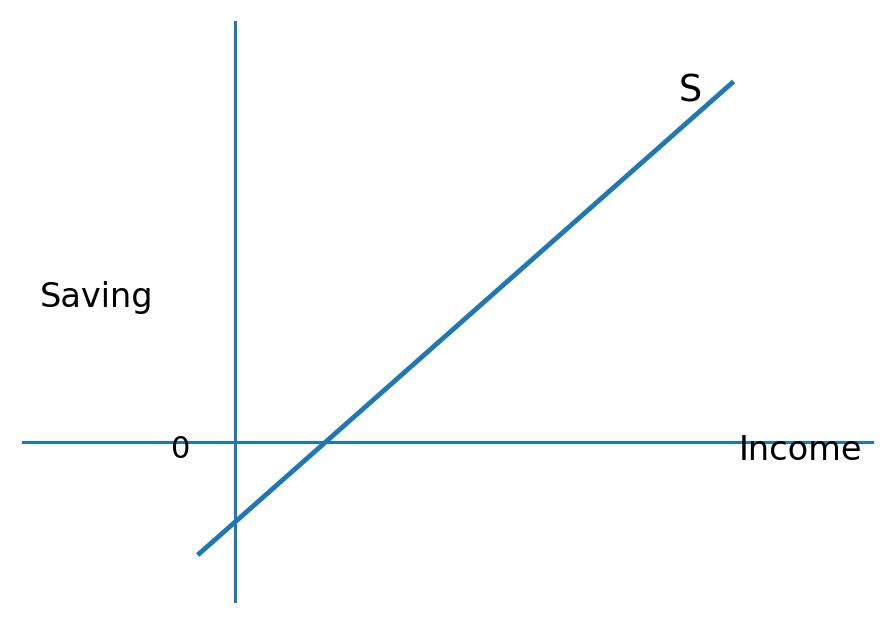
Linear saving function intersecting the horizontal income axis
- AOnly (i)
- BBoth (i) and (ii)
- COnly (ii)
- DNeither (i) nor (ii)
Answer: (B) Both (i) and (ii)
Explanation
Sign in to read the full explanationQuestion 17
An increase in the level of government spending, other things being equal, will in the IS-LM model
- AIncrease interest rates, shifting the LM curve to the left
- BIncrease the level of equilibrium income at all interest rates, shifting the IS curve right
- CLower interest rates, shifting the LM curve to the right
- DAlways move an economy to full employment
Answer: (B) Increase the level of equilibrium income at all interest rates, shifting the IS curve right
Explanation
Sign in to read the full explanationQuestion 18
In a hypothetical economy, the rate of growth of nominal GDP is 15% per annum, the annual rate of growth of GDP deflator is 5%. If the population is growing at the rate of growth of 2% per annum, what will be the annual rate of growth of per capita real GDP?
- A8%
- B10%
- C3%
- D7%
Answer: (A) 8%
Explanation
Sign in to read the full explanationQuestion 19
In an economy with a linear homogeneous Cobb-Douglas production function, the share of capital and labour in total output are, respectively, 40% and 60%. The capital stock and labour force are growing, respectively, at 8% and 3% per annum. If the rate of growth of output is recorded as 7% per annum, then the rate of growth of Total Factor Productivity will be
- A4%
- B11%
- C10%
- D2%
Answer: (D) 2%
Explanation
Sign in to read the full explanationQuestion 20
According to Bent Hansen, which amongst the following were treated as factors enhancing effective demand?
(i) Public expenditure
(ii) Rising population
(iii) Banking and financial systemChoose the correct answer from the code given below:
- A(i) and (iii)
- B(i) and (ii)
- C(ii) and (iii)
- D(i), (ii) and (iii)
Answer: (D) (i), (ii) and (iii)
Explanation
Sign in to read the full explanationQuestion 21
Match List I with List II:
List I (Author) List II (Book) (a) Milton Friedman (i) Das Kapital (b) Joseph Schumpeter (ii) Capitalism and Freedom (c) Karl Marx (iii) Capital in the 21st century (d) Thomas Piketty (iv) Capitalism, Socialism and Democracy - A(a)-(iii), (b)-(ii), (c)-(i), (d)-(iv)
- B(a)-(ii), (b)-(iv), (c)-(i), (d)-(iii)
- C(a)-(iv), (b)-(iii), (c)-(i), (d)-(ii)
- D(a)-(iii), (b)-(i), (c)-(iv), (d)-(ii)
Answer: (B) (a)-(ii), (b)-(iv), (c)-(i), (d)-(iii)
Explanation
Sign in to read the full explanationQuestion 22
On which of the following do Keynesians and Monetarists agree?
- AThe most important cause of demand shocks is changes in supply.
- BThe demand for money is interest elastic.
- COutput deviates at times from the potential output because of demand shocks.
- DWhen there is recessionary gap, flexible wages will retrieve the labour market to equilibrium quickly.
Answer: (C) Output deviates at times from the potential output because of demand shocks.
Explanation
Sign in to read the full explanationQuestion 23
According to the cash-balance approach, the elasticity of demand for money
- AIs less than one
- BIs more than one
- CIs equal to one
- DFluctuates with the changes in the phases of inflation
Answer: (C) Is equal to one
Explanation
Sign in to read the full explanationQuestion 24
Which of the following act as an instrument to help in the borrowing by the government?
(i) Repo Rate
(ii) Reverse Repo Rate
(iii) CRR
(iv) SLRChoose the correct answer from the code given below:
- A(i) and (iii)
- BOnly (iv)
- C(i) and (iv)
- D(iii) and (iv)
Answer: (B) Only (iv)
Explanation
Sign in to read the full explanationQuestion 25
A rise in general price level may be caused by which amongst the following?
(i) An increase in the money supply
(ii) An increase in the aggregate level of output
(iii) An increase in the effective demandChoose the correct answer from the code given below:
- AOnly (iii)
- B(i) and (ii)
- C(i), (ii) and (iii)
- D(i) and (iii)
Answer: (D) (i) and (iii)
Explanation
Sign in to read the full explanationQuestion 26
The concept of Universal Banking in India was recommended by which of the following committee?
- AAbid Hussain Committee
- BR.H. Khan Committee
- CS. Padmanabhan Committee
- DY.H. Malegam Committee
Answer: (B) R.H. Khan Committee
Explanation
Sign in to read the full explanationQuestion 27
What is the required Capital Adequacy Ratio for a new bank to apply for a license, under the draft guidelines of RBI?
- A9 percent
- B10 percent
- C11 percent
- D12 percent
Answer: (D) 12 percent
Explanation
Sign in to read the full explanationQuestion 28
Which of the following is not an objective of Marginal Cost of funds based Lending Rate (MCLR)?
- ATo improve the transmission of policy rates into the lending rates of banks
- BTo ensure availability of bank credit at interest rates which are fair to borrowers are well as banks
- CTo enable banks to become more competitive
- DTo enable the RBI to achieve the inflation target
Answer: (D) To enable the RBI to achieve the inflation target
Explanation
Sign in to read the full explanationQuestion 29
Match List I with List II:
List I List II (a) n = Pk (i) A.C. Pigou (b) M = PkT (ii) Keynes (c) P = kR/M (iii) Alfred Marshall (d) M = kPY (iv) D.H. Robertson - A(a)-(ii), (b)-(iv), (c)-(i), (d)-(iii)
- B(a)-(i), (b)-(ii), (c)-(iii), (d)-(iv)
- C(a)-(iv), (b)-(i), (c)-(ii), (d)-(iii)
- D(a)-(iii), (b)-(ii), (c)-(i), (d)-(iv)
Answer: (A) (a)-(ii), (b)-(iv), (c)-(i), (d)-(iii)
Explanation
Sign in to read the full explanationQuestion 30
The statement, "Too much money chasing too few goods" is based on which of the following theoretical concepts?
- AQuantity theory of prices
- BQuantity theory of money
- CInventory theoretic approach to the demand for money
- DReal balance effect
Answer: (B) Quantity theory of money
Explanation
Sign in to read the full explanationQuestion 31
Who among the following said that "Money is a temporary abode of purchasing power"?
- AIrving Fisher
- BMilton Friedman
- CWilliam J. Baumol
- DJames Tobin
Answer: (B) Milton Friedman
Explanation
Sign in to read the full explanationQuestion 32
Which of the following is not part of the Peacock-Wiseman Hypothesis?
- ADisplacement Effect
- BInspection Effect
- CConcentration Effect
- DAnnouncement Effect
Answer: (D) Announcement Effect
Explanation
Sign in to read the full explanationQuestion 33
An income tax will be progressive if
- AMarginal rate of tax is greater than the average rate of tax.
- BMarginal rate of tax is less than the average rate of tax.
- CMarginal rate of tax is equal to the average rate of tax.
- DMarginal rate of tax is zero.
Answer: (A) Marginal rate of tax is greater than the average rate of tax.
Explanation
Sign in to read the full explanationQuestion 34
The public expenditure in India is classified as capital and revenue. Which of the following is/are revenue expenditure?
(i) Subsidies
(ii) Interest payments on public debt
(iii) Wages and salariesChoose the correct answer from the code given below:
- A(i) and (ii)
- B(i) and (iii)
- C(ii) and (iii)
- D(i), (ii) and (iii)
Answer: (D) (i), (ii) and (iii)
Explanation
Sign in to read the full explanationQuestion 35
Which of the following correctly describes the Musgrave and Thin's measure of tax progressivity?
where
Ga = Gini's coefficient after tax,
Gb = Gini's coefficient before tax.- AM = (1-Ga)/(1-Gb)
- BM = Ga/Gb
- CM = (1-Gb)/(1-Ga)
- DM = Gb/Ga
Answer: (A) M = (1-Ga)/(1-Gb)
Explanation
Sign in to read the full explanationQuestion 36
GST which came into effect from 1st July, 2017 has four (04) tax slabs applicable to the commodities and services in India. Which of the following tax slabs are correct?
- A5%, 12%, 18% and 28%
- B5%, 8%, 12% and 18%
- C8%, 12%, 18% and 28%
- D8%, 12%, 15% and 18%
Answer: (A) 5%, 12%, 18% and 28%
Explanation
Sign in to read the full explanationQuestion 37
According to the Union Budget, which of the following Fiscal deficit targets for 2018 - 19 is correct?
- A3.3% of the GDP
- B4-3% of the GDP
- C5.3% of the GDP
- D4-5% of the GDP
Answer: (A) 3.3% of the GDP
Explanation
Sign in to read the full explanationQuestion 38
Why are indirect taxes called regressive?
- AThey are charged at higher rates than direct tax.
- BThey are charged at the same rate for all income groups.
- CBoth above are correct
- DNone of the above are correct
Answer: (B) They are charged at the same rate for all income groups.
Explanation
Sign in to read the full explanationQuestion 39
Consider the following:
(i) Fringe Benefits Tax
(ii) Capital Gains Tax
(iii) Securities Transaction TaxWhich of the above is/are Direct Tax/Taxes?
Choose the correct answer from the code given below:
- A(ii) and (iii)
- B(i), (ii) and (iii)
- COnly (i)
- D(i) and (iii)
Answer: (B) (i), (ii) and (iii)
Explanation
Sign in to read the full explanationQuestion 40
Which of the following will result in the 'crowding in' effect in the economy?
(i) Public borrowings to finance spending on infrastructure
(ii) Public borrowings to finance spending on salaries and wages
(iii) Public borrowings to finance spending on health and education
(iv) Public borrowings to finance spending on skill developmentChoose the correct answer from the code given below:
- A(i), (ii) and (iii)
- B(iii) and (iv)
- C(i), (iii) and (iv)
- D(i) and (ii)
Answer: (C) (i), (iii) and (iv)
Explanation
Sign in to read the full explanationQuestion 41
Development expenditure of the Central Government does not include
(i) Grant to States under Centrally sponsored schemes
(ii) Expenditure on social and community services
(iii) Expenditure on economic services
(iv) Defence expenditureChoose the correct answer from the code given below:
- A(i) and (ii)
- B(ii) and (iii)
- COnly (iv)
- D(iii) and (iv)
Answer: (C) Only (iv)
Explanation
Sign in to read the full explanationQuestion 42
In the basic neo-classical growth model, where does the growth equilibrium occur?
- AWhere investment per worker is equal to savings per worker.
- BWhere investment per worker equals depreciation of capital for worker.
- CWhere investment per worker equals capital per worker.
- DWhere capital per worker equals output per worker.
Answer: (B) Where investment per worker equals depreciation of capital for worker.
Explanation
Sign in to read the full explanationQuestion 43
According to Schumpeter Theory of Development, which of the following statements is correct?
- AThe expansion of economic output is limited by the real savings of the economy.
- BDemocracy enhances the efficiency of an economic system.
- CAll the above are correct
- DNone of the above are correct
Answer: (D) None of the above are correct
Explanation
Sign in to read the full explanationQuestion 44
Which of the following statements is/are correct about Uzawa's theorem?
- AThe growth rate of output per worker, consumption per worker and capital per worker are equal and constant over time.
- BThe production function is linear homogeneous.
- CThe technical progress is 'Harrod neutral' only.
- DAll of the above
Answer: (D) All of the above
Explanation
Sign in to read the full explanationQuestion 45
What is true for Neo-Classical growth model?
(i) Rate of interest and profit are flexible
(ii) Capital is heterogeneous
(iii) Perfect competition prevails
(iv) Capital and labour are substitutableChoose the correct answer from the code given below:
- A(i), (iii) and (iv)
- B(i), (ii) and (iii)
- C(ii) and (iii)
- DAll of the above
Answer: (A) (i), (iii) and (iv)
Explanation
Sign in to read the full explanationQuestion 46
Technological dualism means
- APrevalence of different production functions in the industrial sector in underdeveloped countries
- BPrevalence of different technologies in agricultural sector in underdeveloped countries
- CPrevalence of different production functions in the advanced and traditional sectors in underdeveloped countries
- DPrevalence of different production functions in domestic and export sectors of underdeveloped countries
Answer: (C) Prevalence of different production functions in the advanced and traditional sectors in underdeveloped countries
Explanation
Sign in to read the full explanationQuestion 47
Match List I with List II:
List I List II (a) Absorptive capacity of capital (i) M. Kalecki (b) Technological dualism (ii) A.O. Hirschman (c) Physical quality of life index (iii) D. Morris (d) Permissive and compulsive sequences of expanding industries (iv) B. Higgins - A(a)-(iv), (b)-(iii), (e)-(ii), (d)-(i)
- B(a)-(i), (b)-(ii), (c)-(iii), (d)-(iv)
- C(a)-(ii), (b)-(iv), (c)-(iii), (d)-(i)
- D(a)-(i), (b)-(iv), (c)-(iii), (d)-(ii)
Answer: (D) (a)-(i), (b)-(iv), (c)-(iii), (d)-(ii)
Explanation
Sign in to read the full explanationQuestion 48
The original interpretation of balanced growth relates to
- AAll sectors growing at the same rate
- BAbsence of shortages or excesses
- CEqual amount to investment in all sectors
- DLarge scale expansion of activities to overcome divergence between private and social benefits
Answer: (D) Large scale expansion of activities to overcome divergence between private and social benefits
Explanation
Sign in to read the full explanationQuestion 49
T.W. Schultz has given the following ratios in relation to education for economic growth:
- AEducation-income ratio
- BEducation-labour ratio, education-income ratio and education-investment ratio
- CEducation-labour ratio
- DEducation-capital and labour ratio
Answer: (B) Education-labour ratio, education-income ratio and education-investment ratio
Explanation
Sign in to read the full explanationQuestion 50
Which of the following Concept - Economist pairs is not correctly matched?
- AKnife-edge Problem - Harrod Domar
- BTurnpike Conjecture - Dorfman, Samuelson and Solow
- CSuper Multiplier - J.M. Keynes
- DGolden Rule of Accumulation - E.S. Phelps
Answer: (C) Super Multiplier - J.M. Keynes
Explanation
Sign in to read the full explanationQuestion 51
Which of the following is considered as the third stage in the Rostow's Stages of Economic Growth model?
- AHigh mass consumption
- BTraditional society
- CPre-conditions for a take-off
- DTake-off
Answer: (D) Take-off
Explanation
Sign in to read the full explanationQuestion 52
Which of the following is/are true for Karl Marx's Theory of Economic Development?
- ARelations in production change independently.
- BMode of production changes independently.
- CBoth above
- DNone of the above
Answer: (D) None of the above
Explanation
Sign in to read the full explanationQuestion 53
In the year 2015-16, India has not been an importer of which of the following products?
(i) Apples
(ii) Rice
(iii) PulsesChoose the correct answer from the code given below:
- A(i), (ii) and (iii)
- B(ii) and (iii)
- C(i) and (iii)
- DOnly (ii)
Answer: (D) Only (ii)
Explanation
Sign in to read the full explanationQuestion 54
Global Competitiveness Report is released by which of the following organisations?
- AWorld Trade Organisation
- BWorld Economic Forum
- CEuropean Union
- DWorld Bank
Answer: (B) World Economic Forum
Explanation
Sign in to read the full explanationQuestion 55
'Round tripping' in international trade is a method
- ATo boost foreign direct investment
- BTo evade tax
- CTo increase exports
- Dof financing start-ups
Answer: (B) To evade tax
Explanation
Sign in to read the full explanationQuestion 56
Balance of payments on capital account does not include
- ABalancing foreign direct investment
- BForeign portfolio investment
- CNet income transfers
- DGovernment loans to foreign governments
Answer: (C) Net income transfers
Explanation
Sign in to read the full explanationQuestion 57
Devaluation will be more effective when
(i) International capital is freely mobile
(ii) International capital is not freely mobile
(iii) Marginal propensity to import is highWhich of the above statements is/are correct?
Choose the correct answer from the code given below:
- AOnly (ii)
- BOnly (iii)
- C(i) and (iii)
- D(ii) and (iii)
Answer: (A) Only (ii)
Explanation
Sign in to read the full explanationQuestion 58
If (K/L)a > (K/L)b, then
- ACountry A is labour abundant
- BCountry A is having cheap labour
- CCountry A is capital abundant
- DCapital is dear in country A
Answer: (C) Country A is capital abundant
Explanation
Sign in to read the full explanationQuestion 59
Opportunity cost theory assumes that
- ALabour is the only factor of production.
- BLabour is homogeneous.
- CCost of commodity is equal to labour cost only.
- DNone of the above
Answer: (D) None of the above
Explanation
Sign in to read the full explanationQuestion 60
Historically the terms of trade of the developing countries have been unfavourable due to the fact that when income in developed countries rises, the demand for primary goods declines because
- AIncome elasticity of demand for primary goods is low.
- BIncome elasticity of demand for primary goods is zero.
- CIncome elasticity of demand for primary goods is high.
- DPrice elasticity of demand for primary goods is high.
Answer: (A) Income elasticity of demand for primary goods is low.
Explanation
Sign in to read the full explanationQuestion 61
Consider the following statements in the context of the New Trade Theory:
(i) It explains why countries trade in similar goods
(ii) It assumes free trade
(iii) It assumes that trade takes place in monopolistic conditions
(iv) It exploits the economies of scale in productionWhich of the above statements are correct?
Choose the correct answer from the code given below:
- A(i), (iii) and (iv)
- B(ii) and (iv)
- C(i) and (iii)
- D(i) and (ii)
Answer: (A) (i), (iii) and (iv)
Explanation
Sign in to read the full explanationQuestion 62
Intellectual Property Rights include
- APatents
- BCopyrights
- CTrademark
- DAll of the above
Answer: (D) All of the above
Explanation
Sign in to read the full explanationQuestion 63
Which of the following is the appropriate measure of openness of the economy?
- AExports/Imports
- BExports - Imports
- C(Exports + Imports)/GDP
- D(Exports - Imports)/Population
Answer: (C) (Exports + Imports)/GDP
Explanation
Sign in to read the full explanationQuestion 64
The frequent farm loan waivers in India may give rise to the problem of
- ADebt Overhang
- BAdverse Selection
- CRisk Aversion
- DMoral Hazard
Answer: (D) Moral Hazard
Explanation
Sign in to read the full explanationQuestion 65
Which of the following are the objectives of the Commission for Agricultural Costs and Prices (CACP)?
(i) To ensure meaningful real income levels to the farmers
(ii) To stabilise agricultural prices
(iii) To protect the interest of the consumersChoose the correct answer from the code given below:
- A(i) and (iii)
- B(i) and (ii)
- C(ii) and (iii)
- DAll of the above
Answer: (D) All of the above
Explanation
Sign in to read the full explanationQuestion 66
Arrange the following events in chronological order regarding Indian Economy:
(i) First Phase of Nationalisation of Banks
(ii) Establishment of Narasimhan Committee on the Banking System
(iii) Enactment of FEMA Act in India
(iv) Establishment of EXIM Bank in IndiaChoose the correct answer from the code given below:
- A(i), (iv), (ii), (iii)
- B(i), (iii), (iv), (ii)
- C(i), (iii), (ii), (iv)
- D(i), (ii), (iii), (iv)
Answer: (A) (i), (iv), (ii), (iii)
Explanation
Sign in to read the full explanationQuestion 67
To compute the 'Index of Sustainable Economic Welfare', which of the following corrections is/are made in the value of GDP ?
- ASubtract the monetary value of depreciation
- BSubtract the monetary value of loss due to floods and droughts
- CSubtract the monetary value of expenditure on defence
- DSubtract the costs of environmental degradation
Answer: (D) Subtract the costs of environmental degradation
Explanation
Sign in to read the full explanationQuestion 68
Arrange the following crop insurance schemes in the chronological order of their launch:
(i) Comprehensive Crop Insurance Scheme
(ii) National Agriculture Insurance Scheme
(iii) Modified National Agriculture Insurance Scheme
(iv) Pradhan Mantri Fasal Bima YojanaChoose the correct answer from the code given below:
- A(i), (ii), (iii), (iv)
- B(ii), (iii), (i), (iv)
- C(iii), (ii), (iv), (i)
- D(i), (iii), (ii), (iv)
Answer: (A) (i), (ii), (iii), (iv)
Explanation
Sign in to read the full explanationQuestion 69
As per the SRS Bulletin of September 2017, the estimated death rate for Kerala is 7-6, while for Bihar it is 6. From these data which is the correct inference to draw?
- AHealth condition of people in Bihar is better than that in Kerala.
- BSuicide rate in Kerala is very high.
- CLife Expectancy in Bihar is higher than that in Kerala.
- DAgeing of population in Kerala is faster than in Bihar.
Answer: (D) Ageing of population in Kerala is faster than in Bihar.
Explanation
Sign in to read the full explanationQuestion 70
The National Rural Health Mission was launched in the year
- A2005
- B2009
- C1998
- D1991
Answer: (A) 2005
Explanation
Sign in to read the full explanationQuestion 71
Planning from below is known as
- ACentralised planning
- BFunctional planning
- CDecentralised planning
- DStructural planning
Answer: (C) Decentralised planning
Explanation
Sign in to read the full explanationQuestion 72
Which of the following is not included in the category of Bio-fuels?
- ABioethanol
- BBiodiesel
- CGobar Gas
- DCompressed Natural Gas
Answer: (D) Compressed Natural Gas
Explanation
Sign in to read the full explanationQuestion 73
Who is the author of the book, 'I do what I do'?
- AJagdish N. Bhagwati
- BArvind Panagariya
- CRaghuram G. Rajan
- DAmartya Sen
Answer: (C) Raghuram G. Rajan
Explanation
Sign in to read the full explanationQuestion 74
Arrange the following States in descending order according to Maternal Mortality Ratio (MMR) as per the Special Bulletin of SRS, May, 2018:
(i) Assam
(ii) Bihar
(iii) Madhya Pradesh
(iv) Uttar PradeshChoose the correct answer from the code given below:
- A(i), (iv), (iii), (ii)
- B(ii), (iv), (iii), (i)
- C(iv), (i), (ii), (iii)
- D(iii), (ii), (i), (iv)
Answer: (A) (i), (iv), (iii), (ii)
Explanation
Sign in to read the full explanationQuestion 75
In the context of 'Transformation of Aspirational Districts' programme, consider the following statements:
(i) There are 115 districts in this programme
(ii) The core strategy of this programme is convergence, collaboration and competition
(iii) There are 49 key performance indicators to measure the progress of the districtsChoose the correct answer from the code given below:
- A(i) and (ii)
- B(i) and (iii)
- C(ii) and (iii)
- D(i), (ii) and (iii)
Answer: (D) (i), (ii) and (iii)
Explanation
Sign in to read the full explanationQuestion 76
Consider the following statements:
(i) Minimum Support Price (MSP) policy of India covers only wheat, paddy and coarse cereals
(ii) Minimum Support Price (MSP) for Grade-A paddy is always higher than that of the common paddyChoose the correct answer from the code given below:
- AOnly (i)
- BOnly (ii)
- CBoth (i) and (ii)
- DNeither (i) nor (ii)
Answer: (B) Only (ii)
Explanation
Sign in to read the full explanationQuestion 77
Which of the following is not a macro economic challenge before Indian economy as of now ?
- ADepreciation of Indian rupee
- BWidening current account deficit
- CRising protectionism in the world
- DHigh imports of gold
Answer: (D) High imports of gold
Explanation
Sign in to read the full explanationQuestion 78
What is not true for the Third Stage of the Theory of Demographic Transition?
- ABirth rate declines faster
- BDeath rate declines but slowly
- CPopulation growth becomes zero
- DPopulation growth rate approximately stabilizes in a narrow range
Answer: (C) Population growth becomes zero
Explanation
Sign in to read the full explanationQuestion 79
Which amongst the following is not an instrument of Money Market?
- ATreasury Bill
- BPreference Share
- CCommercial Paper
- DCertificate of Deposit
Answer: (B) Preference Share
Explanation
Sign in to read the full explanationQuestion 80
Which of the following statements is true for the Indian economy according to the World Bank figures for 2017?
- AIndia is now the world's sixth biggest economy.
- BIndia's GDP amounted to $ 5 trillion at the end of 2017.
- CBoth above
- DNone of the above
Answer: (A) India is now the world's sixth biggest economy.
Explanation
Sign in to read the full explanationQuestion 81
Assertion (A): Business-cycles according to new classical economics are monetary in nature.
Reason (R): These are the result of the fall in real wage rates.- ABoth (A) and (R) are true and (R) is the correct explanation of (A).
- BBoth (A) and (R) are true, but (R) is not the correct explanation of (A).
- C(A) is true, but (R) is false.
- D(A) is false, but (R) is true.
Answer: (D) (A) is false, but (R) is true.
Explanation
Sign in to read the full explanationQuestion 82
Assertion (A): India is a service sector driven economy.
Reason (R): Share of the service sector in total employment is highest.- ABoth (A) and (R) are true and (R) is the correct explanation of (A).
- BBoth (A) and (R) are true, but (R) is not the correct explanation of (A).
- C(A) is true, but (R) is false.
- D(A) is false, but (R) is true.
Answer: (C) (A) is true, but (R) is false.
Explanation
Sign in to read the full explanationQuestion 83
Assertion (A): A progressive income tax is based on equimarginal sacrifice.
Reason (R): Higher the income, lower will be the marginal utility of money for the tax payer.- ABoth (A) and (R) are true and (R) is the correct explanation of (A).
- BBoth (A) and (R) are true, but (R) is not the correct explanation of (A).
- C(A) is true, but (R) is false.
- D(A) is false, but (R) is true.
Answer: (A) Both (A) and (R) are true and (R) is the correct explanation of (A).
Explanation
Sign in to read the full explanationQuestion 84
Assertion (A): In the P.N. Rosenstein-Rodan's model, the positive role of indivisibilities in production has been analysed.
Reason (R): Removal of indivisibilities leads to constant returns to scale in production.- ABoth (A) and (R) are true and (R) is the correct explanation of (A).
- BBoth (A) and (R) are true, but (R) is not the correct explanation of (A).
- C(A) is true, but (R) is false.
- D(A) is false, but (R) is true.
Answer: (C) (A) is true, but (R) is false.
Explanation
Sign in to read the full explanationQuestion 85
Assertion (A): In an oligopolistic market, there is price rigidity.
Reason (R): Rival firms match price decrease but not price increase.- ABoth (A) and (R) are true and (R) is the correct explanation of (A).
- BBoth (A) and (R) are true, but (R) is not the correct explanation of (A).
- C(A) is true, but (R) is false.
- D(A) is false, but (R) is true.
Answer: (A) Both (A) and (R) are true and (R) is the correct explanation of (A).
Explanation
Sign in to read the full explanationQuestion 86
For the diagram, which of the following is correct in terms of derivatives?
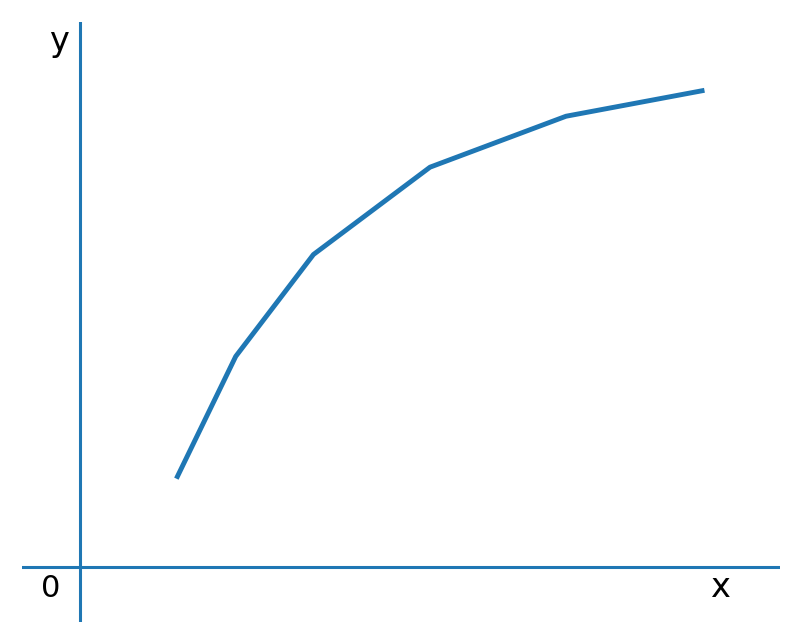
Curve showing y as a function of x in the first quadrant
- Ady/dx > 0, d²y/dx² < 0
- Bdy/dx > 0, d²y/dx² > 0
- Cdy/dx < 0, d²y/dx² < 0
- Ddy/dx < 0, d²y/dx² > 0
Answer: (A) dy/dx > 0, d²y/dx² < 0
Explanation
Sign in to read the full explanationQuestion 87
Harrod's Growth model is given as under:
S_t = alpha * Y_t, 0 < alpha < 1
I_t = beta * [Y_t - Y_{t-1}], beta > 0
S_t = I_twhere S_t = Savings, Y_t = Income, I_t = Investment, t = time
In this model for economic growth, the condition for economic growth is
- Abeta / (beta - alpha) > 1
- Bbeta / (beta - alpha) < 1
- Cbeta / alpha > 0
- Dbeta / (alpha - beta) > 0
Answer: (A) beta / (beta - alpha) > 1
Explanation
Sign in to read the full explanationQuestion 88
If demand for a consumer is given by the function p = 27 - 3x - x² (where x = quantity demanded, p = price), the consumer's surplus at x = 3 is
- A31.5
- B32.5
- C49.5
- D50.5
Answer: (A) 31.5
Explanation
Sign in to read the full explanationQuestion 89
A monopolist faces a linear demand curve p = 100 - 4q, while his cost function is C = 50 + 20q. The profit maximising output for this monopolist is
- A40
- B20
- C10
- D5
Answer: (C) 10
Explanation
Sign in to read the full explanationQuestion 90
Match List I with List II:
List I List II (a) Hawkins-Simon Conditions (i) Theory of Games (b) Saddle Point (ii) Non-Linear Programming (c) Simplex Method (iii) Input-Output Analysis (d) Kuhn-Tucker Conditions (iv) Linear Programming - A(a)-(i), (b)-(ii), (c)-(iv), (d)-(iii)
- B(a)-(ii), (b)-(i), (c)-(iii), (d)-(iv)
- C(a)-(iii), (b)-(ii), (c)-(i), (d)-(iv)
- D(a)-(iii), (b)-(i), (c)-(iv), (d)-(ii)
Answer: (D) (a)-(iii), (b)-(i), (c)-(iv), (d)-(ii)
Explanation
Sign in to read the full explanationQuestion 91
The price elasticity of demand for a good with the demand function q = kp^(-r) (here p is price, q is quantity demanded and k and r are positive constants) is
- A1
- Br
- C1/r
- DNot constant as the function is non-linear
Answer: (B) r
Explanation
Sign in to read the full explanationQuestion 92
A box contains 10 bulbs, 4 of which are defective. If 3 of the bulbs are drawn randomly without replacement, what is the probability that all three bulbs are defective?
- A1/30
- B3/4
- C3/10
- D4/10
Answer: (A) 1/30
Explanation
Sign in to read the full explanationQuestion 93
Consider the series of index numbers:
| Year | 2014 | 2015 | 2016 |
| --- | --- | --- |
| Index Number | 100 | 120 | 126 |If the base year is shifted to year 2015, the value of index number in the year 2016, in the new series will be:
- A106
- B95.2
- C105
- D151.2
Answer: (C) 105
Explanation
Sign in to read the full explanationQuestion 94
Consider the following statements about a time series of annual observations on sales of a firm for ten years:
(i) The series will have seasonal variations
(ii) The series will have a secular trend
(iii) The series will have cyclical variationsChoose the correct answer from the code given below:
- A(ii) and (iii)
- B(i), (ii) and (iii)
- C(i) and (ii)
- D(i) and (iii)
Answer: (A) (ii) and (iii)
Explanation
Sign in to read the full explanationQuestion 95
In a two-variable regression, the correlation coefficient between dependent and independent variables Y and X is 0-7. What is the percentage of variations in Y explained by X?
- A49%
- B7%
- C0.7%
- D70%
Answer: (A) 49%
Explanation
Sign in to read the full explanationQuestion 96
Match List I with List II:
List I List II (a) Delphi Method (i) Stationarity (b) Dickey-Fuller Test (ii) Autocorrelation (c) Durbin-Watson Test (iii) Testing significance of a regression coefficient (d) Student's t-Test (iv) Forecasting - A(a)-(iv), (b)-(i), (c)-(ii), (d)-(iii)
- B(a)-(i), (b)(ii), (c)-(iii), (d)-(iv)
- C(a)-(iv), (b)(ii), (c)-(i), (d)-(iii)
- D(a)-(i), (b)-(iv), (c)-(iii), (d)-(ii)
Answer: (A) (a)-(iv), (b)-(i), (c)-(ii), (d)-(iii)
Explanation
Sign in to read the full explanationQuestion 97
By autocorrelation we mean that
- AThe residuals of a regression model are not independent.
- BThe residuals of a regression model are related with one or more of the regressors.
- CThe square of the residuals of a regression model are not equally spread.
- DThe variance of the residuals of a regression model is not constant for all observations.
Answer: (A) The residuals of a regression model are not independent.
Explanation
Sign in to read the full explanationQuestion 98
In Regression Analysis, if a quantitative variable has 'm' categories, one can introduce
- AOnly m + 1 dummy variables
- BOnly m-1 dummy variables
- COnly m dummy variables
- DOnly 2 m variables
Answer: (B) Only m-1 dummy variables
Explanation
Sign in to read the full explanationQuestion 99
Though two time series are individually non-stationary, their linear combination is stationary. This is an example of
- ARandom walk
- BSpurious regression
- CCointegration
- DTrend stationarity
Answer: (C) Cointegration
Explanation
Sign in to read the full explanationQuestion 100
In the context of simultaneous equations econometric models, consider the following statements:
(i) Both order and rank conditions for identification are to be satisfied before estimation
(ii) Order condition is a necessary but not a sufficient condition of identification
(iii) Two-stage least squares method is suitable for over-identified equationsWhich of the above statements is/are correct?
Choose the correct answer from the code given below:
- AOnly (i)
- B(i), (ii) and (iii)
- C(i) and (iii)
- DOnly (ii)
Answer: (B) (i), (ii) and (iii)
Explanation
Sign in to read the full explanation
Frequently asked questions
How many questions were in the UGC NET Economics December 2018 exam?
Paper 1 had 50 questions and Paper 2 (Economics) had 100 questions, for 150 in total across 3 hours.
Is there negative marking in UGC NET?
No. Each correct answer earns 2 marks and there is no penalty for a wrong answer, so leaving a question blank is never better than attempting it.
Are the December 2018 answers on this page official?
Answers follow the official NTA answer key for this session. If you spot a discrepancy, use the report option inside the practice test and we will review it.
Can I attempt the December 2018 paper as a timed mock test?
Yes. Every paper on this page has an "Attempt this paper" button that opens the same questions in the timed test interface, with instant scoring and weak-area analysis afterwards.
Want the full mock experience?
Attempt Paper 1 + Paper 2 (Economics) together in a single timed session.
More Economics practice
Practice Paper 1 from other subjects
Every subject's exam sitting has its own Paper 1 (General Aptitude) set — more real PYQs to solve.