UGC NET Economics June 2019 Question PaperPaper 1 & Paper 2 with Answer Key
The complete UGC NET June 2019 question paper for Economics, covering Paper 1 (General Aptitude) and Paper 2 (Economics). Every question below is shown with its options and the correct answer, and a detailed explanation you can unlock by signing in. All 150 questions are free to practise.
UGC NET June 2019 at a glance
| Exam | UGC NET June 2019 |
|---|---|
| Papers | Paper 1 (General Aptitude) and Paper 2 (Economics) |
| Exam date(s) | June 21, 2019 |
| Shift(s) | Shift 1 |
| Paper 1 questions | 50 questions · 60 minutes · 100 marks |
| Paper 2 questions | 100 questions · 120 minutes · 200 marks |
| Total | 150 questions |
| Marking scheme | +2 per correct answer · No negative marking |
Paper 1 — General Aptitude
Attempt this paper50 questions with the answer key and explanations.
Question 1
From the list given below identify the instructional events which form part of the structure of a lesson plan. Select your answer from the options given below the list
List of instructional events:
(i) Gaining attention of students
(ii) Prior knowledge of students
(iii) Informing the learner of the objectives
(iv) Stimulating recall of pre-requisite learning
(v) Checking the availability of reading material in the library.
(vi) Eliciting the desired response- A(i) (ii) (iii) (iv)
- B(i) (iii) (iv) (vi)
- C(ii) (iii) (v) (vi)
- D(i) (iii) (iv) (v)
Answer: (B) (i) (iii) (iv) (vi)
Explanation
Sign in to read the full explanationQuestion 2
In the two sets given below, Set-I provides the different levels of learning according to Bloom's Taxonomy, while set-II gives their examples and concerns. Match the two sets and select from the options to indicate your answer :
Set-I (Levels of Learning)
(a) Memory level
(b) Understanding level
(c) Analysing level
(d) Creating levelSet-II (Examples)
(i) Identifying examples of a given concept
(ii) Generating new ideas
(iii) Recalling information
(iv) Isolating information into parts- A(a)-(ii), (b)-(i), (c)-(iii), (d)-(iv)
- B(a)-(i), (b)-(ii), (c)-(iii), (d)-(iv)
- C(a)-(iv), (b)-(iii), (c)-(i), (d)-(ii)
- D(a)-(iii), (b)-(i), (c)-(iv), (d)-(ii)
Answer: (D) (a)-(iii), (b)-(i), (c)-(iv), (d)-(ii)
Explanation
Sign in to read the full explanationQuestion 3
Critical language testing in a research report is
- ATesting language from an ethical point of view, revealing its misuses
- BEvaluating the stylistic characteristics of language
- CCritiquing the ideology of the author
- DObserving the gender role played by language
Answer: (A) Testing language from an ethical point of view, revealing its misuses
Explanation
Sign in to read the full explanationQuestion 4
A university teacher plans to study the effect of level of aspiration of students in terms of their socio-economic background on their scholastic performance at the term end evaluation conducted by an external testing agency. What is the dependent variable in this study?
- ALevel of aspiration of students
- BSocio-economic background of students
- CScholastic performance of students
- DTerm end evaluation
Answer: (C) Scholastic performance of students
Explanation
Sign in to read the full explanationQuestion 5
Plagiarism in research is
- ACreative use of previous data
- BCopying unscrupulously and making use of it
- CQuoting someone and citing him/her
- DReferring to previous data and working over it with new objectives
Answer: (B) Copying unscrupulously and making use of it
Explanation
Sign in to read the full explanationQuestion 6
Think-aloud procedure is
- Aa part of secondary source of data
- Ba technique used to investigate learner strategies and performance
- Ca strategy of testing learners' aptitude by providing primary sources
- Da necessary method in scientific research
Answer: (B) a technique used to investigate learner strategies and performance
Explanation
Sign in to read the full explanationQuestion 7
Participant observation is a part of
- APhilosophical research
- BMentalist Theory of language
- CMathematical research
- DEthnographic research
Answer: (D) Ethnographic research
Explanation
Sign in to read the full explanationQuestion 8
Among the following which one is an example of instructional software?
- AAudio podcast
- BPrinted material or book
- CRadio talk
- DEdusat
Answer: (C) Radio talk
Explanation
Sign in to read the full explanationQuestion 9
Diagnostic Evaluation ascertains
- AStudents performance at the beginning of instructions
- BCauses and remedies of persistent learning problems during instructions
- CDegree of achievement of instructional objectives at the end
- DLearning progress and failure after instructions
Answer: (B) Causes and remedies of persistent learning problems during instructions
Explanation
Sign in to read the full explanationQuestion 10
Which teaching aids enhance the skills like reading, listening and pronunciation?
- AAudio-lingual teaching aids
- BScientific teaching aids
- CGeneral knowledge teaching aids
- DTheoretical based teaching aids
Answer: (A) Audio-lingual teaching aids
Explanation
Sign in to read the full explanationQuestion 11
Literary life is unhappy because
Unquestionably a literary life is for the most part an unhappy life, because if you have genius, you must suffer the penalty of genius; and if you have only talent, there are so many cares and worries incidental to the circumstances of men of letters, as to make life exceedingly miserable. Besides the pangs of composition, and the continuous disappointment which a true artist feels at his inability to reveal himself, there is the ever-recurring difficulty of gaining the public ear. Young writers are buoyed up by the hope and the belief that they have only to throw that poem at the world's feet to get back in return the laurel-crown; that they have only to push as a new light in literature. You can never convince a young author that the editors of magazines and the publishers of books are a practical body of men, who are by no means frantically anxious about placing the best literature before the pubic. Nay, that for the most part they are mere brokers, who conduct their business on the hardest lines of a profit and loss account. But supposing your book fairly launches, its perils are only beginning. You have to run the gauntlet of the critics. When you are a little older, you will find that criticism is not much more serious than the bye-play of clowns in a circus, when they beat around the ring, the victim with bladders stung at the end of long poles. A time comes in the life of every author when he regards critics as comical rather than formidable, and goes his way unheeding. But there are sensitive souls that yield under the chastisement and, perhaps after suffering much silent torture, abandon the profession of the pen forever.
- AOne has to carry the load of being a genius while not being one
- BThe genius can still remain a genius and be amidst misery in the face of adversity
- CTalent brings pseudo happiness
- DThere is a constant desire to outshine others
Answer: (B) The genius can still remain a genius and be amidst misery in the face of adversity
Explanation
Sign in to read the full explanationQuestion 12
Young authors aspire to:
Unquestionably a literary life is for the most part an unhappy life, because if you have genius, you must suffer the penalty of genius; and if you have only talent, there are so many cares and worries incidental to the circumstances of men of letters, as to make life exceedingly miserable. Besides the pangs of composition, and the continuous disappointment which a true artist feels at his inability to reveal himself, there is the ever-recurring difficulty of gaining the public ear. Young writers are buoyed up by the hope and the belief that they have only to throw that poem at the world's feet to get back in return the laurel-crown; that they have only to push as a new light in literature. You can never convince a young author that the editors of magazines and the publishers of books are a practical body of men, who are by no means frantically anxious about placing the best literature before the pubic. Nay, that for the most part they are mere brokers, who conduct their business on the hardest lines of a profit and loss account. But supposing your book fairly launches, its perils are only beginning. You have to run the gauntlet of the critics. When you are a little older, you will find that criticism is not much more serious than the bye-play of clowns in a circus, when they beat around the ring, the victim with bladders stung at the end of long poles. A time comes in the life of every author when he regards critics as comical rather than formidable, and goes his way unheeding. But there are sensitive souls that yield under the chastisement and, perhaps after suffering much silent torture, abandon the profession of the pen forever.
- AEquate themselves to the established authors.
- BRemain content in their work only.
- CAchieve glory by their merit yet always in a hurry.
- DBecome critics subsequently.
Answer: (C) Achieve glory by their merit yet always in a hurry.
Explanation
Sign in to read the full explanationQuestion 13
Experience and age of an author:
Unquestionably a literary life is for the most part an unhappy life, because if you have genius, you must suffer the penalty of genius; and if you have only talent, there are so many cares and worries incidental to the circumstances of men of letters, as to make life exceedingly miserable. Besides the pangs of composition, and the continuous disappointment which a true artist feels at his inability to reveal himself, there is the ever-recurring difficulty of gaining the public ear. Young writers are buoyed up by the hope and the belief that they have only to throw that poem at the world's feet to get back in return the laurel-crown; that they have only to push as a new light in literature. You can never convince a young author that the editors of magazines and the publishers of books are a practical body of men, who are by no means frantically anxious about placing the best literature before the pubic. Nay, that for the most part they are mere brokers, who conduct their business on the hardest lines of a profit and loss account. But supposing your book fairly launches, its perils are only beginning. You have to run the gauntlet of the critics. When you are a little older, you will find that criticism is not much more serious than the bye-play of clowns in a circus, when they beat around the ring, the victim with bladders stung at the end of long poles. A time comes in the life of every author when he regards critics as comical rather than formidable, and goes his way unheeding. But there are sensitive souls that yield under the chastisement and, perhaps after suffering much silent torture, abandon the profession of the pen forever.
- AMakes the author stoic to criticism
- BMakes the author angry and lovely
- CTurns the author to a buffoon
- DDrives the author to cynicism
Answer: (A) Makes the author stoic to criticism
Explanation
Sign in to read the full explanationQuestion 14
The perception towards the publishers and critics in the passage is:
Unquestionably a literary life is for the most part an unhappy life, because if you have genius, you must suffer the penalty of genius; and if you have only talent, there are so many cares and worries incidental to the circumstances of men of letters, as to make life exceedingly miserable. Besides the pangs of composition, and the continuous disappointment which a true artist feels at his inability to reveal himself, there is the ever-recurring difficulty of gaining the public ear. Young writers are buoyed up by the hope and the belief that they have only to throw that poem at the world's feet to get back in return the laurel-crown; that they have only to push as a new light in literature. You can never convince a young author that the editors of magazines and the publishers of books are a practical body of men, who are by no means frantically anxious about placing the best literature before the pubic. Nay, that for the most part they are mere brokers, who conduct their business on the hardest lines of a profit and loss account. But supposing your book fairly launches, its perils are only beginning. You have to run the gauntlet of the critics. When you are a little older, you will find that criticism is not much more serious than the bye-play of clowns in a circus, when they beat around the ring, the victim with bladders stung at the end of long poles. A time comes in the life of every author when he regards critics as comical rather than formidable, and goes his way unheeding. But there are sensitive souls that yield under the chastisement and, perhaps after suffering much silent torture, abandon the profession of the pen forever.
- AThat of a scathing attack
- BThat of sympathy
- CThat of generosity
- DThat of cynicism
Answer: (D) That of cynicism
Explanation
Sign in to read the full explanationQuestion 15
The effective way of tackling criticism is:
Unquestionably a literary life is for the most part an unhappy life, because if you have genius, you must suffer the penalty of genius; and if you have only talent, there are so many cares and worries incidental to the circumstances of men of letters, as to make life exceedingly miserable. Besides the pangs of composition, and the continuous disappointment which a true artist feels at his inability to reveal himself, there is the ever-recurring difficulty of gaining the public ear. Young writers are buoyed up by the hope and the belief that they have only to throw that poem at the world's feet to get back in return the laurel-crown; that they have only to push as a new light in literature. You can never convince a young author that the editors of magazines and the publishers of books are a practical body of men, who are by no means frantically anxious about placing the best literature before the pubic. Nay, that for the most part they are mere brokers, who conduct their business on the hardest lines of a profit and loss account. But supposing your book fairly launches, its perils are only beginning. You have to run the gauntlet of the critics. When you are a little older, you will find that criticism is not much more serious than the bye-play of clowns in a circus, when they beat around the ring, the victim with bladders stung at the end of long poles. A time comes in the life of every author when he regards critics as comical rather than formidable, and goes his way unheeding. But there are sensitive souls that yield under the chastisement and, perhaps after suffering much silent torture, abandon the profession of the pen forever.
- ATo defend oneself through print media.
- BTo be vocal about one's craft.
- CTo become a critic of one's own art and start analysing its merit.
- DTo be gracefully glued to the artistic exercise.
Answer: (D) To be gracefully glued to the artistic exercise.
Explanation
Sign in to read the full explanationQuestion 16
If x and y are two positive numbers and x is 25% greater than y, what is the value of the ratio y/x?
- A0.75
- B0.80
- C1.20
- D1.25
Answer: (B) 0.80
Explanation
Sign in to read the full explanationQuestion 17
The sum of deviation taken from which of the descriptive statistical measure is always equal to zero?
- AMean
- BMedian
- CMode
- DPercentile
Answer: (A) Mean
Explanation
Sign in to read the full explanationQuestion 18
Given below are two premises with four conclusions drawn from them. Which of the following conclusions could be validly drawn from the premises?
Premises:
(i) All fans are tubes
(ii) Bulbs are not tubesConclusions:
(a) Fans are not bulbs
(b) All tubes are fans
(c) Fans are bulbs
(d) No tube is bulbSelect the correct answer from the options given below:
- A(a), (b), (c)
- B(a) and (d)
- C(a) only
- D(b), (c) and (d)
Answer: (B) (a) and (d)
Explanation
Sign in to read the full explanationQuestion 19
In a classroom, delayed feedback can happen due to
- AUse of technology
- BExpanded communication
- CSemantic noise
- DParticipatory environment
Answer: (C) Semantic noise
Explanation
Sign in to read the full explanationQuestion 20
When subject and predicate of both the premises is same but they differ only in quantity, it is known as
- ASubaltern
- BContraries
- CSubcontraries
- DContradictories
Answer: (A) Subaltern
Explanation
Sign in to read the full explanationQuestion 21
In analog communication, contents are considered to be
- AConvergent
- BStatic
- CPhysical
- DEthereal
Answer: (B) Static
Explanation
Sign in to read the full explanationQuestion 22
Identify the reasoning in the following argument :
“Writing on paper is similar to writing on the board”.
- ADeductive
- BHypothetical
- CAnalogical
- DInductive
Answer: (C) Analogical
Explanation
Sign in to read the full explanationQuestion 23
Non-content behaviours such as rate of speaking, loudness, tendency to interrupt and pronunciation peculiarities’ are referred to as __________ behaviour.
- AExtra-personal
- BAnimated
- CExtra-linguistic
- DInvoluntary
Answer: (C) Extra-linguistic
Explanation
Sign in to read the full explanationQuestion 24
Match the following:
Set-I (Communication elements)
(a) Sender
(b) Receiver
(c) Message
(d) MediumSet-II (Description of process part)
(i) Brain
(ii) Electro-magnetic impulses
(iii) The central nervous system
(iv) Sensory organsChoose the correct answer from the options given below:
- A(a)-(i), (b)-(iii), (c)-(ii), (d)-(iv)
- B(a)-(iii), (b)-(i), (c)-(iv), (d)-(ii)
- C(a)-(iv), (b)-(i), (c)-(ii), (d)-(iii)
- D(a)-(ii), (b)-(iv), (c)-(iii), (d)-(i)
Answer: (C) (a)-(iv), (b)-(i), (c)-(ii), (d)-(iii)
Explanation
Sign in to read the full explanationQuestion 25
Which of the following are barriers to effective communication?
(a) Physical noise
(b) Semantic noise
(c) Psychological noise
(d) Non-semantic noiseChoose the correct answer from the options given below
- A(a), (b) and (d)
- B(a), (b) and (c)
- C(a), (c) and (d)
- D(a) and (d) only
Answer: (B) (a), (b) and (c)
Explanation
Sign in to read the full explanationQuestion 26
5% of the inhabitants of a village having died of malaria, a panic set in. During this, 20% of the remaining inhabitants left the village. The population is then reduced to 4750. Find the number of original inhabitants
- A5000
- B5250
- C6250
- D7500
Answer: (C) 6250
Explanation
Sign in to read the full explanationQuestion 27
Choose the missing term out of the given alternatives
TEF, UGH, __________, WKL
- ACMN
- BUJI
- CVIJ
- DIJT
Answer: (C) VIJ
Explanation
Sign in to read the full explanationQuestion 28
The proposition ‘All leaves are green’ is equivalent to which of the following propositions?
(a) No leaves are green
(b) No leaves are non-green
(c) No leaves are in other color than green
(d) No green is leafSelect the correct answer from the options given below :
- A(b), (c) and (d)
- B(a) and (b)
- C(b) only
- D(b) and (c)
Answer: (D) (b) and (c)
Explanation
Sign in to read the full explanationQuestion 29
If the simple interest on a certain sum for 1 year 3 months at 8 1/2% per annum exceeds the simple interest on the same sum for 8 months at 7 1/2% per annum by Rs. 45, then the sum is
- ARs. 600
- BRs. 800
- CRs. 6,000
- DRs. 8,000
Answer: (B) Rs. 800
Explanation
Sign in to read the full explanationQuestion 30
If proposition ‘All pens are not pencils’ is taken to be True then which of the following propositions can be False?
- AAll pens are pencils
- BSome pencils are pens
- CNo pen is pencil
- DSome pens are pencils
Answer: (A) All pens are pencils
Explanation
Sign in to read the full explanationQuestion 31
What is the average number of tickets sold at Cinema B for movies T and S together?
The following table shows the total number of tickets sold of five movies P, Q, R, S and T across two cinema houses A and B on a particular day. In accordance with the table, answer the questions that follow:
Movies Cinema A Cinema B P 200 300 Q 350 400 R 250 350 S 300 350 T 400 250 - A360
- B320
- C300
- D340
Answer: (C) 300
Explanation
Sign in to read the full explanationQuestion 32
What is the difference between the total number of tickets sold of all movies together at Cinema A and the total number of tickets sold of all movies together at Cinema B?
The following table shows the total number of tickets sold of five movies P, Q, R, S and T across two cinema houses A and B on a particular day. In accordance with the table, answer the questions that follow:
Movies Cinema A Cinema B P 200 300 Q 350 400 R 250 350 S 300 350 T 400 250 - A180
- B170
- C150
- D160
Answer: (C) 150
Explanation
Sign in to read the full explanationQuestion 33
What is the total number of tickets sold of movies Q and R together at both the Cinemas A and B together?
The following table shows the total number of tickets sold of five movies P, Q, R, S and T across two cinema houses A and B on a particular day. In accordance with the table, answer the questions that follow:
Movies Cinema A Cinema B P 200 300 Q 350 400 R 250 350 S 300 350 T 400 250 - A1050
- B1200
- C1250
- D1350
Answer: (D) 1350
Explanation
Sign in to read the full explanationQuestion 34
What is the ratio of the number of tickets sold of movie P at Cinema B to the number of tickets sold of movie Q at Cinema B?
The following table shows the total number of tickets sold of five movies P, Q, R, S and T across two cinema houses A and B on a particular day. In accordance with the table, answer the questions that follow:
Movies Cinema A Cinema B P 200 300 Q 350 400 R 250 350 S 300 350 T 400 250 - A2 : 3
- B3 : 4
- C1 : 2
- D3 : 5
Answer: (B) 3 : 4
Explanation
Sign in to read the full explanationQuestion 35
The number of tickets sold of movie T at Cinema house A is what percent of the number of tickets of movie P sold at Cinema A?
The following table shows the total number of tickets sold of five movies P, Q, R, S and T across two cinema houses A and B on a particular day. In accordance with the table, answer the questions that follow:
Movies Cinema A Cinema B P 200 300 Q 350 400 R 250 350 S 300 350 T 400 250 - A220%
- B200%
- C210%
- D190%
Answer: (B) 200%
Explanation
Sign in to read the full explanationQuestion 36
Which one of the following conferences/summit is also known as UN Conference on Sustainable Development (UNCSD)?
- AThe Stockholm Conference, 1972
- BThe Rio de Janerio Conference, 1992
- CThe Johannesburg Summit, 2002
- DThe Rio + 20 Conference, 2012
Answer: (D) The Rio + 20 Conference, 2012
Explanation
Sign in to read the full explanationQuestion 37
In the formation of surface Ozone, which of the following do play an important role?
(a) Oxides of nitrogen
(b) Oxides of sulphur
(c) Sunlight
(d) Carbon monoxideChoose the correct answer from the code given below :
- A(a), (b), (c)
- B(b), (c), (d)
- C(a), (c), (d)
- D(a), (b), (d)
Answer: (C) (a), (c), (d)
Explanation
Sign in to read the full explanationQuestion 38
What is the decimal equivalent of binary number 1100110?
- A102
- B204
- C153
- D51
Answer: (A) 102
Explanation
Sign in to read the full explanationQuestion 39
The premier organisation established in India to deal with capacity building and research in planning and management of education in India and South Asia is
- AAIU
- BSAARC University
- CNUEPA
- DNalanda University
Answer: (C) NUEPA
Explanation
Sign in to read the full explanationQuestion 40
Which of the following best describes a wiki?
- AA system that allows users to add information onto a website but does not change any pre-existing information
- BA system that allows collaborative modification of its content and structure directly from the web browser
- CA system that serves as a publically accessible personal journal for an individual
- DA system that monitors the modification of content within a blog
Answer: (B) A system that allows collaborative modification of its content and structure directly from the web browser
Explanation
Sign in to read the full explanationQuestion 41
Which one of the following five year plans of India has given special emphasis on “Education and Manpower”?
- AThird Five Year Plan
- BFourth Five Year Plan
- CSecond Five Year Plan
- DFifth Five Year Plan
Answer: (B) Fourth Five Year Plan
Explanation
Sign in to read the full explanationQuestion 42
What is spyware in respect of computer software?
- ASoftware that aims to gather information about a person without his/her knowledge, and that may send such information to another entity
- BLegitimate software that allows companies to monitor and supervise the computers of their employees from a central location
- CSoftware used to disrupt computer operation or gain access to private computer systems
- DA computer program hidden within another seemingly harmless program that produces copies of itself and inserts them into another programs or files
Answer: (A) Software that aims to gather information about a person without his/her knowledge, and that may send such information to another entity
Explanation
Sign in to read the full explanationQuestion 43
Which are the examples of potential kinetic energy? Select your answer from the options given below:
(i) Water that is behind a dam
(ii) Radio signals
(iii) An airplane idling on the runway
(iv) A satellite before it is launched
(v) A coiled spring
(vi) Heat harnessed from the oceans- A(i), (iii), (iv) and (v)
- B(i), (ii), (iii) and (vi)
- C(ii), (iii), (iv) and (v)
- D(ii), (iv), (v) and (vi)
Answer: (A) (i), (iii), (iv) and (v)
Explanation
Sign in to read the full explanationQuestion 44
Anjali's teacher uses VLE, a software tool designed to deliver courses online. The acronym VLE stands for
- AVideo Learning Environment
- BVisual Learning Environment
- CVirtual Learning Environment
- DVisual Local Environment
Answer: (C) Virtual Learning Environment
Explanation
Sign in to read the full explanationQuestion 45
Which of the following belongs to the category of geophysical hazards?
- AInfestation
- BAvalanches
- CInvasive species
- DDiseases
Answer: (B) Avalanches
Explanation
Sign in to read the full explanationQuestion 46
Brain drain problem which was dominant in the middle of 20th Century in India is indicative of which one of the following aspects?
(i) Lack of adequate facilities for advanced study and research in India
(ii) The capacity of the developed nations to buy the talent at a price beyond the means of the developing nations
(iii) Increase of population and under utilization of human researchChoose the correct option from below :
- AOnly (i) and (iii)
- BOnly (ii) and (iii)
- COnly (iii)
- DOnly (i) and (ii)
Answer: (D) Only (i) and (ii)
Explanation
Sign in to read the full explanationQuestion 47
Which one of the following forms a necessary component of Conventional Education System in India?
- ALearning from books
- BLearning from the teacher
- CLearning from thinking
- DLearning through instructional material
Answer: (B) Learning from the teacher
Explanation
Sign in to read the full explanationQuestion 48
Which of the following statement(s) is/are True in respect to ICT?
P : ICT is an acronym that stands for information and competitive technology.
Q : The effective use of ICT to support learning in the inclusive education exemplifies good teaching for all learners.- AP only
- BQ only
- CBoth P and Q
- DNeither P nor Q
Answer: (B) Q only
Explanation
Sign in to read the full explanationQuestion 49
Statement I: The Millennium Development Goals were adopted in the United Nations in the year 2010.
Statement II: Developing a global partnership for development was one of the Millennium Development Goals.- AOnly I
- BOnly II
- CBoth I and II
- DNeither I nor II
Answer: (B) Only II
Explanation
Sign in to read the full explanationQuestion 50
GIAN (Global Initiative of Academic Networks) has been launched by Government of India in order to
- AEncourage Indian Scholars to learn abroad
- BDiscourage Indian Scholars from researching in India
- CEncourage global scholars engage with their counter parts in India
- DEncourage global scholars to engage with Indian Scholars abroad
Answer: (C) Encourage global scholars engage with their counter parts in India
Explanation
Sign in to read the full explanation
Paper 2 — Economics
Attempt this paper100 questions with the answer key and explanations.
Question 1
Under non-cooperative games, it is
- AEssential to understand one’s opponent’s point of view
- BNot essential to understand one’s opponent’s point of view
- CEssential to understand one’s opponent’s point of view and to deduce the likely responses accordingly
- DEssential to understand one’s opponent’s likely responses
Answer: (C) Essential to understand one’s opponent’s point of view and to deduce the likely responses accordingly
Explanation
Sign in to read the full explanationQuestion 2
Which of the following statements are true regarding Cobb-Douglas production function?
a. It is long period production function
b. It is short period production function
c. It is based on increasing returns to scale
d. Output elasticities with respect to factors are constantSelect the correct option:
- A(a) & (c)
- B(a) & (d)
- C(b) & (c)
- D(c) & (d)
Answer: (B) (a) & (d)
Explanation
Sign in to read the full explanationQuestion 3
Which of the following methods of selecting strategies is consistent with risk averting behavior?
- AIf two strategies have the same expected profit, select the one with smaller standard deviation
- BIf two strategies have the same standard deviation, select the one with smaller expected profit
- CIf two strategies have the same standard deviation, select the strategy with larger coefficient of variation
- DIf two strategies have different expected profits, select the one with the larger standard deviation
Answer: (A) If two strategies have the same expected profit, select the one with smaller standard deviation
Explanation
Sign in to read the full explanationQuestion 4
Match List-I with List-II:
List-I List-II (a) Various combinations that a consumer can purchase (i) Indifference map (b) Various combinations of two commodities providing equal satisfaction to consumer (ii) Indifference curve (c) A set of indifference curves (iii) Budget line (d) Point of tangency of a budget line on an indifference curve (iv) Consumer’s equilibrium - Aa-i, b-ii, c-iv, d-iii
- Ba-iv, b-iii, c-i, d-ii
- Ca-ii, b-iii, c-iv, d-i
- Da-iii, b-ii, c-i, d-iv
Answer: (D) a-iii, b-ii, c-i, d-iv
Explanation
Sign in to read the full explanationQuestion 5
Which is the socially efficient level of production?
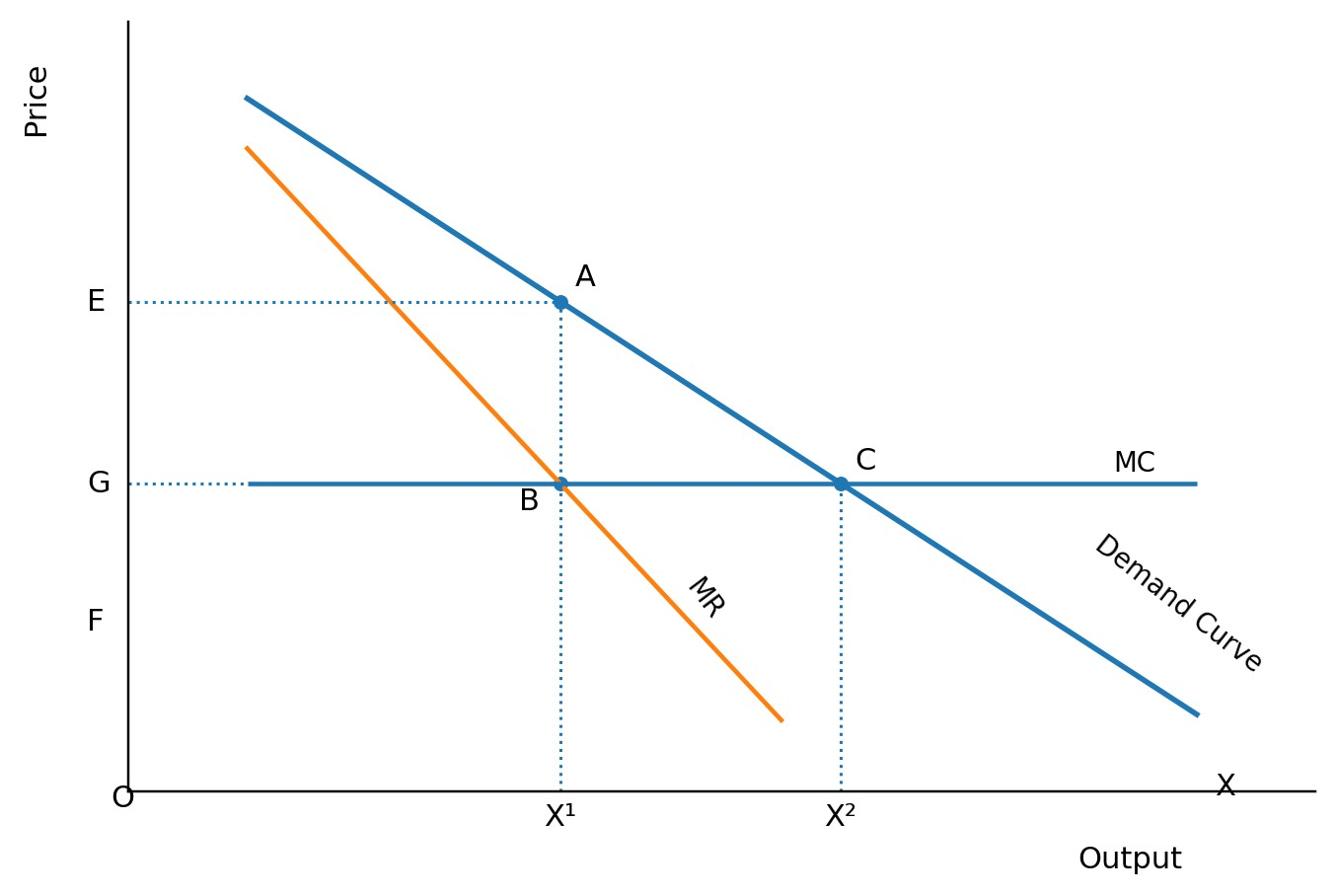
Monopoly price, output, and deadweight loss
- AOX¹
- BOX²
- CAX¹
- DCX²
Answer: (B) OX²
Explanation
Sign in to read the full explanationQuestion 6
Deadweight loss is represented by the area of
Monopoly price, output, and deadweight loss
- AX¹X²CA
- BX¹BCX²
- COX¹AE
- DBAC
Answer: (D) BAC
Explanation
Sign in to read the full explanationQuestion 7
What price will be charged under monopoly?
Monopoly price, output, and deadweight loss
- AOF
- BX²C
- COE
- DOG
Answer: (C) OE
Explanation
Sign in to read the full explanationQuestion 8
The inconsistency of which one of the following criteria is labeled as Scitovsky Paradox?
- ALittle criterion
- BPareto criterion
- CBergson criterion
- DKaldor-Hicks criterion
Answer: (D) Kaldor-Hicks criterion
Explanation
Sign in to read the full explanationQuestion 9
General equilibrium analysis determines
- APrices & quantities in all markets simultaneously
- BPrices & quantities in all markets simultaneously and explicitly takes feedback effects into account
- CFeedback effects
- DPrices in all markets
Answer: (B) Prices & quantities in all markets simultaneously and explicitly takes feedback effects into account
Explanation
Sign in to read the full explanationQuestion 10
The firms are competitive and profit maximizing the demand curve for labour is determined by
- AThe opportunity cost of workers’ time
- BThe value of marginal product of labour
- COffsetting income and substitution effect
- DThe value of marginal product of capital
Answer: (B) The value of marginal product of labour
Explanation
Sign in to read the full explanationQuestion 11
Pareto’s marginal condition for efficiency in composition of output (product-mix) requires
- AMRTSˣₗₖ = MRTSʸₗₖ = MRTSᶻₗₖ
- BMRSᴬₓᵧ = MRSᴬₓ𝓏 = MRSᴮₓ𝓏
- CMRTPₓᵧ = MRSᴬₓᵧ = MRSᴮₓᵧ
- DMRTSʸₗₖ = MRSᴬₓᵧ = MRSᶻₓᵧ
Answer: (C) MRTPₓᵧ = MRSᴬₓᵧ = MRSᴮₓᵧ
Explanation
Sign in to read the full explanationQuestion 12
Why do individuals act in riskier ways after being insured?
- ADue to the problem of adverse selection
- BDue to the problem of false confidence
- CDue to the problem of moral hazard
- DDue to the problem of screening costs
Answer: (C) Due to the problem of moral hazard
Explanation
Sign in to read the full explanationQuestion 13
What is the value of tax multiplier (ΔY/ΔT)?
Suppose that for a particular economy for some time period, investment was equal to 100, government expenditure was equal to 75, net taxes were fixed at 100 and consumption (C) was given by the consumption function:
C = 25 + 0.8 YD
Where YD is disposable income and Y is GDP.
- A-3
- B-2
- C-5
- D-4
Answer: (D) -4
Explanation
Sign in to read the full explanationQuestion 14
What is the value of government expenditure multiplier (ΔY/ΔG)?
Suppose that for a particular economy for some time period, investment was equal to 100, government expenditure was equal to 75, net taxes were fixed at 100 and consumption (C) was given by the consumption function:
C = 25 + 0.8 YD
Where YD is disposable income and Y is GDP.
- A5
- B4
- C6
- D3
Answer: (A) 5
Explanation
Sign in to read the full explanationQuestion 15
What is the level of equilibrium income (Y)?
Suppose that for a particular economy for some time period, investment was equal to 100, government expenditure was equal to 75, net taxes were fixed at 100 and consumption (C) was given by the consumption function:
C = 25 + 0.8 YD
Where YD is disposable income and Y is GDP.
- A700
- B600
- C850
- D800
Answer: (B) 600
Explanation
Sign in to read the full explanationQuestion 16
Which of the following is an example of a public good?
- AResidential building
- BNational defence
- CRestaurant meals
- DSwimming pool of a house
Answer: (B) National defence
Explanation
Sign in to read the full explanationQuestion 17
The excess supply of a commodity above the no-trade equilibrium price given one nation’s?
- AImport demand for the commodity
- BExport supply and import demand for the commodity
- CExport supply of the commodity
- DImport supply of the commodity
Answer: (C) Export supply of the commodity
Explanation
Sign in to read the full explanationQuestion 18
As income falls, consumption declines but proportionately less than the decrease in income because the consumer desires to sustain previous standard of living. This is called?
- ARatchet effect
- BWealth effect
- CDemonstration effect
- DIncome effect
Answer: (A) Ratchet effect
Explanation
Sign in to read the full explanationQuestion 19
Which one is NOT axioms of inequality measures?
- APrinciples of scale invariance
- BPrinciple of equity
- CPrinciples of translation invariance
- DAxiom of decomposability
Answer: (B) Principle of equity
Explanation
Sign in to read the full explanationQuestion 20
The concept of fiscal deficit implies which of the following?
- ARevenue and interest receipts minus revenue expenditures
- BRevenue receipts and recovery of loans and other receipts minus total expenditure
- CReceipts minus disbursement in capital account
- DTotal receipts minus total expenditure
Answer: (B) Revenue receipts and recovery of loans and other receipts minus total expenditure
Explanation
Sign in to read the full explanationQuestion 21
Liquidity approach is also known by the name
- AGurley – Shaw approach
- BRadcliffe approach
- CTraditional approach
- DMonetarist approach
Answer: (B) Radcliffe approach
Explanation
Sign in to read the full explanationQuestion 22
Vertical equity in taxation means that
- APeople in different income groups should be taxed equally
- BPeople in different income groups should be taxed differently
- CPeople in different groups should be charged proportionately
- DUnequal people should be treated equally
Answer: (B) People in different income groups should be taxed differently
Explanation
Sign in to read the full explanationQuestion 23
The commodity or Net Barter Terms of trade are represented by the formula
- A(quantity of exports / quantity of imports) × 100
- B(price × quantity of exports / price × quantity of imports) × 100
- C(volume of exports / volume of imports) × 100
- D(price index of exports / price index of imports) × 100
Answer: (D) (price index of exports / price index of imports) × 100
Explanation
Sign in to read the full explanationQuestion 24
The long term chronic unemployment arising from imbalance between the skills and other characteristics of workers in the market and the need of employers is known as
- ACyclical unemployment
- BFrictional unemployment
- CStructural unemployment
- DSeasonal unemployment
Answer: (C) Structural unemployment
Explanation
Sign in to read the full explanationQuestion 25
According to Marshall – Lerner condition for the foreign exchange market to be stable, the sum of the elasticities of demand for imports and the demand for exports should be
- ALess than 1
- BEqual to zero
- CEqual to 1
- DMore than 1
Answer: (D) More than 1
Explanation
Sign in to read the full explanationQuestion 26
In J. Robinson’s growth model, capital accumulation depends on
- ASavings-income ratio
- BProfit-wage relation and labour productivity
- CProfit-income ratio and capital productivity
- DSavings-investment ratio
Answer: (B) Profit-wage relation and labour productivity
Explanation
Sign in to read the full explanationQuestion 27
Which of the following is NOT the method of debt redemption?
- ARefunding
- BRepudiation
- CSinking fund
- DCapital levy
Answer: (B) Repudiation
Explanation
Sign in to read the full explanationQuestion 28
A tax is said to be direct, when
- AImpact and incidence fall upon the same person
- BOnly incidence falls upon the same person
- CImpact is shifted to another person
- DPerson escapes from paying tax
Answer: (A) Impact and incidence fall upon the same person
Explanation
Sign in to read the full explanationQuestion 29
In the Balance of Payment Account, the transfer payments are included in which one of the following?
- ACapital Account
- BService Account
- CCurrent Account
- DOfficial Reserve Account
Answer: (C) Current Account
Explanation
Sign in to read the full explanationQuestion 30
Which one of the following items is included in the Capital Account of the balance of payment of a country?
- AInvestment income
- BInvisibilities
- CCommercial borrowings
- DPrivate transfer
Answer: (C) Commercial borrowings
Explanation
Sign in to read the full explanationQuestion 31
Which of the following factors is NOT the cause for ‘market failure’?
- AAsymmetric information
- BPublic good
- CExternality
- DLack of demand
Answer: (D) Lack of demand
Explanation
Sign in to read the full explanationQuestion 32
‘Immiserizing growth’ is the term given by
- AAmartya Sen
- BN Kaldor
- CPaul Krugman
- DJagdish Bhagwati
Answer: (D) Jagdish Bhagwati
Explanation
Sign in to read the full explanationQuestion 33
In efficiency wage model, the real wage is set to
- AMinimize the efficiency of worker per rupee of real wages received
- BClear the labour market
- CNot to clear the labour market
- DMaximize the efficiency of workers per rupee of real wages received
Answer: (D) Maximize the efficiency of workers per rupee of real wages received
Explanation
Sign in to read the full explanationQuestion 34
Which of the following is NOT the function of a capital market?
- AMobilizing savings into investment
- BChannelizing funds from less profitable to more profitable
- CMobilizing funds from surplus units to deficit units
- DProviding better returns to direct investors
Answer: (D) Providing better returns to direct investors
Explanation
Sign in to read the full explanationQuestion 35
Which one of the following growth models takes technology as exogenous variable?
- ASolow model
- BRobinson model
- CLucas model
- DTodaro model
Answer: (A) Solow model
Explanation
Sign in to read the full explanationQuestion 36
Three pillars of the Asia –Pacific Economic Cooperation (APEC) are
(a) Trade and investment liberalization
(b) Business facilitation
(c) Economic and technical cooperation
(d) Military cooperationChoose the correct option:
- Aa, b, d
- Ba, b, c
- Ca, c, d
- Db, c, d
Answer: (B) a, b, c
Explanation
Sign in to read the full explanationQuestion 37
During recession which of the following measures is initiated?
- ACutting taxes and boosting government spending
- BIncreasing taxes and decreasing government spending
- CKeeping tax rates constant and increasing government spending
- DIncreasing tax rates and keeping government spending constant
Answer: (A) Cutting taxes and boosting government spending
Explanation
Sign in to read the full explanationQuestion 38
A toll tax is a tax based on which of the following?
- AThe benefit principles
- BHorizontal equity
- CVertical equity
- DTax progressively
Answer: (A) The benefit principles
Explanation
Sign in to read the full explanationQuestion 39
Calculate the rate of effective protection by using the formula g = (t − aᵢtᵢ)/(1 − aᵢ), if g = 0.3, aᵢ = 0.8 and tᵢ = 0, then the value of t is
- A0.2
- B0.3
- C0.1
- D0.4
Answer: (C) 0.1
Explanation
Sign in to read the full explanationQuestion 40
Match List-I with List-II:
List-I List-II (a) Theory of big push (i) J H Boeke (b) Warranted rate of growth (ii) Paul Romer (c) Social dualism (iii) Rosenstein Rodan (d) Endogenous growth theory (iv) R F Harrod - Aa-ii, b-iii, c-iv, d-i
- Ba-iii, b-i, c-iv, d-ii
- Ca-iii, b-iv, c-i, d-ii
- Da-iv, b-ii, c-iii, d-i
Answer: (C) a-iii, b-iv, c-i, d-ii
Explanation
Sign in to read the full explanationQuestion 41
By ‘financial crowding out’ economist mean
- ACredit rationing
- BWhat the government borrows cannot be used for private investment
- CGovernment borrowings drive up interest rate
- DReserve bank of India controls on commercial bank lendings
Answer: (C) Government borrowings drive up interest rate
Explanation
Sign in to read the full explanationQuestion 42
Direct credit programmes introduced
- ASecurity – oriented credit
- BDevelopment – oriented credit
- CPurpose-oriented credit
- DWelfare-oriented credit
Answer: (C) Purpose-oriented credit
Explanation
Sign in to read the full explanationQuestion 43
Which of the following is NOT part of Wiseman and Peacock hypothesis?
- AConcentration effect
- BDisplacement effect
- CInspection effect
- DTaxation effect
Answer: (D) Taxation effect
Explanation
Sign in to read the full explanationQuestion 44
Which consideration a commercial bank does NOT keep in mind to manage its assets and liabilities?
- ALiquidity
- BProfitability
- CSolvency
- DEquity
Answer: (D) Equity
Explanation
Sign in to read the full explanationQuestion 45
External drains leave which type of impact on commercial bank?
- ALowers the reserves of bank
- BIncrease further deposits
- CIncrease credit creation
- DCreates demand deposits
Answer: (A) Lowers the reserves of bank
Explanation
Sign in to read the full explanationQuestion 46
Assume that an economy begins in macroeconomic equilibrium, then taxes are significantly decreased. As a result of this change
- AThere is expansion and deflation in the economy
- BThere is recession and deflation in the economy
- CThere is expansion and inflation in the economy
- DThere is stagflation in the economy
Answer: (C) There is expansion and inflation in the economy
Explanation
Sign in to read the full explanationQuestion 47
An increase in money supply will increase the demand for goods and services by
- AReducing government spending
- BLowering the interest rate so that investment spending increases
- CRaising interest rate so that investment spending reduces
- DIncreasing government spending on goods and services
Answer: (B) Lowering the interest rate so that investment spending increases
Explanation
Sign in to read the full explanationQuestion 48
The provision under the membership clause of the IMF is that any country can become a member, if
- AThe country is willing to be a member of the World Bank and willing to pay all subscriptions in gold
- BThe country is willing to be a member of the WTO and willing to pay all subscriptions in gold
- CThe country is willing to be a member of the World Bank and willing to pay subscription
- DThe country is willing to be a member of UNO and willing to pay subscription
Answer: (C) The country is willing to be a member of the World Bank and willing to pay subscription
Explanation
Sign in to read the full explanationQuestion 49
Match List-I with List-II:
List-I List-II (a) ICICI (i) 1971 (b) IRBI (ii) 1964 (c) IFCI (iii) 1955 (d) IDBI (iv) 1948 - Aa-i, b-ii, c-iii, d-iv
- Ba-ii, b-iii, c-iv, d-i
- Ca-iii, b-i, c-iv, d-ii
- Da-iii, b-ii, c-i, d-iv
Answer: (C) a-iii, b-i, c-iv, d-ii
Explanation
Sign in to read the full explanationQuestion 50
An increase is fiscal spending leads to
- AA shift of Phillips curve to the left
- BA shift of Phillips curve to the right
- CMovement along the Phillips curve such that unemployment rises inflation also rises
- DMovement along the Phillips curve in such a way that shows the decline in unemployment rate with every increase in inflation rate
Answer: (D) Movement along the Phillips curve in such a way that shows the decline in unemployment rate with every increase in inflation rate
Explanation
Sign in to read the full explanationQuestion 51
A foreign exchange risk involves the transaction exposure, the accounting exposure and
- AThe translation exposure
- BThe flexibility exposure
- CThe rigidity exposure
- DThe economic exposure
Answer: (D) The economic exposure
Explanation
Sign in to read the full explanationQuestion 52
Which is NOT the main objective of credit control?
- AStabilization of general price level
- BPromoting economic growth
- CEnsuring adequate flow of credit to productive sectors
- DPromoting economic welfare
Answer: (D) Promoting economic welfare
Explanation
Sign in to read the full explanationQuestion 53
Match List-I with List-II:
List-I List-II (a) Accelerator and multiplier interaction (i) Modigliani, Ando and Brumberg (b) Cambridge approach (ii) Akerlof and Yellen (c) Life cycle hypothesis (iii) Paul Samuelson (d) Efficiency wage model (iv) Alfred Marshal and A C pigou - Aa-i, b-iv, c-ii, d-iii
- Ba-iii, b-iv, c-i, d-ii
- Ca-ii, b-i, c-iii, d-ii
- Da-iv, b-iii, c-ii, d-i
Answer: (B) a-iii, b-iv, c-i, d-ii
Explanation
Sign in to read the full explanationQuestion 54
According to Marxian analysis the surplus value depends upon
- ASurplus and necessary labour time
- BNecessary labour time only
- CSurplus labour time only
- DNominal wage rate
Answer: (C) Surplus labour time only
Explanation
Sign in to read the full explanationQuestion 55
The liquidity aggregates are classified as
- AL₁, L₂ and L₃
- BM₁, M₂ and M₃
- CNM₃
- DM₁, M₂, M₃ and M₄
Answer: (A) L₁, L₂ and L₃
Explanation
Sign in to read the full explanationQuestion 56
During a depression which of the following policy instruments should be used?
- ATaxes should be increased
- BTaxes are kept unchanged and public expenditure is increased
- CPublic expenditure is reduced
- DThere should be a balanced budget
Answer: (B) Taxes are kept unchanged and public expenditure is increased
Explanation
Sign in to read the full explanationQuestion 57
Which one of the following does NOT determine the amount of years of schooling demanded by an individual to qualify for modern job?
- AThe wage or income differential
- BThe probability of success in finding modern sector employment
- COpportunity cost of schooling
- DExpansion of health care infrastructure in urban sector
Answer: (D) Expansion of health care infrastructure in urban sector
Explanation
Sign in to read the full explanationQuestion 58
Who among the following is not associated with the endogenous growth theory?
- ARobert Solow
- BPaul Romer
- CRebelo
- DRobert Lucas
Answer: (A) Robert Solow
Explanation
Sign in to read the full explanationQuestion 59
Under which system the central bank is authorized by law to issue a fixed amount of notes against government securities and any excess is to be fully backed by gold/silver?
- AMaximum fiduciary system
- BMinimum reserve system
- CFixed Fiduciary system
- DMaximum and minimum fiduciary system
Answer: (C) Fixed Fiduciary system
Explanation
Sign in to read the full explanationQuestion 60
The rational expectations hypothesis suggests that the forcasts that people make concerning future inflation rates
- AConsistently over estimates the actual rate of inflation in the future
- BAre always correct
- CConsistently under estimates the actual rate of inflation in the future
- DAre correct on an average but are subject to errors that are distributed randomly
Answer: (D) Are correct on an average but are subject to errors that are distributed randomly
Explanation
Sign in to read the full explanationQuestion 61
Estimate of head count ratio in state –A and state – B are
Monthly per capita consumption expenditure (MPCE in Rs) of eight households:
State 1 2 3 4 5 6 7 8 State A 950 1100 1000 975 750 775 790 1400 State B 1250 1150 1400 1100 550 600 490 1200 The value of Z (poverty line MPCE cut off) is Rs 800.
- AState A : 0.375 ; B: 0.375
- BState A : 0.475 ; B: 0.375
- CState A : 0.575 ; B: 0.575
- DState A: 0.385; B: 0.425
Answer: (A) State A : 0.375 ; B: 0.375
Explanation
Sign in to read the full explanationQuestion 62
Calculate the estimates of Square Poverty Gap Ratio (SPGR) and determine whether the SPGR in State A is
Monthly per capita consumption expenditure (MPCE in Rs) of eight households:
State 1 2 3 4 5 6 7 8 State A 950 1100 1000 975 750 775 790 1400 State B 1250 1150 1400 1100 550 600 490 1200 The value of Z (poverty line MPCE cut off) is Rs 800.
- ASame as in state B
- BHigher than that in state B
- CLower than that in state B
- DSignificantly different from zero
Answer: (C) Lower than that in state B
Explanation
Sign in to read the full explanationQuestion 63
Calculate the estimates of Poverty Gap Ratio (PGR) for State A and State B and select the correct option
Monthly per capita consumption expenditure (MPCE in Rs) of eight households:
State 1 2 3 4 5 6 7 8 State A 950 1100 1000 975 750 775 790 1400 State B 1250 1150 1400 1100 550 600 490 1200 The value of Z (poverty line MPCE cut off) is Rs 800.
- AState A : 0.133 ; B: 0.0119
- BState A : 0.153 ; B: 0.0135
- CState A: 0.0133 ; B: 0.119
- DState A: 0.0153 ; B: 0.135
Answer: (C) State A: 0.0133 ; B: 0.119
Explanation
Sign in to read the full explanationQuestion 64
In an open economy input output model, the viability is examined by
- AHawkins- Simon conditions
- BKuhn – Tucker conditions
- CDickey – fuller test
- DGoldfeld Quandt test
Answer: (A) Hawkins- Simon conditions
Explanation
Sign in to read the full explanationQuestion 65
When the null hypothesis is there as an equality the level of significance is the probability of making
- AType –II error
- BType – I error
- CType I & II errors
- DType I & III errors
Answer: (B) Type – I error
Explanation
Sign in to read the full explanationQuestion 66
In 2011 the proportion of urban population was more than 40% in the states of
- ATamil Nadu, Punjab, Andra Pradesh, Gujarat
- BTamil Nadu, Haryana, Gurajat, Maharastra
- CTamil Nadu, Kerala, Andra Pradesh, West Bengal
- DTamil Nadu, Kerala, Maharastra, Gujarat
Answer: (D) Tamil Nadu, Kerala, Maharastra, Gujarat
Explanation
Sign in to read the full explanationQuestion 67
A Linear programming problem can be solved by using
- AARIMA techniques
- BSimplex method
- CUnit root method
- DNone of the above
Answer: (B) Simplex method
Explanation
Sign in to read the full explanationQuestion 68
Which age structure is important for demographic dividend?
- A0-14
- B15-59
- C60 and above
- D0-14 and 60 and above
Answer: (B) 15-59
Explanation
Sign in to read the full explanationQuestion 69
The correct relationship among Arithmetic Mean (AM), Geometric Mean (GM) and Harmonic Mean (HM) is
- AGM = AM + HM
- BAM < HM
- C(GM)² = HM* AM
- DAM = GM-HM
Answer: (C) (GM)² = HM* AM
Explanation
Sign in to read the full explanationQuestion 70
In a two variable (X and Y) regression analysis, the regression coefficient are bₓᵧ = 0.6 and bᵧₓ = 0.8. If y is dependent variable and x is independent variable, what is the percentage of variations in Y explained by X?
- A47%
- B48%
- C49%
- D36%
Answer: (B) 48%
Explanation
Sign in to read the full explanationQuestion 71
The RBI made Indian rupee fully convertible in current account transactions related to goods and services in the year
- A1985
- B2002
- C1994
- D2011
Answer: (C) 1994
Explanation
Sign in to read the full explanationQuestion 72
Standard Error (SE) of sample mean (x̄) in random sampling from an infinite population or in random sampling with replacement is given by
- ASE = σ²/√n where σ is the population standard deviation
- BSE = σ/√n² where σ is the population standard deviation
- CSE = σ³/√n where σ is the population standard deviation
- DSE = σ/√n where σ is the population standard deviation
Answer: (D) SE = σ/√n where σ is the population standard deviation
Explanation
Sign in to read the full explanationQuestion 73
The IRR is the discount rate that equates the project NPV to ____ and benefit- cost ratio to ____
- A1,0
- B0,1
- C0,0
- D1,1
Answer: (B) 0,1
Explanation
Sign in to read the full explanationQuestion 74
Difference equation is concerned with
- ADiscrete changes
- BContinuous changes
- CBoth of the above
- DNone of the above
Answer: (A) Discrete changes
Explanation
Sign in to read the full explanationQuestion 75
Multiplicative Decomposition model is used to
- ADeseasonalise the time series data
- BBuild cost of living index
- CTest a hypothesis
- DEstimate probability
Answer: (A) Deseasonalise the time series data
Explanation
Sign in to read the full explanationQuestion 76
Match List-I with List-II:
List-I List-II (a) Thomas Doubleday (i) Destiny theory (b) Thomas Sadler (ii) Biological theory (c) Leibenstein (iii) Diet theory (d) Herbert Spencer (iv) Motivation theory of population growth - Aa-i, b-ii, c-iii, d-iv
- Ba-iii, b-i, c-iv, d-ii
- Ca-iv, b-iii, c-ii, d-i
- Da-iv, b-ii, c-i, d-iii
Answer: (B) a-iii, b-i, c-iv, d-ii
Explanation
Sign in to read the full explanationQuestion 77
“Education as investment in human resources plays an important role among the factors which contribute to economic growth”. This statement was given by
- ANew Education policy, 1985
- BEducation Commission, 1966
- CNCERT
- DSupreme Court of India
Answer: (B) Education Commission, 1966
Explanation
Sign in to read the full explanationQuestion 78
Under TRIPS protection for copyrights is for
- A20 years after the death of the author
- B30 years after the death of the author
- C40 years after the death of the author
- D50 years after the death of the author
Answer: (D) 50 years after the death of the author
Explanation
Sign in to read the full explanationQuestion 79
Second National Commission on labour has recommended a three tier system including
- ALok adalats, labour courts and labour commissions
- BLok adalats, labour courts and labour relations commissions
- CLok adalats, labour courts and judicial courts
- DLok adalats, labour courts and labour inspectors
Answer: (B) Lok adalats, labour courts and labour relations commissions
Explanation
Sign in to read the full explanationQuestion 80
The ‘Hedonic Price’ method measures the value of environmental assets through
- AUsing ‘existence’ of an environmental asset
- BUsing linkages between variations of Inhouse prices
- CUsing WTP to value of environmental assets
- DUsing WTA TO value of environmental assets
Answer: (B) Using linkages between variations of Inhouse prices
Explanation
Sign in to read the full explanationQuestion 81
Assertion (A): The share of the non commodity sector in the national income has been increasing in India
Reason (R): Industry and agriculture have been growing at a relatively slower pace in India- ABoth (A) and (R) are true and R explains (A)
- BBoth (A) and (R) are true but R does not explain (A)
- C(A) is true but (R) is false
- D(A) is false but (R) is true
Answer: (A) Both (A) and (R) are true and R explains (A)
Explanation
Sign in to read the full explanationQuestion 82
Market failure occurs in case of most of the environmental goods, because
- AEnvironmental goods are rival products
- BEnvironmental goods are excludable products
- CEnvironmental goods are non rival in production
- DEnvironmental goods are non rival and non excludable in consumption
Answer: (D) Environmental goods are non rival and non excludable in consumption
Explanation
Sign in to read the full explanationQuestion 83
Which of the following is NOT an instrument of capital market with special reference to India
- AEquity share
- BDebenture
- CGold ETF
- DCommercial paper
Answer: (D) Commercial paper
Explanation
Sign in to read the full explanationQuestion 84
Match List-I with List-II:
List-I List-II (a) Gauss – Markov (i) R² (b) Coefficient of determination (ii) One sided test (c) H₀ : B₂ = 0, H₁: B₂ = 70 (iii) Goldfeld – Quandt test (d) Heteroscedasticity (iv) BLUE - Aa-iv, b-i, c-ii, d-iii
- Ba-i, b-ii, c-iv, d-iii
- Ca-ii, b-iii, c-i, d-iv
- Da-iii, b-i, c-ii, d-iv
Answer: (A) a-iv, b-i, c-ii, d-iii
Explanation
Sign in to read the full explanationQuestion 85
Which of the following items completes the life table?
AGE: 7 | lₓ: 90000 | dₓ: 500 | Lₓ: 89,750 | Tₓ: 48,50,000 | eₓ: ?
- A50.50
- B54.00
- C53.89
- D51.31
Answer: (C) 53.89
Explanation
Sign in to read the full explanationQuestion 86
If AR = 15 MR= 5, the price elasticity of demand is
- A2.3
- B1.5
- C1.75
- D1
Answer: (B) 1.5
Explanation
Sign in to read the full explanationQuestion 87
In a binomial distribution, the probability of x successes in n trials in any order is given by
- Ap(x) = ⁿCₓ pˣ · qⁿ⁻ˣ
- Bp(x) = ⁿC₁ p²ˣ · qⁿ⁻¹
- Cp(x) = ⁿCₓ p² · qⁿ⁻¹
- Dp(x) = ⁿCₓ pˣ · qⁿ⁻²
Answer: (A) p(x) = ⁿCₓ pˣ · qⁿ⁻ˣ
Explanation
Sign in to read the full explanationQuestion 88
The cost function of a monopolist is C = 40+ 12X. Write the demand function as P = 60- 3X. What is his profit maximizing output level?
- A12
- B11
- C8
- D9
Answer: (C) 8
Explanation
Sign in to read the full explanationQuestion 89
“Under some conditions, it makes no difference to efficiency whether the polluter has a right to pollute or the victim has a right to clean air”. This statement is related to the work of:
- AG Hardin
- BR Coase
- CN Kaldor
- DJulian Simon
Answer: (B) R Coase
Explanation
Sign in to read the full explanationQuestion 90
Applying OLS to simultaneous equations results in the parameters being
- AInefficient
- BInconsistent
- CBiased
- DBiased and Inconsistent
Answer: (D) Biased and Inconsistent
Explanation
Sign in to read the full explanationQuestion 91
Match List-I with List-II:
List-I List-II (a) World environment day (i) 11th July (b) World wildlife day (ii) 5th June (c) World water day (iii) 3rd March (d) World population day (iv) 22nd March - Aa-i, b-ii, c-iii, d-iv
- Ba-iii, b-i, c-iv, d-ii
- Ca-iv, b-iii, c-ii, d-i
- Da-ii, b-iii, c-iv, d-i
Answer: (D) a-ii, b-iii, c-iv, d-i
Explanation
Sign in to read the full explanationQuestion 92
If A =
[ 6 5 5 ]
[ 3 −11 −5 ]
[ 3 −5 −2 ]Then |A| is equal to
- A15
- B16
- C27
- D20
Answer: (C) 27
Explanation
Sign in to read the full explanationQuestion 93
Which of the following is NOT correct with reference to the service sector of Indian economy?
- AService sector has the largest share in the GDP
- BService sector has the largest share in employment
- CService sector’s growth has been higher than growth of agriculture sector
- DProductivity per worker in service sector is highest
Answer: (B) Service sector has the largest share in employment
Explanation
Sign in to read the full explanationQuestion 94
A simultaneous equation model is exactly identified, if
- AUnique numerical values of structural parameters can be obtained
- BMore than one numerical value can be obtained for some of the parameters of the structural equation
- CUnique solution of all structural coefficients is not possible
- DStructural coefficient cannot be estimated
Answer: (A) Unique numerical values of structural parameters can be obtained
Explanation
Sign in to read the full explanationQuestion 95
National Food Security law covers
- A65% of rural population
- B70% of rural population
- C75% of rural population
- D80% of rural population
Answer: (C) 75% of rural population
Explanation
Sign in to read the full explanationQuestion 96
Which of the following is NOT part of the “PM Kisan Samman Nidhi” scheme as announced on 1-02-2019?
- AAll farmers having land holdings up to 2 hectares are eligible under the scheme
- BThe scheme will be applicable from 1st April, 2019
- CThe government will transfers Rs. 6000 per annum in to the bank account of eligible beneficiaries
- DThe money will be given in three equal installments of Rs. 2000 each
Answer: (B) The scheme will be applicable from 1st April, 2019
Explanation
Sign in to read the full explanationQuestion 97
For a moderately skewed distribution, the value of mode is 10 and value of median is 20. Then the mean is
- A15
- B30
- C25
- D35
Answer: (C) 25
Explanation
Sign in to read the full explanationQuestion 98
Who propounded optimum theory of population?
- ARobbins
- BDalton
- CCannan
- DCarr Saunders
Answer: (C) Cannan
Explanation
Sign in to read the full explanationQuestion 99
What is the equation of corrected birthrate?
- ACorrected birthrate = (Registered births in one year + possible birth) / mid year population × 1000
- BCorrected Birth rate = Live births in one year / mid year population × 1000
- CCorrected birth rate = number of female births / mid year populations × 1000
- DCorrected birth rate = (Registered births + possible births) / Mid year female population × 1000
Answer: (A) Corrected birthrate = (Registered births in one year + possible birth) / mid year population × 1000
Explanation
Sign in to read the full explanationQuestion 100
Match List-I with List-II:
List-I List-II (a) Skewness (i) Dispersion (b) Variance (ii) Random Variations (c) Earthquake (iii) Ratio of variances (d) F –test (iv) Lack of symmetry - Aa-iii, b-iv, c-i, d-ii
- Ba-iv, b-i, c-ii, d-iii
- Ca-i, b-iii, c-iv, d-ii
- Da-ii, b-i, c-iv, d-iii
Answer: (B) a-iv, b-i, c-ii, d-iii
Explanation
Sign in to read the full explanation
Frequently asked questions
How many questions were in the UGC NET Economics June 2019 exam?
Paper 1 had 50 questions and Paper 2 (Economics) had 100 questions, for 150 in total across 3 hours.
Is there negative marking in UGC NET?
No. Each correct answer earns 2 marks and there is no penalty for a wrong answer, so leaving a question blank is never better than attempting it.
Are the June 2019 answers on this page official?
Answers follow the official NTA answer key for this session. If you spot a discrepancy, use the report option inside the practice test and we will review it.
Can I attempt the June 2019 paper as a timed mock test?
Yes. Every paper on this page has an "Attempt this paper" button that opens the same questions in the timed test interface, with instant scoring and weak-area analysis afterwards.
Want the full mock experience?
Attempt Paper 1 + Paper 2 (Economics) together in a single timed session.
More Economics practice
Practice Paper 1 from other subjects
Every subject's exam sitting has its own Paper 1 (General Aptitude) set — more real PYQs to solve.