UGC NET Computer Science & Applications October 2022 Question PaperPaper 1 & Paper 2 with Answer Key
The complete UGC NET October 2022 question paper for Computer Science & Applications, covering Paper 1 (General Aptitude) and Paper 2 (Computer Science & Applications). Every question below is shown with its options and the correct answer, and a detailed explanation you can unlock by signing in. All 150 questions are free to practise.
UGC NET October 2022 at a glance
| Exam | UGC NET October 2022 |
|---|---|
| Papers | Paper 1 (General Aptitude) and Paper 2 (Computer Science & Applications) |
| Exam date(s) | October 8, 2022 |
| Shift(s) | Shift 1 |
| Paper 1 questions | 50 questions · 60 minutes · 100 marks |
| Paper 2 questions | 100 questions · 120 minutes · 200 marks |
| Total | 150 questions |
| Marking scheme | +2 per correct answer · No negative marking |
General Aptitude
UGC NET October 2022 · Computer Science & Applications sitting
Paper 1 — General Aptitude
Attempt this paper50 questions with the answer key and explanations.
Question 1
The difference between the number of boys and girls studying in College D is:
The table gives each college's student share out of 60,000 and girls' share out of 24,000.
College Students (% of 60,000) Girls (% of 24,000) A 10% 15% B 9% 12% C 23% 18% D 18% 14% E 16% 20% F 24% 21% - A4040
- B4080
- C7440
- D3360
Answer: (B) 4080
Explanation
Sign in to read the full explanationQuestion 2
The number of girls in College F is ____ % more than the number of girls in College A.
The table gives each college's student share out of 60,000 and girls' share out of 24,000.
College Students (% of 60,000) Girls (% of 24,000) A 10% 15% B 9% 12% C 23% 18% D 18% 14% E 16% 20% F 24% 21% - A25
- B30
- C40
- D50
Answer: (C) 40
Explanation
Sign in to read the full explanationQuestion 3
The ratio of the number of boys in College F to the number of boys in College D is:
The table gives each college's student share out of 60,000 and girls' share out of 24,000.
College Students (% of 60,000) Girls (% of 24,000) A 10% 15% B 9% 12% C 23% 18% D 18% 14% E 16% 20% F 24% 21% - A31:39
- B39:31
- C29:37
- D37:29
Answer: (B) 39:31
Explanation
Sign in to read the full explanationQuestion 4
The average number of boys studying in Colleges A, B and C is:
The table gives each college's student share out of 60,000 and girls' share out of 24,000.
College Students (% of 60,000) Girls (% of 24,000) A 10% 15% B 9% 12% C 23% 18% D 18% 14% E 16% 20% F 24% 21% - A4900
- B4700
- C4400
- D4800
Answer: (D) 4800
Explanation
Sign in to read the full explanationQuestion 5
The number of girl students in College C as a percentage of the number of boys in College E is:
The table gives each college's student share out of 60,000 and girls' share out of 24,000.
College Students (% of 60,000) Girls (% of 24,000) A 10% 15% B 9% 12% C 23% 18% D 18% 14% E 16% 20% F 24% 21% - A70%
- B75%
- C80%
- D90%
Answer: (D) 90%
Explanation
Sign in to read the full explanationQuestion 6
Which of the following three numbers in decimal, octal and hexadecimal notations, respectively, is/are equivalent to
(11011001)₂?A.
(217)₁₀
B.(661)₈
C.(D9)₁₆- AA only
- BB only
- CA and B only
- DA and C only
Answer: (D) A and C only
Explanation
Sign in to read the full explanationQuestion 7
Human communication involves:
A. Message transmission
B. Message reception
C. Verbal and non-verbal messages
D. Power-packed messages only
E. Messages for non-consumption- AA, B and C only
- BB, C and D only
- CB, D and E only
- DA, C and E only
Answer: (A) A, B and C only
Explanation
Sign in to read the full explanationQuestion 8
Assertion (A): Discussion forums are one of the Four Quadrants for MOOCs.
Reason (R): Discussion forums are an in-built feature of learning management systems (LMS).
- ABoth A and R are correct and R is the correct explanation of A
- BBoth A and R are correct but R is not the correct explanation of A
- CA is correct but R is not correct
- DA is not correct but R is correct
Answer: (B) Both A and R are correct but R is not the correct explanation of A
Explanation
Sign in to read the full explanationQuestion 9
Which goal of the 2030 Agenda for Sustainable Development seeks to ensure inclusive and equitable quality education and promote lifelong learning opportunities for all?
- AGoal 2
- BGoal 4
- CGoal 6
- DGoal 15
Answer: (B) Goal 4
Explanation
Sign in to read the full explanationQuestion 10
Responses to open-ended questions are:
- AQuantifiable
- BRealistic
- CSubjective
- DImitative
Answer: (C) Subjective
Explanation
Sign in to read the full explanationQuestion 11
Communication apprehension is often described as:
- ASocial relativity
- BPsycho-social barrier
- CSocial anxiety
- DSocial ambiguity
Answer: (C) Social anxiety
Explanation
Sign in to read the full explanationQuestion 12
Match List-I with List-II.
List-I: Learning definitions List-II: Proponent A. Learning is an organization of behaviour I. Guilford B. Learning is the change in behaviour resulting from behaviour II. Skinner C. Learning is selecting the appropriate response and connecting with the stimulus III. Garret D. Learning is a process of progressive behaviour adaptation IV. Thorndike - AA-I, B-III, C-II, D-IV
- BA-IV, B-III, C-II, D-I
- CA-III, B-IV, C-I, D-II
- DA-III, B-I, C-IV, D-II
Answer: (D) A-III, B-I, C-IV, D-II
Explanation
Sign in to read the full explanationQuestion 13
Find the wrong term in the series: 6, 11, 18, 27, 34, 51, 66, 83.
- A34
- B51
- C83
- D11
Answer: (A) 34
Explanation
Sign in to read the full explanationQuestion 14
Two shopkeepers sell machines at the same list price. A gives successive discounts of 20% and 15%; B gives 10% and 25%. Which statement is correct?
- AA offers more discount
- BB offers more discount
- CBoth offer the same discount
- DA offers 35% discount and B offers 30% discount
Answer: (B) B offers more discount
Explanation
Sign in to read the full explanationQuestion 15
Which Indian Act makes it illegal to knowingly spread a computer virus?
- AData Protection and Security Act, 1997
- BInformation Security Act, 1998
- CInformation Technology Act, 2000
- DComputer Misuse and Cyber Act, 2009
Answer: (C) Information Technology Act, 2000
Explanation
Sign in to read the full explanationQuestion 16
Statement I: Cache memory is volatile memory and is much slower than RAM.
Statement II: CDs, DVDs and magnetic tapes are all optical media devices.
- ABoth Statement I and Statement II are true
- BBoth Statement I and Statement II are false
- CStatement I is true but Statement II is false
- DStatement I is false but Statement II is true
Answer: (B) Both Statement I and Statement II are false
Explanation
Sign in to read the full explanationQuestion 17
A geothermal field requires a combination of:
A. A natural underground source of water
B. A mountain in the vicinity
C. An impermeable layer
D. A coal mine in the vicinity
E. A large mass of hot rock in the vicinity- AA, C and E only
- BA, C and D only
- CB, C and D only
- DB, D and E only
Answer: (A) A, C and E only
Explanation
Sign in to read the full explanationQuestion 18
At what annual compound-interest rate will a sum double in 14 years?
- A4%
- B5%
- C6%
- D6.5%
Answer: (B) 5%
Explanation
Sign in to read the full explanationQuestion 19
The National Education Policy 2020 recommended replacing the UGC with HECI and its four verticals. Which belong to the four verticals?
A. National Higher Education Regulatory Council
B. General Education Council
C. Medical Council of India
D. National Accreditation Council
E. Higher Education Grants Council- AA, B, C and D only
- BB, C, D and E only
- CA, C, D and E only
- DA, B, D and E only
Answer: (D) A, B, D and E only
Explanation
Sign in to read the full explanationQuestion 20
Which is a tool of grounded theory?
- AConstant comparison
- BAuditing
- CDeconstruction of narratives
- DUse of uncritical language
Answer: (A) Constant comparison
Explanation
Sign in to read the full explanationQuestion 21
Statement I: Natural erosion is the gradual removal of topsoil by natural processes.
Statement II: Accelerated erosion is caused by human activities and occurs at the same rate as soil formation.
- ABoth Statement I and Statement II are true
- BBoth Statement I and Statement II are false
- CStatement I is true but Statement II is false
- DStatement I is false but Statement II is true
Answer: (C) Statement I is true but Statement II is false
Explanation
Sign in to read the full explanationQuestion 22
Statement I: Non-probability samples use available respondents without a specific selection procedure.
Statement II: Non-probability samples accurately reflect population characteristics.
- ABoth Statement I and Statement II are true
- BBoth Statement I and Statement II are false
- CStatement I is true but Statement II is false
- DStatement I is false but Statement II is true
Answer: (C) Statement I is true but Statement II is false
Explanation
Sign in to read the full explanationQuestion 23
If “All women are honest” is true, which propositions can be inferred?
A. “No woman is honest” is false
B. “Some women are honest” is true
C. “No woman is honest” is undetermined
D. “Some women are not honest” is false- AA, B and D only
- BB and D only
- CB, C and D only
- DC and D only
Answer: (A) A, B and D only
Explanation
Sign in to read the full explanationQuestion 24
In Nyāya syllogism, all three terms stand synthesized at which step of the inferential process?
- AExample (Udāharaṇa)
- BConclusion (Nigamana)
- CApplication (Upanaya)
- DReason (Hetu)
Answer: (C) Application (Upanaya)
Explanation
Sign in to read the full explanationQuestion 25
Which are sources of data in historical research?
A. Personal observation
B. Focused group discussion
C. Oral testimony
D. Relics
E. Actuaries- AA, B and C only
- BB, C and D only
- CA, C and D only
- DC, D and E only
Answer: (D) C, D and E only
Explanation
Sign in to read the full explanationQuestion 26
Which logical informal fallacy is committed in the following argument? “Mr. X used abusive language toward the child who threw a stone at his car. Since child abuse is a crime, he should be reported to the authorities.”
- AAppeal to emotion
- BHasty generalisation
- CEquivocation
- DAppeal to force
Answer: (C) Equivocation
Explanation
Sign in to read the full explanationQuestion 27
Statement I: The contrapositive replaces the subject by the complement of the predicate and the predicate by the complement of the subject.
Statement II: All contrapositions are valid.
- ABoth statements are true
- BBoth statements are false
- CStatement I is true but Statement II is false
- DStatement I is false but Statement II is true
Answer: (C) Statement I is true but Statement II is false
Explanation
Sign in to read the full explanationQuestion 28
Statement I: NEP 2020 changes 10+2 to 5+4+4+3 for ages 3-18.
Statement II: Before age 5, every child will move to a Preparatory Class or Balvatika with an ECCE-qualified teacher.
- ABoth statements are correct
- BBoth statements are incorrect
- CStatement I is correct but Statement II is incorrect
- DStatement I is incorrect but Statement II is correct
Answer: (D) Statement I is incorrect but Statement II is correct
Explanation
Sign in to read the full explanationQuestion 29
Chlorine in drinking water is used for:
A. Disinfection
B. Removal of hardness
C. Odour treatment
D. Turbidity control
E. Removal of iron and manganese- AA, C and E only
- BA, B and C only
- CA, D and E only
- DC, D and E only
Answer: (A) A, C and E only
Explanation
Sign in to read the full explanationQuestion 30
Match the protocol or summit in List-I with its theme in List-II.
List-I: Protocol/Summit List-II: Theme A. Paris Agreement I. Emissions trading B. Kyoto Protocol II. Ozone depletion C. Rio Declaration III. INDCs D. Montreal Protocol IV. Environment and development - AA-III, B-I, C-II, D-IV
- BA-I, B-II, C-IV, D-III
- CA-III, B-I, C-IV, D-II
- DA-I, B-II, C-III, D-IV
Answer: (C) A-III, B-I, C-IV, D-II
Explanation
Sign in to read the full explanationQuestion 31
Match the communication context in List-I with its related factor in List-II.
List-I: Communication context List-II: Related factor A. Physical I. Group norms B. Cultural II. Sequential positioning C. Social and Psychological III. Tangible environment D. Temporal IV. Value system - AA-II, B-III, C-IV, D-I
- BA-III, B-IV, C-I, D-II
- CA-IV, B-I, C-II, D-III
- DA-I, B-II, C-III, D-IV
Answer: (B) A-III, B-IV, C-I, D-II
Explanation
Sign in to read the full explanationQuestion 32
The grapevine communication is often driven by:
- AExternal professional agencies
- BCompeting organisations
- CTop management of an organisation
- DSocial networks of employees
Answer: (D) Social networks of employees
Explanation
Sign in to read the full explanationQuestion 33
Which formula entered in D1 will give the shown values when copied to D2 and D3?
A B C D 1 5 10 50 2 15 50 3 20 50 4 - AB1 * $C$1
- B$B$1 * C1
- CB1 * C1
- D$B$1 * $C$1
Answer: (D) $B$1 * $C$1
Explanation
Sign in to read the full explanationQuestion 34
Which statements about CERT-In are correct?
A. It is the national nodal agency for responding to computer-security incidents.
B. It has operated since January 2014.
C. Forecast and alert of cyber-security incidents is one of its functions.- AA, B and C
- BA and B only
- CA and C only
- DB and C only
Answer: (C) A and C only
Explanation
Sign in to read the full explanationQuestion 35
Which are actions of an ethnographic researcher?
A. Gets immersed in the social setting
B. Avoids collecting documents about the group
C. Observes group members' behaviour
D. Listens to their conversation
E. Does not interview participants who are not amenable to observation- AA, B and C only
- BA, C and D only
- CB, C and D only
- DC, D and E only
Answer: (B) A, C and D only
Explanation
Sign in to read the full explanationQuestion 36
Statement I: In symbolic communication, power operates through images.
Statement II: This advantage of exercising power does not exist in other types of communication.
- ABoth statements are true
- BBoth statements are false
- CStatement I is true but Statement II is false
- DStatement I is false but Statement II is true
Answer: (C) Statement I is true but Statement II is false
Explanation
Sign in to read the full explanationQuestion 37
Which is a group-centred teaching-learning method?
- AProviding lecture notes
- BTeam-teaching
- CDemonstration method
- DBrainstorming
Answer: (D) Brainstorming
Explanation
Sign in to read the full explanationQuestion 38
Which educational institution was the first to start college classes for women?
- ACentral Hindu Girls School
- BVasanta College
- CMiranda House
- DBethune School for Girls
Answer: (D) Bethune School for Girls
Explanation
Sign in to read the full explanationQuestion 39
Statement I: Volatile organic chemicals are among the most commonly found groundwater contaminants.
Statement II: Their concentration in groundwater is much less than in surface waters.
- ABoth statements are true
- BBoth statements are false
- CStatement I is true but Statement II is false
- DStatement I is false but Statement II is true
Answer: (C) Statement I is true but Statement II is false
Explanation
Sign in to read the full explanationQuestion 40
Which level of Bloom's taxonomy is achieved by rote learning?
- ARemembering
- BApplying
- CAnalysing
- DUnderstanding
Answer: (A) Remembering
Explanation
Sign in to read the full explanationQuestion 41
Indira Gandhi National Open University was established in:
- A1975
- B1980
- C1985
- D2000
Answer: (C) 1985
Explanation
Sign in to read the full explanationQuestion 42
Find the average of the squares of the consecutive odd numbers from 1 to 21.
- A162
- B159
- C161
- D160
Answer: (C) 161
Explanation
Sign in to read the full explanationQuestion 43
Two numbers are in the ratio 7:8. If their difference is 30, find the numbers.
- A215, 245
- B205, 235
- C220, 250
- D210, 240
Answer: (D) 210, 240
Explanation
Sign in to read the full explanationQuestion 44
Statement I: Aristotelian syllogism treats deduction and induction as inseparably related.
Statement II: The Nyāya school treats deduction and induction as two aspects of the same process.
- ABoth statements are true
- BBoth statements are false
- CStatement I is true but Statement II is false
- DStatement I is false but Statement II is true
Answer: (D) Statement I is false but Statement II is true
Explanation
Sign in to read the full explanationQuestion 45
To develop students holistically, a teacher should emphasise:
- ASubject knowledge only
- BRemedial classes for slow learners
- CExplaining the concept well
- DOutcome-based education along with value education
Answer: (D) Outcome-based education along with value education
Explanation
Sign in to read the full explanationQuestion 46
One characteristic of languages is:
Languages can acquire prestige and power through religion, scholarship, conquest and imperialism. At different points in history, a language spoken by a relatively small minority may become the medium of scholarship, administration, record-keeping or religious ceremony. Latin in medieval Europe is an example. The language of conquerors may similarly become the language of commerce, administration and law. Imperial languages can enter higher education, science and technology, while older or local languages are held back or excluded from these spheres.
Languages are never static. They change in response to developments in knowledge, technology, social relations, politics and economics. Words change their meanings and acquire new applications; new words enter use and older expressions may decline. Sometimes these changes are gradual and sometimes rapid. Language is therefore not simply a fixed corpus of learning but an instrument continually adapted to human purposes.
- AConstant change in meanings of words
- BSubjection to different alien powers
- CAbility to survive against heavy odds
- DMonopoly by elites
Answer: (A) Constant change in meanings of words
Explanation
Sign in to read the full explanationQuestion 47
Historically, minority languages were the basis of:
Languages can acquire prestige and power through religion, scholarship, conquest and imperialism. At different points in history, a language spoken by a relatively small minority may become the medium of scholarship, administration, record-keeping or religious ceremony. Latin in medieval Europe is an example. The language of conquerors may similarly become the language of commerce, administration and law. Imperial languages can enter higher education, science and technology, while older or local languages are held back or excluded from these spheres.
Languages are never static. They change in response to developments in knowledge, technology, social relations, politics and economics. Words change their meanings and acquire new applications; new words enter use and older expressions may decline. Sometimes these changes are gradual and sometimes rapid. Language is therefore not simply a fixed corpus of learning but an instrument continually adapted to human purposes.
- AMedieval culture
- BCultural independence
- CScholarship
- DReligious harmony
Answer: (C) Scholarship
Explanation
Sign in to read the full explanationQuestion 48
The language of conquerors was used in:
Languages can acquire prestige and power through religion, scholarship, conquest and imperialism. At different points in history, a language spoken by a relatively small minority may become the medium of scholarship, administration, record-keeping or religious ceremony. Latin in medieval Europe is an example. The language of conquerors may similarly become the language of commerce, administration and law. Imperial languages can enter higher education, science and technology, while older or local languages are held back or excluded from these spheres.
Languages are never static. They change in response to developments in knowledge, technology, social relations, politics and economics. Words change their meanings and acquire new applications; new words enter use and older expressions may decline. Sometimes these changes are gradual and sometimes rapid. Language is therefore not simply a fixed corpus of learning but an instrument continually adapted to human purposes.
- ARuling over landed elite
- BAdministration of law
- CColonising other countries
- DCreating social inclusiveness
Answer: (B) Administration of law
Explanation
Sign in to read the full explanationQuestion 49
Imperialism was responsible for:
Languages can acquire prestige and power through religion, scholarship, conquest and imperialism. At different points in history, a language spoken by a relatively small minority may become the medium of scholarship, administration, record-keeping or religious ceremony. Latin in medieval Europe is an example. The language of conquerors may similarly become the language of commerce, administration and law. Imperial languages can enter higher education, science and technology, while older or local languages are held back or excluded from these spheres.
Languages are never static. They change in response to developments in knowledge, technology, social relations, politics and economics. Words change their meanings and acquire new applications; new words enter use and older expressions may decline. Sometimes these changes are gradual and sometimes rapid. Language is therefore not simply a fixed corpus of learning but an instrument continually adapted to human purposes.
- ACodification of law
- BRacial equity
- CPrimacy of local languages
- DExclusion of old languages
Answer: (D) Exclusion of old languages
Explanation
Sign in to read the full explanationQuestion 50
The passage analyses language as a:
Languages can acquire prestige and power through religion, scholarship, conquest and imperialism. At different points in history, a language spoken by a relatively small minority may become the medium of scholarship, administration, record-keeping or religious ceremony. Latin in medieval Europe is an example. The language of conquerors may similarly become the language of commerce, administration and law. Imperial languages can enter higher education, science and technology, while older or local languages are held back or excluded from these spheres.
Languages are never static. They change in response to developments in knowledge, technology, social relations, politics and economics. Words change their meanings and acquire new applications; new words enter use and older expressions may decline. Sometimes these changes are gradual and sometimes rapid. Language is therefore not simply a fixed corpus of learning but an instrument continually adapted to human purposes.
- ACorpus of learning
- BSymbol of State power
- CTool to meet human purposes
- DFormal link between old and new generations
Answer: (C) Tool to meet human purposes
Explanation
Sign in to read the full explanation
Paper 2 — Computer Science & Applications
Attempt this paper100 questions with the answer key and explanations.
Question 1
In a database, a rule is defined as (P1 and P2) or P3: R1 (0.8) and R2 (0.3), where P1, P2, P3 are premises and R1, R2 are conclusions of rules with certainty factors (CF) 0.8 and 0.3 respectively. If any running program has produced P1, P2, P3 with CF as 0.5, 0.8, 0.2 respectively, find the CF of results on the basis of premises.
- ACF (R1 = 0.8), CF (R2 = 0.3)
- BCF (R1 = 0.40), CF (R2 = 0.15)
- CCF (R1 = 0.15), CF (R2 = 0.35)
- DCF (R1 = 0.8), CF (R2 = 0.35)
Answer: (B) CF (R1 = 0.40), CF (R2 = 0.15)
Explanation
Sign in to read the full explanationQuestion 2
There are three boxes. First box has 2 white, 3 black and 4 red balls. Second box has 3 white, 2 black and 2 red balls. Third box has 4 white, 1 black and 3 red balls. A box is chosen at random and 2 balls are drawn out of which 1 is white, and 1 is red. What is the probability that the balls came from first box?
- A0.237
- B0.723
- C0.18
- D0.452
Answer: (A) 0.237
Explanation
Sign in to read the full explanationQuestion 3
Consider a memory system having address spaced at a distance of m, T = Bank cycle time and n number of banks, then the average data access time per word access in synchronous organization is
- At = { m·T/n for m << n ; T for m >> n }
- Bt = { T/n for m << n ; T for m >> n }
- Ct = { m·T for m << n ; T for m >> n }
- Dt = { m·T for m << n ; m/T for m >> n }
Answer: (B) t = { T/n for m << n ; T for m >> n }
Explanation
Sign in to read the full explanationQuestion 4
For multiprocessor system, interconnection network – cross bar switch is an example of
- ANon blocking network
- BBlocking network
- CThat varies from connection to connection
- DRecurrent network
Answer: (A) Non blocking network
Explanation
Sign in to read the full explanationQuestion 5
The representation of 4 bit code 1101 into 7 bit, even parity Hamming code is
- A(1010101)
- B(1111001)
- C(1011101)
- D(1110000)
Answer: (A) (1010101)
Explanation
Sign in to read the full explanationQuestion 6
The number of gate inputs, required to realize expression A̅BC + A̅BCD + EF̅ + A̅D is
- A12
- B13
- C14
- D15
Answer: (D) 15
Explanation
Sign in to read the full explanationQuestion 7
Consider a logic gate circuit, with 8 input lines (D0, D1, ….. D7) and 3 output lines (A0, A1, A2) specified by following operations
A2 = D4 + D5 + D6 + D7
A1 = D2 + D3 + D6 + D7
A0 = D1 + D3 + D5 + D0
Where + indicates logical OR operation. This circuit is- A8 × 8 multiplexer
- BDecimal to BCD converter
- COctal to Binary encoder
- DPriority encoder
Answer: (C) Octal to Binary encoder
Explanation
Sign in to read the full explanationQuestion 8
The total storage capacity of a floppy disk having 80 tracks and storing 128 bytes/sector is 163,840 bytes. How many sectors does this disk have?
- A27
- B2048
- C4K
- D16
Answer: (D) 16
Explanation
Sign in to read the full explanationQuestion 9
In a cache memory, if address has 9 bits in Tag field and 12 bits in index field, the size of main memory and cache memory would be respectively
- A2 K, 4 K
- B1024 K, 2 K
- C4 K, 2048 K
- D2048 K, 4 K
Answer: (D) 2048 K, 4 K
Explanation
Sign in to read the full explanationQuestion 10
Consider the primal problem:
Maximize z = 5x₁ + 12x₂ + 4x₃
Subject to x₁ + 2x₂ + x₃ = 10
2x₁ − x₂ + 3x₃ = 8
x₁, x₂, x₃ ≥ 0
its dual problem is
Minimize w = 10y₁ + 8y₂
Subject to y₁ + 2y₂ ≥ 5
2y₁ − y₂ ≥ 12
y₁ + 3y₂ ≥ 4
Which of the following is correct?- Ay₁ ≥ 0, y₂ unrestricted
- By₁ ≥ 0, y₂ ≥ 0
- Cy₁ is unrestricted, y₂ ≥ 0
- Dy₁ is unrestricted, y₂ restricted
Answer: (C) y₁ is unrestricted, y₂ ≥ 0
Explanation
Sign in to read the full explanationQuestion 11
The logic expression (P̅ ∧ Q) ∨ (P ∧ Q̅) ∨ (P ∧ Q) is equivalent to
- AP̅ ∨ Q
- BP ∨ Q̅
- CP ∨ Q
- DP̅ ∨ Q̅
Answer: (C) P ∨ Q
Explanation
Sign in to read the full explanationQuestion 12
The reduced grammar equivalent to the grammar, whose production rules are given below, is
S → AB | CA
B → BC | AB
A → a
C → aB | b- AS → CA, A → a, C → b
- BS → CA | B, B → BC | B, A → a, C → aB | b
- CS → CA | B, B → BC, A → a, C → aB | b
- DS → AB | AC, B → BC | BA, A → a, C → aB | b
Answer: (A) S → CA, A → a, C → b
Explanation
Sign in to read the full explanationQuestion 13
Consider the production rules of grammer G:
S → AbB
A → aAb | λ
B → bB | λ
Which of the following language L is generated by grammer G?- AL = {aⁿbᵐ : n ≥ 0, m > n}
- BL = {aⁿbᵐ : n ≥ 0, m ≥ 0}
- CL = {aⁿbᵐ : n ≥ m}
- DL = {aⁿbᵐ : n ≥ m, m > 0}
Answer: (A) L = {aⁿbᵐ : n ≥ 0, m > n}
Explanation
Sign in to read the full explanationQuestion 14
Consider the language L = {aⁿbᵐ : n ≥ 4, m ≤ 3}. Which of the following regular expression represents language L?
- Aaaaa*(λ + b + bb + bbb)
- Baaaaa*(b + bb + bbb)
- Caaaaa*(λ + b + bb + bbb)
- Daaaa*(b + bb + bbb)
Answer: (C) aaaaa*(λ + b + bb + bbb)
Explanation
Sign in to read the full explanationQuestion 15
Consider L = {ab, aa, baa}. Which of the following string is NOT in L*?
- Abaaaaabaaaaa
- Babaabaaabaa
- Caaaabaaaa
- Dbaaaaabaa
Answer: (A) baaaaabaaaaa
Explanation
Sign in to read the full explanationQuestion 16
Consider the following NPDA = ({q₀, q₁, qf}, {a,b}, {1,z}, δ, q₀, z, {qf})
δ(q₀, λ, z) = {(q₁, z)}
δ(q₀, a, z) = {(q₁, 11z)}
δ(q₁, a, 1) = {(q₁, 111)}
δ(q₁, b, 1) = {(q₁, λ)}
δ(q₁, λ, z) = {(qf, z)}
Which of the following Language L is accepted by NPDA?- AL = {a²ⁿbⁿ : n ≥ 0}
- BL = {aⁿb²ⁿ : n ≥ 0}
- CL = {a²ⁿbⁿ : n > 0}
- DL = {aⁿb²ⁿ : n > 0}
Answer: (B) L = {aⁿb²ⁿ : n ≥ 0}
Explanation
Sign in to read the full explanationQuestion 17
Hidden surface removal problem with minimal 3D pipeline can be solved with
- APainter's algorithm
- BWindow Clipping algorithm
- CBrute force rasterization algorithm
- DFlood fill algorithm
Answer: (A) Painter's algorithm
Explanation
Sign in to read the full explanationQuestion 18
Using 'RSA' algorithm, if p = 13, q = 5 and e = 7, the value of d and cipher value of '6' with (e, n) key are
- A7, 4
- B7, 1
- C7, 46
- D55, 1
Answer: (C) 7, 46
Explanation
Sign in to read the full explanationQuestion 19
The condition num != 65 cannot be replaced by
- Anum > 65 || num < 65
- B!(num == 65)
- Cnum − 65
- D!(num = 65)
Answer: (D) !(num = 65)
Explanation
Sign in to read the full explanationQuestion 20
Pointers cannot be used to
- Afind the address of a variable in memory
- Breference value directly
- Csimulate call by reference
- Dmanipulate dynamic data structure
Answer: (B) reference value directly
Explanation
Sign in to read the full explanationQuestion 21
Which mechanism in XML allows organizations to specify globally unique names as element tags in documents?
- Aroot
- Bheader
- Cschema
- Dnamespace
Answer: (D) namespace
Explanation
Sign in to read the full explanationQuestion 22
If an operating system does not allow a child process to exist when the parent process has been terminated, this phenomenon is called as -
- AThreading
- BCascading termination
- CZombie termination
- DProcess killing
Answer: (B) Cascading termination
Explanation
Sign in to read the full explanationQuestion 23
What is called Journalling in Linux operating system?
- AProcess scheduling
- BFile saving as transaction
- CA type of thread
- DAn editor
Answer: (B) File saving as transaction
Explanation
Sign in to read the full explanationQuestion 24
This transformation is called
[x̅ y̅ z̅ w̅]ᵀ = [[a₁ b₁ c₁ d₁],[a₂ b₂ c₂ d₂],[a₃ b₃ c₃ d₃],[e f g h]] [x y z 1]ᵀ- AScaling
- BShear
- CHomography
- DSteganography
Answer: (C) Homography
Explanation
Sign in to read the full explanationQuestion 25
RAD software process model stands for
- ARapid Application Development
- BRelative Application Development
- CRapid Application Design
- DRecent Application Development
Answer: (A) Rapid Application Development
Explanation
Sign in to read the full explanationQuestion 26
If every requirement can be checked by a cost – effective process, then SRS is called
- AVerifiable
- BTracable
- CModifiable
- DComplete
Answer: (A) Verifiable
Explanation
Sign in to read the full explanationQuestion 27
Fault base testing technique is
- AUnit testing
- BBeta testing
- CStress testing
- DMutation testing
Answer: (D) Mutation testing
Explanation
Sign in to read the full explanationQuestion 28
Alpha and Beta testing are forms of
- AWhite – Box Testing
- BBlack – Box Testing
- CAcceptance Testing
- DSystem Testing
Answer: (C) Acceptance Testing
Explanation
Sign in to read the full explanationQuestion 29
The process to gather the software requirements from client, analyze and document is known as:-
- ASoftware Engineering Process
- BUser Engineering Process
- CRequirement Elicitation Process
- DRequirement Engineering Process
Answer: (D) Requirement Engineering Process
Explanation
Sign in to read the full explanationQuestion 30
Size and complexity are a part of
- APeople Metrics
- BProject Metrics
- CProcess Metrics
- DProduct Metrics
Answer: (D) Product Metrics
Explanation
Sign in to read the full explanationQuestion 31
Which Metrics are derived by normalizing quality and/or productivity measures by considering the size of the software that has been produced?
- AFunction – Oriented Metrics
- BFunction – Point Metrics
- CLine of Code Metrics
- DSize Oriented Metrics
Answer: (D) Size Oriented Metrics
Explanation
Sign in to read the full explanationQuestion 32
The model in which the requirements are implemented by its category is
- AEvolutionary Development Model
- BWaterfall Model
- CPrototyping Model
- DIterative Enhancement Model
Answer: (D) Iterative Enhancement Model
Explanation
Sign in to read the full explanationQuestion 33
Which of the following is an indirect measure of product?
- AQuality
- BComplexity
- CReliability
- DAll of these
Answer: (D) All of these
Explanation
Sign in to read the full explanationQuestion 34
Modules X and Y operate on the same input and output, then the cohesion is
- ALogical cohesion
- BSequential cohesion
- CProcedural cohesion
- DCommunicational cohesion
Answer: (D) Communicational cohesion
Explanation
Sign in to read the full explanationQuestion 35
Which mode is a block cipher implementation as a self synchronizing stream cipher?
- ACipher Block Chaining Mode
- BCipher Feedback Mode
- CElectronic Codebook Mode
- DOutput Feedback Mode
Answer: (B) Cipher Feedback Mode
Explanation
Sign in to read the full explanationQuestion 36
Which one is a connectionless transport – layer protocol that belongs to the Internet protocol family?
- ATransmission Control Protocol (TCP)
- BUser Datagram Protocol (UDP)
- CRouting Protocol (RP)
- DDatagram Control Protocol (DCP)
Answer: (B) User Datagram Protocol (UDP)
Explanation
Sign in to read the full explanationQuestion 37
Consider an error free 64 kbps satellite channel used to send 512 byte data frames in one direction with very short acknowledgements coming back the other way. What is the maximum throughput for window size of 15?
- A32 kbps
- B48 kbps
- C64 kbps
- D70 kbps
Answer: (C) 64 kbps
Explanation
Sign in to read the full explanationQuestion 38
A classless address is given as 167.199.170.82/27. The number of addresses in the network is
- A64 addresses
- B32 addresses
- C28 addresses
- D30 addresses
Answer: (B) 32 addresses
Explanation
Sign in to read the full explanationQuestion 39
Which layer divides each message into packets at the source and re-assembles them at the destination?
- ANetwork layer
- BTransport layer
- CData link layer
- DPhysical layer
Answer: (A) Network layer
Explanation
Sign in to read the full explanationQuestion 40
A 4-stage pipeline has the stage delay as 150,120,160 and 140 ns respectively. Registers that are used between the stages have delay of 5 ns. Assuming constant locking rate, the total time required to process 1000 data items on this pipeline is
- A160.5 ms
- B165.5 ms
- C120.5 ms
- D590.5 ms
Answer: (B) 165.5 ms
Explanation
Sign in to read the full explanationQuestion 41
Which of the following is correct for the destination address 4A : 30 : 10 : 21 : 10 : 1A?
- Aunicast address
- Bmulticast address
- Cbroadcast address
- Dunicast and broadcast address
Answer: (A) unicast address
Explanation
Sign in to read the full explanationQuestion 42
Assume that f(n) and g(n) are asymptotically positive. Which of the following is correct?
- Af(n)=O(g(n)) and g(n)=O(h(n)) ⇒ f(n)=ω(h(n))
- Bf(n)=Ω(g(n)) and g(n)=Ω(h(n)) ⇒ f(n)=O(h(n))
- Cf(n)=o(g(n)) and g(n)=o(h(n)) ⇒ f(n)=o(h(n))
- Df(n)=ω(g(n)) and g(n)=ω(h(n)) ⇒ f(n)=Ω(h(n))
Answer: (C) f(n)=o(g(n)) and g(n)=o(h(n)) ⇒ f(n)=o(h(n))
Explanation
Sign in to read the full explanationQuestion 43
The solution of the recurrence relation T(n) = 3T(n/4) + n lg n is
- Aθ(n² lg n)
- Bθ(n lg n)
- Cθ(n lg n)²
- Dθ(n lg lg n)
Answer: (B) θ(n lg n)
Explanation
Sign in to read the full explanationQuestion 44
The number of nodes of height h in any n-element heap is atmost:
- An / 2^(h+1)
- Bn / 2^(h−1)
- Cn / 2^h
- D(n−1) / 2^(h−1)
Answer: (A) n / 2^(h+1)
Explanation
Sign in to read the full explanationQuestion 45
Consider a B-tree of height h, minimum degree t ≥ 2 that contains any n-key, where n ≥ 1. Which of the following is correct?
- Ah ≥ log ((n+1)/2) ₜ
- Bh ≤ log ((n+1)/2) ₜ
- Ch ≥ log ((n−1)/2) ₜ
- Dh ≤ log ((n−1)/2) ₜ
Answer: (B) h ≤ log ((n+1)/2) ₜ
Explanation
Sign in to read the full explanationQuestion 46
Which of the following algorithm design approach is used in Quick sort algorithm?
- ADynamic programming
- BBack Tracking
- CDivide and conquer
- DGreedy approach
Answer: (C) Divide and conquer
Explanation
Sign in to read the full explanationQuestion 47
Consider the hash table of size 11 that uses open addressing with linear probing. Let h(k)=k mod 11 be the hash function. A sequence of records with keys 43, 36, 92, 87, 11, 47, 11, 13, 14 is inserted into an initially empty hash table, the bins of which are indexed from 0 to 10. What is the index of the bin into which the last record is inserted?
- A8
- B7
- C10
- D4
Answer: (B) 7
Explanation
Sign in to read the full explanationQuestion 48
Consider the traversal of a tree
Preorder → ABCEIFJDGHKL
Inorder → EICFJBGDKHLA
Which of the following is correct post order traversal?- AEIFJCKGLHDBA
- BFCGKLHDBUAE
- CFCGKLHDBAEIJ
- DIEJFCGKLHDBA
Answer: (D) IEJFCGKLHDBA
Explanation
Sign in to read the full explanationQuestion 49
How many rotations are required during the construction of an AVL tree if the following elements are to be added in the given sequence?
35, 50, 40, 25, 30, 60, 78, 20, 28- A2 left rotations, 2 right rotations
- B2 left rotations, 3 right rotations
- C3 left rotations, 2 right rotations
- D3 left rotations, 1 right rotation
Answer: (C) 3 left rotations, 2 right rotations
Explanation
Sign in to read the full explanationQuestion 50
Match List I with List II regarding types of interrupts.
List-I List-II A. Stack overflow I. Software interrupt B. Timer II. Internal interrupt C. Invalid opcode III. External interrupt D. Superior call IV. Machine check interrupt - A(A)-(I), (B)-(II), (C)-(III), (D)-(IV)
- B(A)-(II), (B)-(III), (C)-(I), (D)-(IV)
- C(A)-(I), (B)-(II), (C)-(IV), (D)-(III)
- D(A)-(II), (B)-(III), (C)-(IV), (D)-(I)
Answer: (D) (A)-(II), (B)-(III), (C)-(IV), (D)-(I)
Explanation
Sign in to read the full explanationQuestion 51
Let R (ABCDEFGH) be a relation schema and F be the set of dependencies F = {A → B, ABCD → E, EF → G, EF → H and ACDF → EG}. The minimal cover of a set of functional dependencies is
- AA → B, ACD → E, EF → G, and EF → H
- BA → B, ACD → E, EF → G, EF → H and ACDF → G
- CA → B, ACD → E, EF → G, EF → H and ACDF → E
- DA → B, ABCD → E, EF → H and EF → G
Answer: (A) A → B, ACD → E, EF → G, and EF → H
Explanation
Sign in to read the full explanationQuestion 52
A trigger is
- AA statement that enables to start DBMS.
- BA statement that is executed by the user when debugging an application program.
- CA condition the system tests for the validity of the database user.
- DA statement that is executed automatically by the system as a side effect of modification to the database.
Answer: (D) A statement that is executed automatically by the system as a side effect of modification to the database.
Explanation
Sign in to read the full explanationQuestion 53
For the following page reference string 4, 3, 2, 1, 4, 3, 5, 4, 3, 2, 1, 5, the number of page faults that occur in Least Recently Used (LRU) page replacement algorithm with frame size 3 is
- A6
- B8
- C10
- D12
Answer: (C) 10
Explanation
Sign in to read the full explanationQuestion 54
A magnetic tape drive has transport speed of 200 inches per second and a recording density of 1600 bytes per inch. The time required to write 600000 bytes of data grouped in 100 characters record with a blocking factor 10 is
- A2.0625 sec
- B2.6251 sec
- C2.0062 sec
- D2.6150 sec
Answer: (B) 2.6251 sec
Explanation
Sign in to read the full explanationQuestion 55
Consider two lists A and B of three strings on {0,1}.
X: (1,111), (10111,10), (10,0)
Y: (10,101), (011,11), (101,011)
Which of the following is true?- AOnly PCP in X has solution.
- BOnly PCP in Y has solution.
- CPCP in both X and Y has solution.
- DPCP neither in X nor in Y has solution.
Answer: (A) Only PCP in X has solution.
Explanation
Sign in to read the full explanationQuestion 56
Consider the properties of recursively enumerable sets:
A. Finiteness
B. Context Freedom
C. Emptiness
Which of the following is true?- AOnly (A) and (B) are not decidable
- BOnly (B) and (C) are not decidable
- COnly (C) and (A) are not decidable
- DAll (A), (B) and (C) are not decidable
Answer: (D) All (A), (B) and (C) are not decidable
Explanation
Sign in to read the full explanationQuestion 57
Match List I with List II.
List-I List-II A. Activation record I. Linking Loader B. Location counter II. Garbage Collection C. Reference count III. Subroutine Call D. Address relocation IV. Assembler - A(A)-(III), (B)-(IV), (C)-(I), (D)-(II)
- B(A)-(IV), (B)-(III), (C)-(I), (D)-(II)
- C(A)-(IV), (B)-(III), (C)-(II), (D)-(I)
- D(A)-(II), (B)-(III), (C)-(I), (D)-(IV)
Answer: (A) (A)-(III), (B)-(IV), (C)-(I), (D)-(II)
Explanation
Sign in to read the full explanationQuestion 58
Consider the following related to Fourth Generation Technique (4GT):
A. It controls efforts.
B. It controls resources.
C. It controls cost of development.
Choose the correct answer from the options given below:- A(A) and (B) only
- B(B) and (C) only
- C(C) and (A) only
- DAll (A), (B) and (C)
Answer: (D) All (A), (B) and (C)
Explanation
Sign in to read the full explanationQuestion 59
Consider the grammer S → SbS | a.
Consider the following statements:
The string abababa has
A. two parse trees
B. two left most derivations
C. two right most derivations
Which of the following is correct?- AAll (A), (B) and (C) are true
- BOnly (B) is true
- COnly (C) is true
- DOnly (A) is true
Answer: (A) All (A), (B) and (C) are true
Explanation
Sign in to read the full explanationQuestion 60
In a game playing search tree, upto which depth α – β pruning can be applied?
A. Root (0) level
B. 6 level
C. 8 level
D. Depends on utility value in a breadth first order
Choose the correct answer from the options given below:- A(B) and (C) only
- B(A) and (B) only
- C(A), (B) and (C) only
- D(A) and (D) only
Answer: (D) (A) and (D) only
Explanation
Sign in to read the full explanationQuestion 61
Consider α, β, γ as logical variables. Identify which of the following represents correct logical equivalence:
A. (α ∧ (β ∨ γ)) ≡ ((α ∧ β) ∨ (α ∧ γ))
B. (α ∨ β̅) ≡ ¬α ∨ β
C. (α ⇒ β) ≡ (¬β ⇒ ¬α)
D. ¬(α ∨ β) ≡ (¬α ⇒ ¬β)
Choose the correct answer from the options given below:- A(A) and (D) only
- B(B) and (C) only
- C(A) and (C) only
- D(B) and (D) only
Answer: (C) (A) and (C) only
Explanation
Sign in to read the full explanationQuestion 62
Let ({a,b},) be a semigroup, where aa=b.
A. ab = ba
B. b*b = b
Choose the most appropriate answer from the options given below:- A(A) only true
- B(B) only true
- CBoth (A) and (B) true
- DNeither (A) nor (B) true
Answer: (C) Both (A) and (B) true
Explanation
Sign in to read the full explanationQuestion 63
Consider the following graph.
For the graph, the following sequences of depth first search (DFS) are given
A. abcghf
B. abfchg
C. abfhgc
D. afghbc
Which of the following is correct?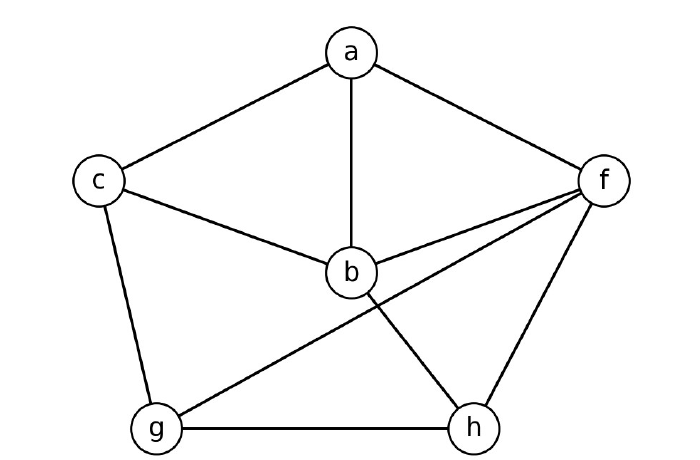
Undirected graph with vertices a, b, c, f, g, h for the DFS traversal question
- A(A), (B) and (D) only
- B(A), (B), (C) and (D)
- C(B), (C) and (D) only
- D(A), (C) and (D) only
Answer: (D) (A), (C) and (D) only
Explanation
Sign in to read the full explanationQuestion 64
Let ε=0.0005. and Let Re be the relation {(x,y) ∈ R² : |x−y| < ε}. Re could be interpreted as the relation approximately equal. Re is
A. Reflexive
B. Symmetric
C. transitive
Choose the correct answer from the options given below:- A(A) and (B) only true
- B(B) and (C) only true
- C(A) and (C) only true
- D(A), (B) and (C) true
Answer: (A) (A) and (B) only true
Explanation
Sign in to read the full explanationQuestion 65
In reference to Big data, consider the following database:
A. Memcached
B. Couch DB
C. Infinite graph
Choose the most appropriate answer from the options given below:- A(A) and (B) only
- B(B) and (C) only
- C(C) and (A) only
- D(A), (B) and (C)
Answer: (D) (A), (B) and (C)
Explanation
Sign in to read the full explanationQuestion 66
Match List I with List II regarding normal forms.
List-I List-II A. BCNF I. Removes multivalued dependency B. 3NF II. Not always dependency preserving C. 2NF III. Removes transitive dependency D. 4NF IV. Removes partial functional dependency - A(A)-(III), (B)-(II), (C)-(IV), (D)-(I)
- B(A)-(II), (B)-(IV), (C)-(I), (D)-(III)
- C(A)-(II), (B)-(III), (C)-(IV), (D)-(I)
- D(A)-(II), (B)-(I), (C)-(IV), (D)-(III)
Answer: (C) (A)-(II), (B)-(III), (C)-(IV), (D)-(I)
Explanation
Sign in to read the full explanationQuestion 67
Match List I with List II regarding software design concepts.
List-I List-II A. Localization I. Encapsulation B. Packaging or binding of a collection of items II. Abstraction C. Mechanism that enables designer to focus on essential details of a program component III. Characteristic of software that indicates the manner in which information is concentrated in program D. Information hiding IV. Suppressing the operational details of a program component - A(A)-(I), (B)-(II), (C)-(III), (D)-(IV)
- B(A)-(II), (B)-(I), (C)-(III), (D)-(IV)
- C(A)-(III), (B)-(I), (C)-(II), (D)-(IV)
- D(A)-(III), (B)-(I), (C)-(IV), (D)-(II)
Answer: (C) (A)-(III), (B)-(I), (C)-(II), (D)-(IV)
Explanation
Sign in to read the full explanationQuestion 68
Match List I with List II regarding the Chomsky hierarchy.
List-I List-II A. Type 0 I. Finite automata B. Type 1 II. Turing machine C. Type 2 III. Linear bound automata D. Type 3 IV. Pushdown automata - A(A)-(III), (B)-(IV), (C)-(II), (D)-(I)
- B(A)-(II), (B)-(III), (C)-(IV), (D)-(I)
- C(A)-(III), (B)-(IV), (C)-(I), (D)-(II)
- D(A)-(II), (B)-(III), (C)-(II), (D)-(IV)
Answer: (B) (A)-(II), (B)-(III), (C)-(IV), (D)-(I)
Explanation
Sign in to read the full explanationQuestion 69
Match List I with List II regarding knowledge representation.
List-I List-II A. Ontological Engineering I. Organizing subclass relations B. Taxonomy Hierarchy II. Organizing knowledge into category and sub category C. Inheritance III. Attaches a number with each possibility D. Probability mode IV. Representing concepts, events, time, physical concepts of different domains - A(A)-(II), (B)-(I), (C)-(IV), (D)-(III)
- B(A)-(I), (B)-(II), (C)-(III), (D)-(IV)
- C(A)-(IV), (B)-(III), (C)-(I), (D)-(II)
- D(A)-(IV), (B)-(I), (C)-(II), (D)-(III)
Answer: (D) (A)-(IV), (B)-(I), (C)-(II), (D)-(III)
Explanation
Sign in to read the full explanationQuestion 70
Match List I with List II regarding operating system concepts.
List-I List-II A. Least frequently used I. Memory is distributed among processors B. Critical Section II. Page replacement policy in cache memory C. Loosely coupled multiprocessor system III. Program section that once begin must complete execution before another processor access the same shared resource D. Distributed operating system organization IV. O/S routines are distributed among available processors - A(A)-(III), (B)-(II), (C)-(IV), (D)-(I)
- B(A)-(I), (B)-(II), (C)-(III), (D)-(IV)
- C(A)-(II), (B)-(III), (C)-(I), (D)-(IV)
- D(A)-(II), (B)-(I), (C)-(III), (D)-(IV)
Answer: (C) (A)-(II), (B)-(III), (C)-(I), (D)-(IV)
Explanation
Sign in to read the full explanationQuestion 71
Match List I with List II regarding systems concepts.
List-I List-II A. Firmware I. Number of logical records into physical blocks B. Batch file II. ASCII format C. Packing III. Resource allocation D. Banker's Algorithm IV. ROM - A(A)-(II), (B)-(I), (C)-(IV), (D)-(III)
- B(A)-(II), (B)-(I), (C)-(III), (D)-(IV)
- C(A)-(IV), (B)-(II), (C)-(I), (D)-(III)
- D(A)-(IV), (B)-(I), (C)-(II), (D)-(III)
Answer: (C) (A)-(IV), (B)-(II), (C)-(I), (D)-(III)
Explanation
Sign in to read the full explanationQuestion 72
Match List I with List II regarding cryptographic key sizes.
List-I List-II A. DES I. Key size - 256 B. AES II. Key size - 1024 C. 3 DES III. Key size - 56 D. RSA IV. Key size - 168 - A(A)-(I), (B)-(II), (C)-(IV), (D)-(III)
- B(A)-(III), (B)-(I), (C)-(IV), (D)-(II)
- C(A)-(III), (B)-(IV), (C)-(II), (D)-(I)
- D(A)-(IV), (B)-(II), (C)-(III), (D)-(I)
Answer: (B) (A)-(III), (B)-(I), (C)-(IV), (D)-(II)
Explanation
Sign in to read the full explanationQuestion 73
Match List I with List II regarding socket programming calls.
List-I List-II A. BIND I. Block the caller until a connection attempt arrives B. LISTEN II. Give a local address to a socket C. ACCEPT III. Show willingness to accept connections D. SOCKET IV. Create a new point - A(A)-(I), (B)-(III), (C)-(II), (D)-(IV)
- B(A)-(II), (B)-(III), (C)-(I), (D)-(IV)
- C(A)-(III), (B)-(II), (C)-(I), (D)-(IV)
- D(A)-(I), (B)-(II), (C)-(III), (D)-(IV)
Answer: (B) (A)-(II), (B)-(III), (C)-(I), (D)-(IV)
Explanation
Sign in to read the full explanationQuestion 74
Match List I with List II regarding OSI layer functions.
List-I List-II A. Physical layer I. Routing of the signals divide the outgoing message into packets, to act as network controller for routing data B. Data link layer II. Make and break connections, define voltages and data rates, convert data bits into electrical signal C. Network layer III. Synchronization, error detection and correction. To assemble outgoing message into frames D. Presentation layer IV. It works as a translating layer - A(A)-(IV), (B)-(III), (C)-(II), (D)-(I)
- B(A)-(II), (B)-(III), (C)-(IV), (D)-(I)
- C(A)-(IV), (B)-(III), (C)-(I), (D)-(II)
- D(A)-(II), (B)-(III), (C)-(I), (D)-(IV)
Answer: (D) (A)-(II), (B)-(III), (C)-(I), (D)-(IV)
Explanation
Sign in to read the full explanationQuestion 75
Match each algorithm with its running-time complexity.
Algorithm Complexity A. Breadth First Search II. O(V+E) B. Rabin-Karp Algorithm III. θ((n−m+1)m) C. Depth-First Search I. θ(V+E) D. Heap sort (worst case) V. O(n lg n) E. Quick sort (worst case) IV. O(n²) - A(A)-(III), (B)-(II), (C)-(I), (D)-(IV), (E)-(V)
- B(A)-(II), (B)-(III), (C)-(I), (D)-(IV), (E)-(V)
- C(A)-(II), (B)-(III), (C)-(I), (D)-(V), (E)-(IV)
- D(A)-(III), (B)-(I), (C)-(II), (D)-(IV), (E)-(V)
Answer: (C) (A)-(II), (B)-(III), (C)-(I), (D)-(V), (E)-(IV)
Explanation
Sign in to read the full explanationQuestion 76
Match List I with List II regarding classic operating system algorithms.
List-I List-II A. Stack algorithm I. Deadlock B. Elevator algorithm II. Disk scheduling C. Priority scheduling algorithm III. Page replacement D. Havender's algorithm IV. CPU scheduling - A(A)-(III), (B)-(II), (C)-(IV), (D)-(I)
- B(A)-(II), (B)-(III), (C)-(IV), (D)-(I)
- C(A)-(III), (B)-(II), (C)-(I), (D)-(IV)
- D(A)-(II), (B)-(III), (C)-(I), (D)-(IV)
Answer: (A) (A)-(III), (B)-(II), (C)-(IV), (D)-(I)
Explanation
Sign in to read the full explanationQuestion 77
Consider the following statements of approximation algorithm:
Statement I: Vertex-cover is a polynomial time 2-approximation algorithm.
Statement II: TSP-tour is a polynomial time 3-approximation algorithm for travelling salesman problem with the triangle inequality.
Which of the following is correct?- AStatement I true and Statement II false
- BStatement I and Statement II true
- CStatement I false and Statement II true
- DStatement I and Statement II false
Answer: (A) Statement I true and Statement II false
Explanation
Sign in to read the full explanationQuestion 78
Consider the following statements:
Statement I: Conservative 2 PL is a deadlock-free protocol.
Statement II: Thomas's write rule enforces conflict serializability.
Statement III: Timestamp ordering protocol ensures serializability based on the order of transaction timestamps.
Which of the following is correct?- AStatement I, Statement II true and Statement III false
- BStatement I, Statement III true and Statement II false
- CStatement I, Statement II false and Statement III true
- DStatement I, Statement II and Statement III true
Answer: (B) Statement I, Statement III true and Statement II false
Explanation
Sign in to read the full explanationQuestion 79
Consider the following statements:
Statement I: Composite attributes cannot be divided into smaller subparts.
Statement II: Complex attribute is formed by nesting composite attributes and multi-valued attributes in an arbitrary way.
Statement III: A derived attribute is an attribute whose values are computed from other attribute.
Which of the following is correct?- AStatement I, Statement II and Statement III are true
- BStatement I true and Statement II, Statement III false
- CStatement I, Statement II true and Statement III false
- DStatement I false and Statement II, Statement III true
Answer: (D) Statement I false and Statement II, Statement III true
Explanation
Sign in to read the full explanationQuestion 80
A top down approach to programming calls for :
Statement I: Working from the general to the specific.
Statement II: Postpone the minor decisions.
Statement III: A systematic approach.
Statement IV: Intermediate coding of the problem.
Which of the following is true?- AStatement I only
- BStatement I and Statement II only
- CStatement I, Statement II and Statement III only
- DStatement I, Statement II and Statement IV only
Answer: (C) Statement I, Statement II and Statement III only
Explanation
Sign in to read the full explanationQuestion 81
Consider the following statements:
Statement I: LALR parser is more powerful than canonical LR Parser.
Statement II: SLR parser is more powerful than LALR
Which of the following is correct?- AStatement I true and Statement II false
- BStatement I false and Statement II true
- CBoth Statement I and Statement II false
- DBoth Statement I and Statement II true
Answer: (C) Both Statement I and Statement II false
Explanation
Sign in to read the full explanationQuestion 82
Consider the following statements about Context Free Language (CFL):
Statement I: CFL is closed under homomorphism.
Statement II: CFL is closed under complement.
Which of the following is correct?- AStatement I is true and Statement II is false
- BStatement II is true and Statement I is false
- CBoth Statement I and Statement II are true
- DNeither Statement I nor Statement II is true
Answer: (A) Statement I is true and Statement II is false
Explanation
Sign in to read the full explanationQuestion 83
Consider the following in Boolean Algebra:
X : a ∨ (b ∧ (a ∨ c)) = (a ∨ b) ∧ (a ∨ c)
Y : a ∧ (b ∨ (a ∧ c)) = (a ∧ b) ∨ (a ∧ c)
a ∨ (b ∧ c) = (a ∨ b) ∧ c is satisfied if- AX is true
- BY is true
- CBoth X and Y are true
- DIt does not depend on X and Y
Answer: (D) It does not depend on X and Y
Explanation
Sign in to read the full explanationQuestion 84
A good software requirement specification does NOT have the characteristic
- ACompleteness
- BConsistency
- CClarity
- DReliability
Answer: (D) Reliability
Explanation
Sign in to read the full explanationQuestion 85
Assertion (A): p̅
Reason (R): (r → q̅, r ∨ s, s → q̅, p → q)
In the light of the above statements, choose the correct answer from the options given below:- ABoth (A) and (R) are true and (R) is the correct explanation of (A)
- BBoth (A) and (R) are true but (R) is NOT the correct explanation of (A)
- C(A) is true but (R) is false
- D(A) is false but (R) is true
Answer: (A) Both (A) and (R) are true and (R) is the correct explanation of (A)
Explanation
Sign in to read the full explanationQuestion 86
Of the following, which is NOT a logical error?
- AUsing the '=', instead of '==' to determine if two values are equal
- BDivide by zero
- CFailing to initialize counter and total variables before the body of loop
- DUsing commas instead of two required semicolon in a for loop header
Answer: (B) Divide by zero
Explanation
Sign in to read the full explanationQuestion 87
Assertion (A): A load-and-go assembler avoids the overhead of writing the object program out and reading it back in.
Reason (R): This can be done with either one-pass or two pass assembler.
In the light of the above statements, choose the correct answer from the options given below:- ABoth (A) and (R) are true and (R) is the correct explanation of (A)
- BBoth (A) and (R) are true but (R) is NOT the correct explanation of (A)
- C(A) is true but (R) is false
- D(A) is false but (R) is true
Answer: (C) (A) is true but (R) is false
Explanation
Sign in to read the full explanationQuestion 88
Which statement is false?
- AAll function calls in C pass arguments using call by value.
- BCall by reference enables a called function to modify a variable in calling function.
- CCall by value is always more efficient than call by reference.
- DProgrammers use pointers and indirection operation to simulate call by reference.
Answer: (C) Call by value is always more efficient than call by reference.
Explanation
Sign in to read the full explanationQuestion 89
Given below are two statements:
Statement I: "Grandparent is a parent of one's parent".
Statement II: First Order Predicate Logic (FOPL) representation of above statement is
∀ g, c grandparent(g, c) ⇔ ∃ p parent(g, p) ∧ parent(p, c)
In the light of the above statements, choose the most appropriate answer from the options given below:- ABoth Statement I and Statement II are correct
- BBoth Statement I and Statement II are incorrect
- CStatement I is correct but Statement II is incorrect
- DStatement I is incorrect but Statement II is correct
Answer: (A) Both Statement I and Statement II are correct
Explanation
Sign in to read the full explanationQuestion 90
Given below are two statements:
Statement I: Consider 20 bit 'Branch' microinstruction code format given below:
F1(3) | F2(3) | F3(3) | CD(2) | BR(2) | AD(7)
F1, F2, F3 : Micro-operation fields
CD : Condition for branching
BR : Branch field
AD : Address field
Statement II: Instruction represented in above format can perform branch in 4 conditions.
In the light of the above statements, choose the most appropriate answer from the options given below:- ABoth Statement I and Statement II are correct
- BBoth Statement I and Statement II are incorrect
- CStatement I is correct but Statement II is incorrect
- DStatement I is incorrect but Statement II is correct
Answer: (A) Both Statement I and Statement II are correct
Explanation
Sign in to read the full explanationQuestion 91
Which of the following relational algebra query computes the Sid's of sailors with age over 20 who have not reserved a red boat?
Consider the relational schema of Sailors S, Reserves R, and Boats B given below.
Table 1: Sailors S
Sid Sname Rating Age 22 Dustin 7 45.0 29 Brutus 1 33.0 31 Lubber 8 55.5 32 Andy 8 25.5 58 Rusty 10 35.0 64 Horatio 7 35.0 71 Zorba 10 16.0 74 Horatio 9 35.0 85 Art 3 25.5 95 Bob 3 63.5 Table 2: Reserves R
Sid Bid Day 22 101 10/10/98 22 102 10/10/98 22 103 10/8/98 22 104 10/7/98 31 102 11/10/98 31 103 11/6/98 31 104 11/12/98 64 101 9/5/98 64 102 9/8/98 74 103 9/8/98 Table 3: Boats B
Bid Bname Color 101 Interlake blue 102 Interlake red 103 Clipper green 104 Marine red - Aπ sid (σ age > 20 Sailors) − π sid ((σ color = red Boats) ⋈ Reserves ⋈ Sailors)
- Bπ sid ((σ color ≠ red ∧ age > 20 (Boats ⋈ Sailors ⋈ Reserves)))
- Cπ sid (σ age > 20 Sailors) − π sid ((σ color = red Boats) ⋈ Reserves ⋈ Sailors)
- Dπ sid (σ age > 20 Sailors) ∧ π sid ((σ color ≠ red Boats) ⋈ Reserves ⋈ Sailors)
Accepted answers: (A) π sid (σ age > 20 Sailors) − π sid ((σ color = red Boats) ⋈ Reserves ⋈ Sailors), (C) π sid (σ age > 20 Sailors) − π sid ((σ color = red Boats) ⋈ Reserves ⋈ Sailors)
Explanation
Sign in to read the full explanationQuestion 92
Which of the following relational algebra query/queries computes/compute the names of sailors who have reserved a red boat?
Q1: π sname ((σ color = red Boats) ⋈ Reserves ⋈ Sailors)
Q2: π sname (π sid ((π bid σ color = red Boats) ⋈ Reserves) ⋈ Sailors)
Q3: π sname ((σ color = red Reserves) ⋈ Boats ⋈ Sailors)Consider the relational schema of Sailors S, Reserves R, and Boats B given below.
Table 1: Sailors S
Sid Sname Rating Age 22 Dustin 7 45.0 29 Brutus 1 33.0 31 Lubber 8 55.5 32 Andy 8 25.5 58 Rusty 10 35.0 64 Horatio 7 35.0 71 Zorba 10 16.0 74 Horatio 9 35.0 85 Art 3 25.5 95 Bob 3 63.5 Table 2: Reserves R
Sid Bid Day 22 101 10/10/98 22 102 10/10/98 22 103 10/8/98 22 104 10/7/98 31 102 11/10/98 31 103 11/6/98 31 104 11/12/98 64 101 9/5/98 64 102 9/8/98 74 103 9/8/98 Table 3: Boats B
Bid Bname Color 101 Interlake blue 102 Interlake red 103 Clipper green 104 Marine red - ABoth Q1 and Q2
- BBoth Q2 and Q3
- COnly Q1
- DOnly Q2
Answer: (A) Both Q1 and Q2
Explanation
Sign in to read the full explanationQuestion 93
Which of the following relational algebra query/queries computes/compute the name of sailors who have reserved boat 103?
Q1: π sname ((σ bid = 103 Boats) ⋈ Sailors)
Q2: π sname (σ bid = 103 (Reserves ⋈ Sailors))
Q3: π sname ((σ bid = 103 Reserves) ⋈ Sailors)Consider the relational schema of Sailors S, Reserves R, and Boats B given below.
Table 1: Sailors S
Sid Sname Rating Age 22 Dustin 7 45.0 29 Brutus 1 33.0 31 Lubber 8 55.5 32 Andy 8 25.5 58 Rusty 10 35.0 64 Horatio 7 35.0 71 Zorba 10 16.0 74 Horatio 9 35.0 85 Art 3 25.5 95 Bob 3 63.5 Table 2: Reserves R
Sid Bid Day 22 101 10/10/98 22 102 10/10/98 22 103 10/8/98 22 104 10/7/98 31 102 11/10/98 31 103 11/6/98 31 104 11/12/98 64 101 9/5/98 64 102 9/8/98 74 103 9/8/98 Table 3: Boats B
Bid Bname Color 101 Interlake blue 102 Interlake red 103 Clipper green 104 Marine red - ABoth Q1 and Q3
- BBoth Q2 and Q3
- COnly Q3
- DOnly Q2
Answer: (B) Both Q2 and Q3
Explanation
Sign in to read the full explanationQuestion 94
Which of the following relational algebra query computes the names of sailor who have reserved all boats?
Consider the relational schema of Sailors S, Reserves R, and Boats B given below.
Table 1: Sailors S
Sid Sname Rating Age 22 Dustin 7 45.0 29 Brutus 1 33.0 31 Lubber 8 55.5 32 Andy 8 25.5 58 Rusty 10 35.0 64 Horatio 7 35.0 71 Zorba 10 16.0 74 Horatio 9 35.0 85 Art 3 25.5 95 Bob 3 63.5 Table 2: Reserves R
Sid Bid Day 22 101 10/10/98 22 102 10/10/98 22 103 10/8/98 22 104 10/7/98 31 102 11/10/98 31 103 11/6/98 31 104 11/12/98 64 101 9/5/98 64 102 9/8/98 74 103 9/8/98 Table 3: Boats B
Bid Bname Color 101 Interlake blue 102 Interlake red 103 Clipper green 104 Marine red - Aρ (Tempsids, (π bid Reserves) / π bid Boats) π sname ((Tempsids) ⋈ Sailors)
- Bρ (Tempsids, (π sid,bid Reserves) / π bid Boats) π sname ((Tempsids) ⋈ Sailors)
- Cρ (Tempsids, (π sid Sailors) / π bid Boats) π sname ((Tempsids) ⋈ Sailors)
- Dρ (Tempsids, (π sid Reserves) / π bid Boats) π sname ((Tempsids) ⋈ Boats)
Answer: (B) ρ (Tempsids, (π sid,bid Reserves) / π bid Boats) π sname ((Tempsids) ⋈ Sailors)
Explanation
Sign in to read the full explanationQuestion 95
Which of the following relational algebra query computes the names of sailors who have reserved a red and a green boat?
Consider the relational schema of Sailors S, Reserves R, and Boats B given below.
Table 1: Sailors S
Sid Sname Rating Age 22 Dustin 7 45.0 29 Brutus 1 33.0 31 Lubber 8 55.5 32 Andy 8 25.5 58 Rusty 10 35.0 64 Horatio 7 35.0 71 Zorba 10 16.0 74 Horatio 9 35.0 85 Art 3 25.5 95 Bob 3 63.5 Table 2: Reserves R
Sid Bid Day 22 101 10/10/98 22 102 10/10/98 22 103 10/8/98 22 104 10/7/98 31 102 11/10/98 31 103 11/6/98 31 104 11/12/98 64 101 9/5/98 64 102 9/8/98 74 103 9/8/98 Table 3: Boats B
Bid Bname Color 101 Interlake blue 102 Interlake red 103 Clipper green 104 Marine red - Aρ (Tempred, π sid ((σ color = 'red' Boats) ⋈ Reserves)), ρ (Tempgreen, π sid ((σ color = 'green' Boats) ⋈ Reserves)), π sname (Tempred ∩ Tempgreen) ⋈ Sailors
- Bρ (Tempboats 2, (σ color = 'red' Boats) ∩ (σ color = 'green' Boats)) π sname (Tempboats 2 ⋈ Reserves)
- Cπ sname ((σ color = 'red' Boats) ∩ (σ color = 'green' Boats) (Tempboats 2 ⋈ Sailors ⋈ Reserves))
- Dρ (Tempboats 2, (σ color = 'red' ∧ color = 'green' Boats)) π sname (Tempboats 2 ⋈ Sailors)
Answer: (A) ρ (Tempred, π sid ((σ color = 'red' Boats) ⋈ Reserves)), ρ (Tempgreen, π sid ((σ color = 'green' Boats) ⋈ Reserves)), π sname (Tempred ∩ Tempgreen) ⋈ Sailors
Explanation
Sign in to read the full explanationQuestion 96
Based on the passage, the transmission and propagation delays are respectively
A 3000 km long trunk operates at 1.536 mbps and is used to transmit 64 bytes frames and uses sliding window protocol. The propagation speed is 6 μ sec/km.
- AT = 333.33 μ sec, T = 18000 μ sec
- BT = 300 μ sec, T = 15360 μ sec
- CT = 83.33 μ sec, T = 1800 μ sec
- DT = 1800 μ sec, T = 33.33 μ sec
Answer: (A) T = 333.33 μ sec, T = 18000 μ sec
Explanation
Sign in to read the full explanationQuestion 97
Based on the passage, the minimum number of bits required in the sequence number field of the packet is
A 3000 km long trunk operates at 1.536 mbps and is used to transmit 64 bytes frames and uses sliding window protocol. The propagation speed is 6 μ sec/km.
- A6 bits
- B7 bits
- C5 bits
- D4 bits
Answer: (B) 7 bits
Explanation
Sign in to read the full explanationQuestion 98
Based on the passage, the sender window size to get the maximum efficiency is
A 3000 km long trunk operates at 1.536 mbps and is used to transmit 64 bytes frames and uses sliding window protocol. The propagation speed is 6 μ sec/km.
- A108
- B109
- C55
- D56
Answer: (B) 109
Explanation
Sign in to read the full explanationQuestion 99
Based on the passage, if only 6 bits are reserved for sequence number field, then the efficiency of the system is:
A 3000 km long trunk operates at 1.536 mbps and is used to transmit 64 bytes frames and uses sliding window protocol. The propagation speed is 6 μ sec/km.
- A0.587
- B0.875
- C0.578
- D0.50
Answer: (A) 0.587
Explanation
Sign in to read the full explanationQuestion 100
Based on the passage, the maximum achievable throughput is
A 3000 km long trunk operates at 1.536 mbps and is used to transmit 64 bytes frames and uses sliding window protocol. The propagation speed is 6 μ sec/km.
- A0.768
- B0.678
- C0.901
- D0.887
Answer: (C) 0.901
Explanation
Sign in to read the full explanation
Frequently asked questions
How many questions were in the UGC NET Computer Science & Applications October 2022 exam?
Paper 1 had 50 questions and Paper 2 (Computer Science & Applications) had 100 questions, for 150 in total across 3 hours.
Is there negative marking in UGC NET?
No. Each correct answer earns 2 marks and there is no penalty for a wrong answer, so leaving a question blank is never better than attempting it.
Are the October 2022 answers on this page official?
Answers follow the official NTA answer key for this session. If you spot a discrepancy, use the report option inside the practice test and we will review it.
Can I attempt the October 2022 paper as a timed mock test?
Yes. Every paper on this page has an "Attempt this paper" button that opens the same questions in the timed test interface, with instant scoring and weak-area analysis afterwards.
Want the full mock experience?
Attempt Paper 1 + Paper 2 (Computer Science & Applications) together in a single timed session.
Every Computer Science & Applications PYQ on one topic
More Computer Science & Applications practice
Practice Paper 1 from other subjects
Every subject's exam sitting has its own Paper 1 (General Aptitude) set — more real PYQs to solve.