UGC NET Computer Science & Applications June 2025 Question PaperPaper 1 & Paper 2 with Answer Key
The complete UGC NET June 2025 question paper for Computer Science & Applications, covering Paper 1 (General Aptitude) and Paper 2 (Computer Science & Applications). Every question below is shown with its options and the correct answer, and a detailed explanation you can unlock by signing in. All 150 questions are free to practise.
UGC NET June 2025 at a glance
| Exam | UGC NET June 2025 |
|---|---|
| Papers | Paper 1 (General Aptitude) and Paper 2 (Computer Science & Applications) |
| Exam date(s) | June 26, 2025 |
| Shift(s) | Shift 1 |
| Paper 1 questions | 50 questions · 60 minutes · 100 marks |
| Paper 2 questions | 100 questions · 120 minutes · 200 marks |
| Total | 150 questions |
| Marking scheme | +2 per correct answer · No negative marking |
General Aptitude
UGC NET June 2025 · Computer Science & Applications sitting
Paper 1 — General Aptitude
Attempt this paper50 questions with the answer key and explanations.
Question 1
What is the average of the number of students scoring 50 or more but less than 60 marks in Punjabi and in Hindi?
Marks (out of 100) Cumulative percentage of Hindi and Punjabi students Cumulative number of Hindi students 80 and above 15% 108 70 and above 35% 264 60 and above 65% 424 50 and above 90% 554 40 and above 100% 624 Marks-wise distribution of students. Total students: 1200; no student failed; each student appeared in either Hindi or Punjabi.
- A180
- B150
- C200
- D140
Answer: (B) 150
Explanation
Sign in to read the full explanationQuestion 2
What is the difference between the number of Punjabi students scoring 70 or more but less than 80 marks and Hindi students scoring 40 or more but less than 50 marks?
Marks (out of 100) Cumulative percentage of Hindi and Punjabi students Cumulative number of Hindi students 80 and above 15% 108 70 and above 35% 264 60 and above 65% 424 50 and above 90% 554 40 and above 100% 624 Marks-wise distribution of students. Total students: 1200; no student failed; each student appeared in either Hindi or Punjabi.
- A20
- B16
- C14
- D30
Answer: (C) 14
Explanation
Sign in to read the full explanationQuestion 3
What is the ratio of Hindi students scoring 50 or more but less than 60 marks to Punjabi students scoring 40 or more but less than 50 marks?
Marks (out of 100) Cumulative percentage of Hindi and Punjabi students Cumulative number of Hindi students 80 and above 15% 108 70 and above 35% 264 60 and above 65% 424 50 and above 90% 554 40 and above 100% 624 Marks-wise distribution of students. Total students: 1200; no student failed; each student appeared in either Hindi or Punjabi.
- A7:3
- B8:7
- C9:4
- D13:5
Answer: (D) 13:5
Explanation
Sign in to read the full explanationQuestion 4
What is the sum of Hindi students scoring 70 or more but less than 80 marks and Punjabi students scoring 80 or more marks?
Marks (out of 100) Cumulative percentage of Hindi and Punjabi students Cumulative number of Hindi students 80 and above 15% 108 70 and above 35% 264 60 and above 65% 424 50 and above 90% 554 40 and above 100% 624 Marks-wise distribution of students. Total students: 1200; no student failed; each student appeared in either Hindi or Punjabi.
- A330
- B228
- C272
- D284
Answer: (B) 228
Explanation
Sign in to read the full explanationQuestion 5
The number of Hindi students scoring 80 or more is what percentage less than the number of Punjabi students scoring 60 or more but less than 70?
Marks (out of 100) Cumulative percentage of Hindi and Punjabi students Cumulative number of Hindi students 80 and above 15% 108 70 and above 35% 264 60 and above 65% 424 50 and above 90% 554 40 and above 100% 624 Marks-wise distribution of students. Total students: 1200; no student failed; each student appeared in either Hindi or Punjabi.
- A46%
- B54%
- C44%
- D52%
Answer: (A) 46%
Explanation
Sign in to read the full explanationQuestion 6
Standard deviation (S) and coefficient of variation (CV, as a percentage) are given below. Compute each mean and arrange them in ascending order.
A. S = 4, CV = 40/9
B. S = 5, CV = 62.5
C. S = 14, CV = 70/3
D. S = 16, CV = 160/7Choose the correct answer.
- AB, A, C, D
- BC, D, B, A
- CA, D, B, C
- DD, B, C, A
Answer: (A) B, A, C, D
Explanation
Sign in to read the full explanationQuestion 7
Which are the risks of plagiarism for a researcher who plagiarises?
A. Losing the inspiration
B. Losing obtained titles
C. Destruction of obtained solutions
D. Destroying the public imageChoose the most appropriate answer.
- AA and C only
- BB and C only
- CB and D only
- DC and D only
Answer: (C) B and D only
Explanation
Sign in to read the full explanationQuestion 8
The role of a teacher in the simulation model is that of
- AExplaining
- BDesigning
- CDescribing
- DChoosing activity
Answer: (B) Designing
Explanation
Sign in to read the full explanationQuestion 9
Match List-I with List-II.
List-I: institution List-II: function A. NIEPA IV. Promoting research in planning and management B. RUSA III. Infrastructure development for upgrading colleges into model colleges C. QAA I. Ensuring quality D. HEFA II. Providing loans to higher-education institutions Match List-I with List-II.
- AA-I, B-III, C-II, D-IV
- BA-I, B-II, C-III, D-IV
- CA-I, B-IV, C-III, D-II
- DA-IV, B-III, C-I, D-II
Answer: (D) A-IV, B-III, C-I, D-II
Explanation
Sign in to read the full explanationQuestion 10
Learning for all implies:
A. Inclusive Education
B. Equitable Education
C. Inclusive and Equitable Education
D. Quality Education
E. Categorized based Education- AA, B and D only
- BA and E only
- CC only
- DD only
Answer: (C) C only
Explanation
Sign in to read the full explanationQuestion 11
Match List-I with List-II.
List-I: learning style List-II: strength A. Convergent II. Practical application of ideas B. Divergent IV. Imaginative ability and generation of ideas C. Assimilation I. Creating theoretical model D. Accommodative III. Carrying out plans and tasks involving new experiences Match List-I with List-II.
- AA-I, B-II, C-III, D-IV
- BA-II, B-I, C-III, D-IV
- CA-II, B-IV, C-I, D-III
- DA-IV, B-I, C-III, D-II
Answer: (C) A-II, B-IV, C-I, D-III
Explanation
Sign in to read the full explanationQuestion 12
Which is the correct sequence of increasing access time of storage/memory devices?
A. Magnetic tape
B. RAM
C. Cache memory
D. Hard disk
E. Registers- AA, B, C, D, E
- BB, E, C, A, D
- CE, C, B, D, A
- DC, E, B, A, D
Answer: (C) E, C, B, D, A
Explanation
Sign in to read the full explanationQuestion 13
Who directed the first film made in India?
- ASatyajit Ray
- BDadasaheb Phalke
- CPrithviraj Kapoor
- DArdeshir Irani
Answer: (B) Dadasaheb Phalke
Explanation
Sign in to read the full explanationQuestion 14
As per National Education Policy 1986, the major functions of the National Apex Body are:
A. To allocate resources
B. To evaluate the examination system
C. To advise government on policy
D. To encourage interdisciplinarity and interfaces among different areas
E. To conduct research in higher educationChoose the correct answer.
- AA, C and E only
- BB, D and E only
- CC, D and E only
- DA, C and D only
Answer: (D) A, C and D only
Explanation
Sign in to read the full explanationQuestion 15
Arrange the following events in correct chronological order.
A. Establishment of the University of Madras
B. Introduction of the Indian Universities Act
C. Establishment of UGC
D. First National Education Policy of India- AA, B, C, D
- BA, D, C, B
- CB, C, A, D
- DC, B, A, D
Answer: (A) A, B, C, D
Explanation
Sign in to read the full explanationQuestion 16
According to classical Indian logic, which instrument of knowledge is knowledge of the relation between a word and its denotation, produced through knowledge of resemblance or similarity?
- APratyaksa (perception)
- BAnumana (inference)
- CUpamana (comparison)
- DSabda (verbal testimony)
Answer: (C) Upamana (comparison)
Explanation
Sign in to read the full explanationQuestion 17
Increasing the ratio of fissile uranium (U-235) in natural uranium is known as
- AEnhancement
- BConcentration
- CAccumulation
- DEnrichment
Answer: (D) Enrichment
Explanation
Sign in to read the full explanationQuestion 18
Which statements about coliform bacteria are true?
A. They are used to test water contamination.
B. Coliform bacteria are harmless and cause no disease.
C. They are found naturally in the human intestinal tract.
D. Their presence in water indicates faecal contamination.Choose the most appropriate answer.
- AA and D only
- BB and C only
- CA, C and D only
- DA, B, C and D
Answer: (C) A, C and D only
Explanation
Sign in to read the full explanationQuestion 19
When a producer allows 36% commission on the retail price, the profit is 8.8%. What is the profit if commission is reduced by 24%?
- A36.6%
- B49.6%
- C59.6%
- D45.6%
Answer: (B) 49.6%
Explanation
Sign in to read the full explanationQuestion 20
With reference to cyber attacks, which statements are correct?
A. Malware is malicious software designed to cause damage to a computer, server, or network.
B. Malware includes viruses, worms, Trojan horses, ransomware, and spyware.
C. Pegasus is ransomware.
D. India is not a signatory to the Budapest Convention on Cybercrime.Choose the most appropriate answer.
- AA, B and C only
- BB, C and D only
- CA, B, C and D
- DA, B and D only
Answer: (D) A, B and D only
Explanation
Sign in to read the full explanationQuestion 21
Which international organisation coordinates the Education for All programme globally?
- AUNDP
- BUNESCO
- CIMF
- DUNEP
Answer: (B) UNESCO
Explanation
Sign in to read the full explanationQuestion 22
In the ancient period, the Diksha Guru performed duty as a
- AGuru of secular subjects
- BSpiritual guide for both girls and boys
- CSpiritual guide of boys
- DTutor
Answer: (C) Spiritual guide of boys
Explanation
Sign in to read the full explanationQuestion 23
Find the number replacing the question mark: 7, 12, 32, 122, ?, 3602, 25202.
- A602
- B610
- C702
- D622
Answer: (A) 602
Explanation
Sign in to read the full explanationQuestion 24
Arrange the following in increasing order of extension.
A. Social Science
B. Political Science
C. Sciences
D. Politics of International Relations- AC, A, B, D
- BA, C, B, D
- CB, D, A, C
- DD, B, A, C
Answer: (D) D, B, A, C
Explanation
Sign in to read the full explanationQuestion 25
What is explanatory research?
- AIt studies a subject about which no or limited information is available.
- BIt describes social situations, events, systems, or structures.
- CIt explains the causes of social phenomena.
- DIt is based on accumulated common-sense beliefs.
Answer: (C) It explains the causes of social phenomena.
Explanation
Sign in to read the full explanationQuestion 26
Match List-I with List-II.
List-I: operating system/program List-II: task A. UNIX IV. Multi-user operating system B. MS-DOS III. Single-user operating system C. Android OS II. Mobile device D. Utility programs I. Assist users in system-maintenance tasks Match List-I with List-II.
- AA-III, B-IV, C-I, D-II
- BA-I, B-II, C-IV, D-III
- CA-IV, B-III, C-II, D-I
- DA-II, B-I, C-I, D-IV
Answer: (C) A-IV, B-III, C-II, D-I
Explanation
Sign in to read the full explanationQuestion 27
Match List-I with List-II.
List-I: meaning List-II: term A. Who II. Communicator B. Says what III. Message C. In which channel IV. Medium D. To whom I. Receiver Match List-I with List-II.
- AA-III, B-II, C-I, D-IV
- BA-I, B-IV, C-III, D-II
- CA-II, B-III, C-IV, D-I
- DA-IV, B-II, C-I, D-III
Answer: (C) A-II, B-III, C-IV, D-I
Explanation
Sign in to read the full explanationQuestion 28
Why is the concentration of CO₂ higher in the Northern Hemisphere than in the Southern Hemisphere?
A. Land mass is greater in the Northern Hemisphere.
B. Ocean area is greater in the Southern Hemisphere.
C. More fossil fuel is burnt in the Northern Hemisphere.
D. The Northern Hemisphere is colder.Choose the most appropriate answer.
- AA and C only
- BB, C and D only
- CA, B and C only
- DB and D only
Answer: (A) A and C only
Explanation
Sign in to read the full explanationQuestion 29
The CBCS (Choice Based Credit System) in higher education promotes
- ARigid curriculum structure
- BFlexibility in course selection
- CLimited student choices
- DOnly theoretical learning
Answer: (B) Flexibility in course selection
Explanation
Sign in to read the full explanationQuestion 30
Which statements contradict each other?
A. All ducks are birds.
B. Some ducks are birds.
C. Some ducks are not birds.
D. No ducks are birds.Choose the most appropriate answer.
- AA and D only
- BB and C only
- CB and D only
- DC and D only
Answer: (A) A and D only
Explanation
Sign in to read the full explanationQuestion 31
Which is an example of IEEE 802.3?
- ALAN
- BMAN
- CWAN
- DPAN
Answer: (A) LAN
Explanation
Sign in to read the full explanationQuestion 32
A sum was put at simple interest for 3 years. At a rate 1% higher, it would have fetched ₹5,100 more. Find the sum.
- A₹170,000
- B₹150,000
- C₹175,000
- D₹200,000
Answer: (A) ₹170,000
Explanation
Sign in to read the full explanationQuestion 33
Which technology was used in the second generation of computers?
- AVacuum tubes
- BTransistors
- CIntegrated circuits
- DVLSI
Answer: (B) Transistors
Explanation
Sign in to read the full explanationQuestion 34
What is exploratory research?
- AIt describes social situations, events, systems, or structures.
- BIt studies a subject about which no or limited information is available.
- CIt explains causes of social phenomena.
- DIt is based on accumulated common-sense beliefs.
Answer: (B) It studies a subject about which no or limited information is available.
Explanation
Sign in to read the full explanationQuestion 35
Which statement(s) is/are wrong?
A. Aman runs at 20 km/hr and covers 400 m in 8 minutes.
B. A person travels equal distances at x km/hr and y km/hr; the average speed is 2xy/(x+y) km/hr.
C. A cyclist covers 750 m in 2.5 minutes; the speed is 18 km/hr.
D. x km/hr equals 5x/18 m/sec.Choose the most appropriate answer.
- AA only
- BA and B only
- CA and C only
- DB, C and D only
Answer: (A) A only
Explanation
Sign in to read the full explanationQuestion 36
Match List-I with List-II.
List-I: population mean (μ) and mean of x² List-II: population standard deviation (σ) A. μ = 9, (1/N)Σxᵢ² = 117 III. 6 B. μ = 10, (1/N)Σxᵢ² = 200 I. 10 C. μ = 11, (1/N)Σxᵢ² = 202 IV. 9 D. μ = 12, (1/N)Σxᵢ² = 160 II. 4 Match List-I with List-II.
- AA-III, B-IV, C-I, D-II
- BA-II, B-I, C-IV, D-III
- CA-III, B-I, C-IV, D-II
- DA-I, B-IV, C-II, D-III
Answer: (C) A-III, B-I, C-IV, D-II
Explanation
Sign in to read the full explanationQuestion 37
In a code language, NOIDA is written as 1, 4, 9, 15, 14 and INDIA as 1, 9, 4, 14, 9. How will HELLO be written?
- A15, 12, 12, 5, 8
- B5, 12, 12, 15, 8
- C8, 5, 12, 12, 15
- D12, 5, 12, 8, 15
Answer: (A) 15, 12, 12, 5, 8
Explanation
Sign in to read the full explanationQuestion 38
What is the correct sequence, from initial to final, of surface wastewater treatment?
A. Disinfection
B. Sedimentation
C. Filtration
D. Screening- AA, B, C, D
- BA, B, D, C
- CD, B, A, C
- DD, B, C, A
Answer: (D) D, B, C, A
Explanation
Sign in to read the full explanationQuestion 39
Who directed the first talkie feature film made in India?
- AArdeshir Irani
- BRitwik Ghatak
- CDadasaheb Phalke
- DBimal Roy
Answer: (A) Ardeshir Irani
Explanation
Sign in to read the full explanationQuestion 40
“This is the richest fraternity on campus; therefore Mr. X, a member of it, must be one of the richest young men on campus.” Which fallacy is involved?
- AFallacy of division
- BFallacy of irrelevant conclusion
- CRed herring
- DSlippery slope
Answer: (A) Fallacy of division
Explanation
Sign in to read the full explanationQuestion 41
What is the correct chronological order of these Doordarshan programmes, from earliest to latest?
A. Mahabharat
B. Chandrakanta
C. Hum Log
D. Ramayan
E. Buniyaad- AA, B, C, D, E
- BC, E, D, A, B
- CB, C, A, D, E
- DB, A, D, E, C
Answer: (B) C, E, D, A, B
Explanation
Sign in to read the full explanationQuestion 42
Which are differences between the Modified Mercalli Scale (MMS) and Richter Scale (RS)?
A. RS measures released energy while MMS measures both energy and devastation.
B. RS uses a linear scale while MMS uses a logarithmic scale.
C. RS value is constant for an earthquake while MMS varies with distance.
D. RS has more levels than MMS.Choose the most appropriate answer.
- AA and B only
- BB and C only
- CC and D only
- DA and C only
Answer: (C) C and D only
Explanation
Sign in to read the full explanationQuestion 43
If “No birds are animals” is false, which statements can be inferred true?
A. Some animals are not birds.
B. Some birds are not animals.
C. Some animals are birds.
D. Some birds are animals.Choose the most appropriate answer.
- AA and B only
- BC and D only
- CB only
- DA, B, C and D
Answer: (B) C and D only
Explanation
Sign in to read the full explanationQuestion 44
Which films were directed by Satyajit Ray?
A. Madhumati
B. Apur Sansar
C. Sujata
D. Aparajito
E. Pather PanchaliChoose the most appropriate answer.
- AB, D and E only
- BA and C only
- CA, B, C and D only
- DA, B and C only
Answer: (A) B, D and E only
Explanation
Sign in to read the full explanationQuestion 45
Arrange the problem-solving strategy.
A. Generate many possible solutions
B. Determine how to implement the solution and evaluate its success
C. Make a decision
D. Evaluate each solution
E. Define the problemChoose the correct answer.
- AB, E, A, D, C
- BE, A, D, C, B
- CA, B, C, D, E
- DC, A, B, E, D
Answer: (B) E, A, D, C, B
Explanation
Sign in to read the full explanationQuestion 46
Which Act/section gives parents the right to seek relief from any kind of abuse?
Read the following passage carefully and answer the questions.
Forced by circumstances and in search of success and status, educated young men and women settle far away from their parents. Some go abroad. The very education that the parents manage to give to their children turns against them in the end. Their children go away in search of green pastures leaving them alone. International community as well as our government is aware of their problems. The UNO proclaimed the year 1999 as ‘International Year for the Aged’. In our own country too the year 2000 was proclaimed ‘The Year for the Aged’.
Article 41 of our constitution clearly makes it incumbent on the state to look after the aged. There is a social welfare ministry responsible for the welfare of the aged. Laws are made from time-to-time to protect the rights of senior citizens. For example under law parents cannot be evicted from a house without due process of law under section 105 of the Criminal Procedure Code. A magistrate can order a person to maintain his/her old parents under the Maintenance of Parents Act. The Hindu Adoption and Maintenance Act says that the aged parents can demand maintenance from their children. The Domestic Violence Act also provides parents with the rights to seek relief from any kind of abuse.
- AHindu Adoption and Maintenance Act
- BSection 105 of CPC
- CThe Domestic Violence Act
- DSection 98 of CPC
Answer: (C) The Domestic Violence Act
Explanation
Sign in to read the full explanationQuestion 47
Who is empowered to order the concerned person to maintain their parents?
Read the following passage carefully and answer the questions.
Forced by circumstances and in search of success and status, educated young men and women settle far away from their parents. Some go abroad. The very education that the parents manage to give to their children turns against them in the end. Their children go away in search of green pastures leaving them alone. International community as well as our government is aware of their problems. The UNO proclaimed the year 1999 as ‘International Year for the Aged’. In our own country too the year 2000 was proclaimed ‘The Year for the Aged’.
Article 41 of our constitution clearly makes it incumbent on the state to look after the aged. There is a social welfare ministry responsible for the welfare of the aged. Laws are made from time-to-time to protect the rights of senior citizens. For example under law parents cannot be evicted from a house without due process of law under section 105 of the Criminal Procedure Code. A magistrate can order a person to maintain his/her old parents under the Maintenance of Parents Act. The Hindu Adoption and Maintenance Act says that the aged parents can demand maintenance from their children. The Domestic Violence Act also provides parents with the rights to seek relief from any kind of abuse.
- AA retired judge
- BA High Court judge
- CLocal Sarpanch
- DA magistrate
Answer: (D) A magistrate
Explanation
Sign in to read the full explanationQuestion 48
The year 1999 was proclaimed as
Read the following passage carefully and answer the questions.
Forced by circumstances and in search of success and status, educated young men and women settle far away from their parents. Some go abroad. The very education that the parents manage to give to their children turns against them in the end. Their children go away in search of green pastures leaving them alone. International community as well as our government is aware of their problems. The UNO proclaimed the year 1999 as ‘International Year for the Aged’. In our own country too the year 2000 was proclaimed ‘The Year for the Aged’.
Article 41 of our constitution clearly makes it incumbent on the state to look after the aged. There is a social welfare ministry responsible for the welfare of the aged. Laws are made from time-to-time to protect the rights of senior citizens. For example under law parents cannot be evicted from a house without due process of law under section 105 of the Criminal Procedure Code. A magistrate can order a person to maintain his/her old parents under the Maintenance of Parents Act. The Hindu Adoption and Maintenance Act says that the aged parents can demand maintenance from their children. The Domestic Violence Act also provides parents with the rights to seek relief from any kind of abuse.
- ANational Year for the Aged
- BUniversal Year for the Aged
- CInternational Year for the Aged
- DSAARC Year for the Aged
Answer: (C) International Year for the Aged
Explanation
Sign in to read the full explanationQuestion 49
Under section 105 of the criminal procedure code, parents cannot be evicted from a house
Read the following passage carefully and answer the questions.
Forced by circumstances and in search of success and status, educated young men and women settle far away from their parents. Some go abroad. The very education that the parents manage to give to their children turns against them in the end. Their children go away in search of green pastures leaving them alone. International community as well as our government is aware of their problems. The UNO proclaimed the year 1999 as ‘International Year for the Aged’. In our own country too the year 2000 was proclaimed ‘The Year for the Aged’.
Article 41 of our constitution clearly makes it incumbent on the state to look after the aged. There is a social welfare ministry responsible for the welfare of the aged. Laws are made from time-to-time to protect the rights of senior citizens. For example under law parents cannot be evicted from a house without due process of law under section 105 of the Criminal Procedure Code. A magistrate can order a person to maintain his/her old parents under the Maintenance of Parents Act. The Hindu Adoption and Maintenance Act says that the aged parents can demand maintenance from their children. The Domestic Violence Act also provides parents with the rights to seek relief from any kind of abuse.
- AWithout due process of law
- BIn any situation
- CWithout submitting their will
- DUnless property is transferred to their legal heir
Answer: (A) Without due process of law
Explanation
Sign in to read the full explanationQuestion 50
According to the passage, who usually leaves their parents in the lurch?
Read the following passage carefully and answer the questions.
Forced by circumstances and in search of success and status, educated young men and women settle far away from their parents. Some go abroad. The very education that the parents manage to give to their children turns against them in the end. Their children go away in search of green pastures leaving them alone. International community as well as our government is aware of their problems. The UNO proclaimed the year 1999 as ‘International Year for the Aged’. In our own country too the year 2000 was proclaimed ‘The Year for the Aged’.
Article 41 of our constitution clearly makes it incumbent on the state to look after the aged. There is a social welfare ministry responsible for the welfare of the aged. Laws are made from time-to-time to protect the rights of senior citizens. For example under law parents cannot be evicted from a house without due process of law under section 105 of the Criminal Procedure Code. A magistrate can order a person to maintain his/her old parents under the Maintenance of Parents Act. The Hindu Adoption and Maintenance Act says that the aged parents can demand maintenance from their children. The Domestic Violence Act also provides parents with the rights to seek relief from any kind of abuse.
- ADisobedient wards
- BFrustrated youth
- CCareer-seeking children settled in distant places
- DThose with job insecurity
Answer: (C) Career-seeking children settled in distant places
Explanation
Sign in to read the full explanation
Paper 2 — Computer Science & Applications
Attempt this paper100 questions with the answer key and explanations.
Question 1
In a group of 120 people, 65 eat rice, 45 eat bread, 42 eat curd, 20 eat both rice and bread, 25 eat both rice and curd, 15 eat both bread and curd, and 8 eat all three. How many eat at least one of the three items?
- A56
- B100
- C92
- D65
Answer: (B) 100
Explanation
Sign in to read the full explanationQuestion 2
In a pack of 42 cards, 3 cards are chosen one after another without replacement. How many ordered selections are possible?
- A1722
- B1752
- C68880
- D6880
Answer: (C) 68880
Explanation
Sign in to read the full explanationQuestion 3
A positive integer is selected uniformly from the integers not exceeding 200. What is the probability that it is divisible by either 2 or 5?
- A2/5
- B3/5
- C4/5
- D1/5
Answer: (B) 3/5
Explanation
Sign in to read the full explanationQuestion 4
Consider the Boolean expression A(x, y, z) = x(y'z)'. Which is its complete sum-of-products form?
- Axyz + x'yz' + x'y'z'
- Bxyz' + x'yz' + x'y'z'
- Cxyz' + xy'z + x'y'z'
- Dxyz + xyz' + xy'z'
Answer: (D) xyz + xyz' + xy'z'
Explanation
Sign in to read the full explanationQuestion 5
Choose the correct statement for a group G.
- AIf (xy)^2 = x^2y^2 for all x, y in G, then G is commutative.
- BIf x^3 = 1 for all x in G, then G is commutative.
- CIf x^5 = 1 for all x in G, then G is commutative.
- DIf G is commutative, a subgroup of G need not be commutative.
Answer: (A) If (xy)^2 = x^2y^2 for all x, y in G, then G is commutative.
Explanation
Sign in to read the full explanationQuestion 6
What is the binary equivalent of (A0F)₁₆?
- A111000111
- B101001111
- C101000001111
- D111100001010
Answer: (C) 101000001111
Explanation
Sign in to read the full explanationQuestion 7
In an I/O operation, what does a write operation do?
- ATransfers data from an I/O device to memory
- BTransfers data from memory to an I/O device
- CTransfers data from a CPU register to memory
- DTransfers data from a CPU register to an I/O device
Answer: (B) Transfers data from memory to an I/O device
Explanation
Sign in to read the full explanationQuestion 8
The transformation of data from main memory to cache memory is called:
- AData exchange
- BData transformation
- CMapping
- DMatching
Answer: (C) Mapping
Explanation
Sign in to read the full explanationQuestion 9
What is the Gray-code equivalent of decimal 8?
- A1000
- B1100
- C1010
- D1110
Answer: (B) 1100
Explanation
Sign in to read the full explanationQuestion 10
What is printed by this C program?
int x = 128, y = 110; do { if (x > y) x = x - y; else y = y - x; } while (x != y); printf("%d", x);- A18
- B2
- C92
- D74
Answer: (B) 2
Explanation
Sign in to read the full explanationQuestion 11
Which technique is used for clipping?
- AStack-based seed
- BScan-line seed
- CSutherland-Cohen
- DInverse scaling
Answer: (C) Sutherland-Cohen
Explanation
Sign in to read the full explanationQuestion 12
What is printed by this C program?
int i, j; for (i = 1; i < 5; i += 2) for (j = 1; j < i; j += 2) printf("%d", j);- A1
- B1 2
- C1 3
- D1 1 3
Answer: (A) 1
Explanation
Sign in to read the full explanationQuestion 13
Which pointer expression refers to the array element
ar[m][n][o]?- A((*(ar) + m + n) + o)
- B(((*ar + m) + n) + o)
- C(((ar + m) + n) + o)
- D((*(ar + m) + n) + o)
Answer: (D) ((*(ar + m) + n) + o)
Explanation
Sign in to read the full explanationQuestion 14
Consider relation R with attributes A, B, C, D, and E, and dependencies C → F, E → A, EC → D, and A → B. Which option is a key for R?
- ACD
- BEC
- CAE
- DAC
Answer: (B) EC
Explanation
Sign in to read the full explanationQuestion 15
Let T1 have attributes A, B, C, D, and E with dependencies {EB → C, D → E, EA → B}; T2 has attributes A, B, C, and D with dependencies {C → A, A → B, A → D}. Which statement is true?
- AT1 is in 3NF
- BT2 is in 3NF
- CT1 is not in 3NF
- DT1 is in 2NF
Answer: (C) T1 is not in 3NF
Explanation
Sign in to read the full explanationQuestion 16
In a relational database, which statement is correct?
- AA relation with only two attributes is always in BCNF.
- BIf all attributes of a relation are prime attributes, then the relation is in BCNF.
- CEvery relation has at least one non-prime attribute.
- DBCNF decomposition preserves functional dependencies.
Answer: (A) A relation with only two attributes is always in BCNF.
Explanation
Sign in to read the full explanationQuestion 17
Consider Employee(eid, eName), Comp(cid, cName), and Own(eid, cid). Which relational-algebra expression returns eid values for people who own every brand?
- Aπ_eid(π_eid,cid(Own) ÷ π_cid(Comp))
- Bπ_eid(π_eid(Own) × π_cid(Comp))
- Cπ_eid(π_eid,cid(Own) × π_cid(Comp))
- Dπ_eid(π_eid(Own) × (π_cid,cName(Own) ÷ π_cid(Comp)))
Answer: (A) π_eid(π_eid,cid(Own) ÷ π_cid(Comp))
Explanation
Sign in to read the full explanationQuestion 18
Using non-preemptive SJF and Round Robin with time quantum 10, which process finishes second last in each schedule?
Process Burst time Arrival time P1 9 0 P2 30 0 P3 4 0 P4 8 2 P5 11 6 - ASJF: P4; RR: P4
- BSJF: P5; RR: P4
- CSJF: P4; RR: P3
- DSJF: P5; RR: P5
Answer: (D) SJF: P5; RR: P5
Explanation
Sign in to read the full explanationQuestion 19
Which statement about Pthreads is correct?
- AIt refers to POSIX standard IEEE 1002.1c.
- BThe standard defines an API only for thread creation.
- CIt specifies thread behaviour but not an implementation.
- DSolaris, Linux, and macOS, except Tru64 UNIX, implement Pthreads.
Answer: (C) It specifies thread behaviour but not an implementation.
Explanation
Sign in to read the full explanationQuestion 20
On average, 10 processes arrive each second and 20 processes are normally in the queue. What is the average waiting time per process?
- A3 seconds
- B2 seconds
- C18 seconds
- D9 seconds
Answer: (B) 2 seconds
Explanation
Sign in to read the full explanationQuestion 21
What is the total swap time (swap-in and swap-out) for a 15 MB process at a transfer rate of 30 MB/s, with average latency 12 ms and no head seeks?
- A1.024 s
- B1.00 s
- C0.512 s
- D12 s
Answer: (A) 1.024 s
Explanation
Sign in to read the full explanationQuestion 22
Which is not a requirements-elicitation technique?
- AInterviews
- BThe use-case approach
- CFacilitated Application Specification Technique (FAST)
- DData-flow diagram
Answer: (D) Data-flow diagram
Explanation
Sign in to read the full explanationQuestion 23
In basic COCOMO, the effort estimate for organic software is:
- AE = 2.4(KLOC)^1.05 person-months
- BE = 3.4(KLOC)^1.06 person-months
- CE = 2.0(KLOC)^1.05 person-months
- DE = 2.4(KLOC)^1.07 person-months
Answer: (A) E = 2.4(KLOC)^1.05 person-months
Explanation
Sign in to read the full explanationQuestion 24
The process used to discover difficult, unknown, and hidden information about an existing software system is called:
- ASoftware engineering
- BSoftware re-engineering
- CReverse engineering
- DInverse engineering
Answer: (C) Reverse engineering
Explanation
Sign in to read the full explanationQuestion 25
Which is not a software characteristic?
- ASoftware does not wear out.
- BSoftware is flexible.
- CSoftware is not manufactured.
- DSoftware is always correct.
Answer: (D) Software is always correct.
Explanation
Sign in to read the full explanationQuestion 26
For infix expression
((A+B)*D)↑(E-F), what is its equivalent postfix expression?- AA B + D * E F ↑
- BA B + D * - ↑ E F
- CA B + D E * F - ↑
- DA B + D * E F - ↑
Answer: (D) A B + D * E F - ↑
Explanation
Sign in to read the full explanationQuestion 27
What is the tight asymptotic bound for
T(n) = 2T(n/4) + √n?- AΘ(√n)
- BΘ(n log n)
- CΘ(√n log n)
- DΘ(n log √n)
Answer: (C) Θ(√n log n)
Explanation
Sign in to read the full explanationQuestion 28
Which sequence is a longest common subsequence of
{1, 2, 3, 2, 4, 1, 2}and{2, 4, 3, 1, 2, 1}?- A2, 1, 2, 3
- B1, 3, 2, 1
- C2, 3, 2, 1
- D2, 3, 1, 2, 1
Answer: (C) 2, 3, 2, 1
Explanation
Sign in to read the full explanationQuestion 29
Maintaining a graph in memory using its adjacency matrix is called:
- AComplete representation
- BLinked representation
- CCircular representation
- DSequential representation
Answer: (D) Sequential representation
Explanation
Sign in to read the full explanationQuestion 30
What is printed by this C code?
int *i, a = 12, b = 2, c; c = (a = a + b, b = a / b, a = a * b, b = a - b); i = &c; printf("%d", --(*i));- A91
- B90
- C98
- D92
Answer: (B) 90
Explanation
Sign in to read the full explanationQuestion 31
Which is the best description of the language accepted by the DFA?
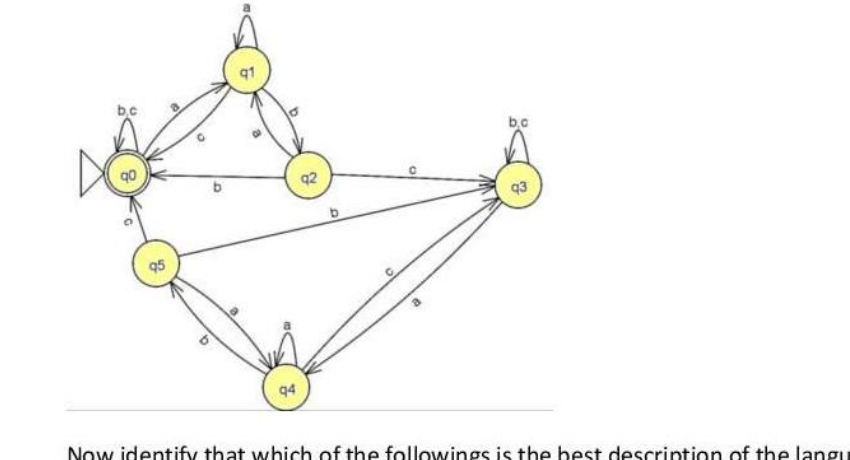
DFA over the alphabet {a, b, c}.
- AL = (a* + b* + c*)+
- BL = (a + b + c)(abc)+(a + b + c)
- CThe set of strings that start with a, b, or c and end with c
- DThe set of strings having an even count, including zero, of the substring
abc
Answer: (D) The set of strings having an even count, including zero, of the substring
abcExplanation
Sign in to read the full explanationQuestion 32
Which pictured NFA is valid for the given DFA?
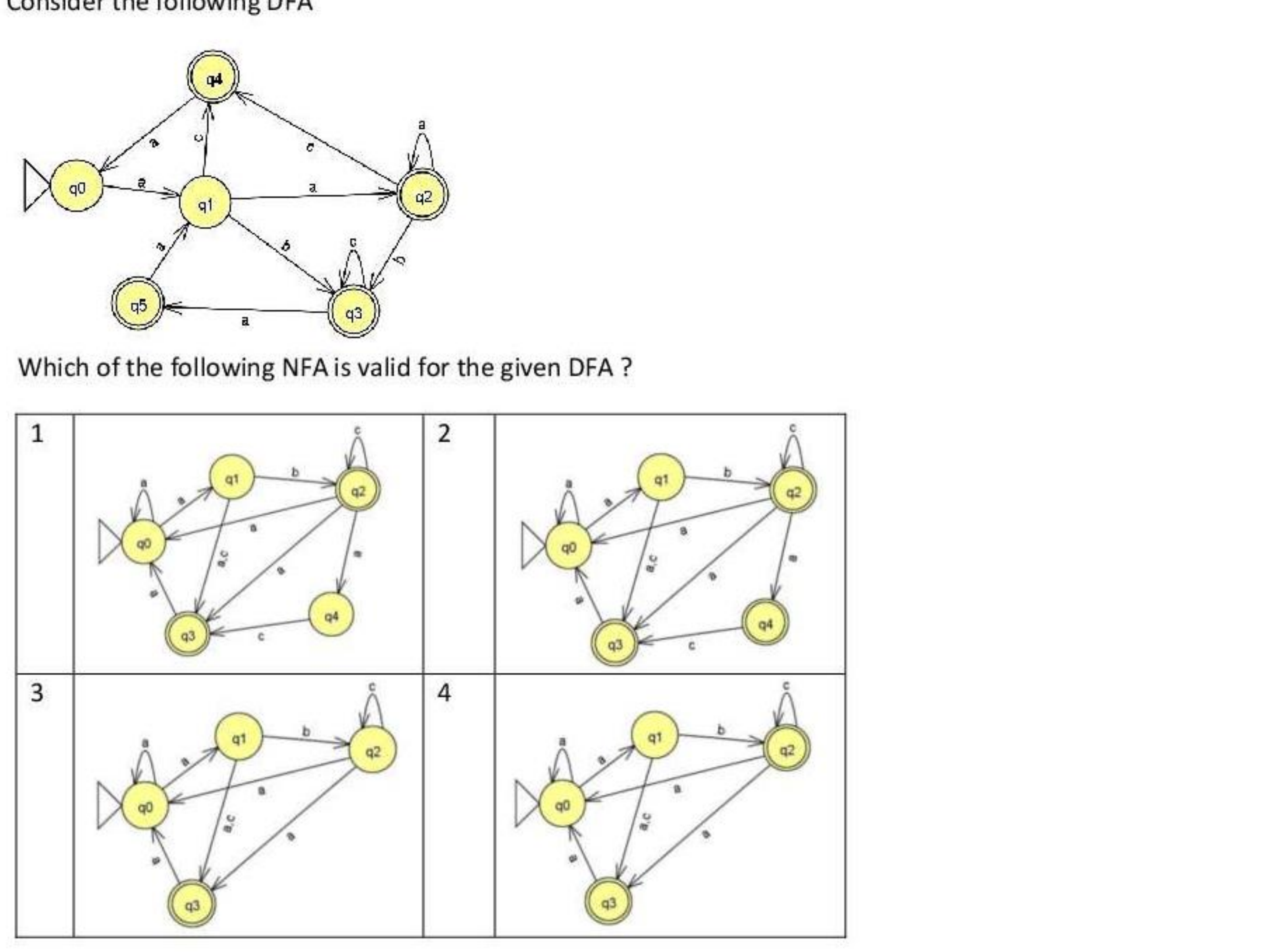
Given DFA and four candidate NFA diagrams.
- ADiagram 1
- BDiagram 2
- CDiagram 3
- DDiagram 4
Answer: (D) Diagram 4
Explanation
Sign in to read the full explanationQuestion 33
In a stop-and-wait system, line bandwidth is 1 Mbps and round-trip delay is 30 ms. What is the bandwidth-delay product?
- A15,000 bits
- B20,000 bits
- C30,000 bits
- D60,000 bits
Answer: (C) 30,000 bits
Explanation
Sign in to read the full explanationQuestion 34
CB84000D001C001Cis a UDP header in hexadecimal. What is the source-port number?- A52100
- B13
- C28
- D52000
Answer: (A) 52100
Explanation
Sign in to read the full explanationQuestion 35
A packet sent by a router or node to the source to inform it of congestion is called a:
- AExplicit packet
- BBackpressure packet
- CChoke packet
- DRetransmission packet
Answer: (C) Choke packet
Explanation
Sign in to read the full explanationQuestion 36
Which is not a characteristic of packet switching?
- AData is broken into packets.
- BEach packet may take a different route.
- CIt requires a dedicated path.
- DIt supports dynamic routing.
Answer: (C) It requires a dedicated path.
Explanation
Sign in to read the full explanationQuestion 37
Which is not a valid property of λ-cuts of fuzzy relations R̃ and S̃?
- A(R̃ ∪ S̃)λ = Rλ ∪ Sλ
- B(R̃ ∩ S̃)λ = Rλ ∩ Sλ
- CThe λ-cut of the complement of R̃ differs from the complement of Rλ except when λ = 1.
- DFor λ ≤ β with 0 ≤ β ≤ 1, Rβ ⊆ Rλ.
Answer: (C) The λ-cut of the complement of R̃ differs from the complement of Rλ except when λ = 1.
Explanation
Sign in to read the full explanationQuestion 38
Which is not a parent-selection technique in genetic-algorithm implementations?
- ARadial
- BTournament
- CBoltzmann
- DRank
Answer: (A) Radial
Explanation
Sign in to read the full explanationQuestion 39
With η as learning rate and xi as the ith input, which update rule best describes a Kohonen self-organizing map weight wij?
- Awij(new) = (1 − η)wij(old) + ηxi
- Bwij(new) = ηwij(old) + (1 − η)xi
- Cwij(new) = (1 − η)wij(old) + xi
- Dwij(new) = wij(old) + ηxi
Answer: (A) wij(new) = (1 − η)wij(old) + ηxi
Explanation
Sign in to read the full explanationQuestion 40
After applying samples S1 through S4 in order to a perceptron with initial weights w1 = w2 = 0, learning rate 0.1, no bias, and output 0 when yin = 0, what are the updated weights?
Sample x1 x2 Target S1 0 0 0 S2 0 1 1 S3 1 0 1 S4 1 1 1 - Aw1 = 0.1, w2 = 0.1
- Bw1 = 0.0, w2 = 0.2
- Cw1 = 0.0, w2 = 0.1
- Dw1 = 0.2, w2 = 0.2
Answer: (A) w1 = 0.1, w2 = 0.1
Explanation
Sign in to read the full explanationQuestion 41
A computer processes an instruction by fetching it, decoding it, calculating its effective address, fetching operands, and executing it. Which sequence is correct?
- AA, B, C, D, E
- BB, A, D, A, E
- CB, C, A, D, E
- DC, B, A, D, E
Answer: (C) B, C, A, D, E
Explanation
Sign in to read the full explanationQuestion 42
In an arithmetic pipeline, the operations are compare exponents, align mantissas, add or subtract mantissas, and normalize the result. Which sequence is correct?
- AD, A, B, C
- BD, B, A, C
- CB, C, A, D
- DB, C, D, A
Answer: (A) D, A, B, C
Explanation
Sign in to read the full explanationQuestion 43
To input data through a CPU-controlled I/O program, the actions are reading the status register, checking its flag bit, reading the data register, and transferring data to memory. Which sequence is correct?
- AA, B, C, D
- BB, A, C, D
- CC, B, A, D
- DA, C, B, D
Answer: (A) A, B, C, D
Explanation
Sign in to read the full explanationQuestion 44
For C operators
&&,+=,>>,>=, and?:, what is the precedence order from higher to lower?- A
, >=, ?:, +=, &&
- B
, &&, >=, ?:, +=
- C
, >=, &&, ?:, +=
- D
=, >>, &&, +=, ?:
Answer: (C)
, >=, &&, ?:, +=
Explanation
Sign in to read the full explanation- A
Question 45
Arrange Linux interrupt-protection levels from increasing priority: user-mode programs, preemptible kernel system-service routines, bottom-half interrupt handlers, and top-half interrupt handlers.
- AB → A → C → D
- BC → B → A → D
- CC → A → B → D
- DA → D → B → C
Answer: (D) A → D → B → C
Explanation
Sign in to read the full explanationQuestion 46
Which sequence gives the hierarchy of a layered file system from application level down to I/O control?
- AA → B → D → C → E
- BD → E → C → A → B
- CE → A → B → C → D
- DE → C → B → A → D
Answer: (C) E → A → B → C → D
Explanation
Sign in to read the full explanationQuestion 47
Arrange stamp coupling, control coupling, external coupling, common coupling, and content coupling from lowest to highest coupling.
- AE, A, C, B, D
- BD, B, A, E, C
- CB, C, D, A, E
- DC, A, B, D, E
Answer: (C) B, C, D, A, E
Explanation
Sign in to read the full explanationQuestion 48
Arrange unit, integration, system, and acceptance testing in their usual software-development order.
- AB, C, A, D
- BB, A, C, D
- CC, B, A, D
- DC, B, D, A
Answer: (B) B, A, C, D
Explanation
Sign in to read the full explanationQuestion 49
To construct a Huffman tree, first create leaf nodes, build a priority queue, repeatedly combine the lowest-frequency nodes, and stop when the root is formed. Which sequence is correct?
- AB, C, A, D
- BD, B, A, C
- CB, C, D, A
- DC, A, B, D
Answer: (C) B, C, D, A
Explanation
Sign in to read the full explanationQuestion 50
In dynamic programming, the steps are characterizing an optimal solution, recursively defining its value, computing that value bottom-up, and constructing an optimal solution. Which sequence is correct?
- AB, C, A, D
- BB, A, C, D
- CC, B, A, D
- DC, B, D, A
Answer: (D) C, B, D, A
Explanation
Sign in to read the full explanationQuestion 51
Arrange LL(0), LR(0), SLR, LALR(1), and LR(1) parsers from least to greatest grammar-handling power.
- ALL(0) → LR(0) → SLR → LR(1) → LALR(1)
- BSLR → LR(0) → LL(0) → LR(1) → LALR(1)
- CLL(0) → LR(0) → SLR → LALR(1) → LR(1)
- DLR(0) → LL(0) → SLR → LR(1) → LALR(1)
Answer: (C) LL(0) → LR(0) → SLR → LALR(1) → LR(1)
Explanation
Sign in to read the full explanationQuestion 52
Arrange the steps of accessing a website after a user enters a URL: DNS resolution, HTTP request, URL entry, IP-address acquisition, and webpage display.
- AB, A, C, E, D
- BC, B, A, E, D
- CB, C, D, A, E
- DC, A, D, B, E
Answer: (D) C, A, D, B, E
Explanation
Sign in to read the full explanationQuestion 53
Arrange virtualization steps in a cloud environment: install a hypervisor, create virtual machines, allocate their resources, and run isolated workloads.
- AB, C, A, D
- BA, B, C, D
- CA, C, B, D
- DB, C, D, A
Answer: (B) A, B, C, D
Explanation
Sign in to read the full explanationQuestion 54
For knowledge-base design, arrange choosing a task domain, selecting atoms for propositions, axiomatizing the domain, and asking questions about the intended interpretation.
- AC → A → D → B
- BC → A → B → D
- CB → C → A → D
- DA → C → B → D
Answer: (A) C → A → D → B
Explanation
Sign in to read the full explanationQuestion 55
Arrange these genetic-algorithm actions: calculate population fitness, select parents, apply crossover, and mutate each locus.
- AA → C → B → D
- BC → A → D → B
- CC → A → B → D
- DA → D → B → C
Answer: (B) C → A → D → B
Explanation
Sign in to read the full explanationQuestion 56
Let P mean “she is intelligent” and Q mean “she is happy.” Which set correctly formalizes: intelligent implies unhappy; neither intelligent nor happy; being not intelligent is necessary for happiness; and not intelligent implies unhappy?
- AP → ¬Q; P ∧ ¬Q; Q → ¬P; P → ¬Q
- BP → Q; ¬P ∧ ¬Q; ¬Q → P; ¬P → ¬Q
- CP → ¬Q; ¬P ∧ ¬Q; Q → ¬P; ¬P → ¬Q
- DP → ¬Q; P ∧ ¬Q; Q → P; ¬P → ¬Q
Answer: (C) P → ¬Q; ¬P ∧ ¬Q; Q → ¬P; ¬P → ¬Q
Explanation
Sign in to read the full explanationQuestion 57
For positive integers m and n, which statements are correct: n ≠ 1 implies m < mn; a composite k can be written k = mn with 1 < m,n > k; mn = 1 implies m = n = 1; and a composite k can be written k = mn with 1 < m,n < k?
- AA, C, D only
- BB, C, D only
- CA, B only
- DA, B, C
Answer: (A) A, C, D only
Explanation
Sign in to read the full explanationQuestion 58
Which statements are true: write-through updates only cache; write-back updates cache and main memory together; private writable caches create coherence problems; and cache coherence can be solved by a hardware-only scheme?
- AA and B only
- BB and C only
- CC and D only
- DA, B, and C only
Answer: (C) C and D only
Explanation
Sign in to read the full explanationQuestion 59
Which gate does not output 1 when both inputs are 0?
- ANAND and NOR only
- BNOR and XOR only
- CXOR and XNOR only
- DXOR only
Answer: (D) XOR only
Explanation
Sign in to read the full explanationQuestion 60
Editorially repaired version of an ambiguous NTA item. Consider these XML statements:
A. XML has no predefined tag set, and users can define their own tags.
B. XML is used primarily for presentation.
C. XML is case-sensitive.
D. XML supports dynamic data representation.Which statements are true?
- AB, C, and D only
- BA, B, and D only
- CA, C, and D only
- DB and D only
Answer: (C) A, C, and D only
Explanation
Sign in to read the full explanationQuestion 61
Which pointer operations are legal in C?
- AA, B, C only
- BA, B, D only
- CA and B only
- DA and E only
Answer: (D) A and E only
Explanation
Sign in to read the full explanationQuestion 62
Once a process is executing, which events could not occur: issuing I/O then joining the ready queue; creating a child and waiting for it; time-slice expiry then joining the waiting queue; or interrupt-driven removal then joining the waiting queue?
- AB only
- BD only
- CA and C only
- DA, C, and D only
Answer: (D) A, C, and D only
Explanation
Sign in to read the full explanationQuestion 63
Which statement about spinlock semaphores is correct?
- AThey are busy-waiting semaphores.
- BThey are not useful when locks are held briefly.
- CWaiting for one may require multiple context switches.
- DThey are often employed on uniprocessor systems.
Answer: (A) They are busy-waiting semaphores.
Explanation
Sign in to read the full explanationQuestion 64
Which cohesions are better than procedural cohesion?
- AFunctional and communicational only
- BFunctional, sequential, and communicational only
- CTemporal, communicational, and logical only
- DFunctional, communicational, and logical only
Answer: (B) Functional, sequential, and communicational only
Explanation
Sign in to read the full explanationQuestion 65
Which are McCall quality factors: maintainability, usability, integrity, and functionality?
- AA and D only
- BA, B, and D only
- CC and D only
- DA, B, and C only
Answer: (D) A, B, and C only
Explanation
Sign in to read the full explanationQuestion 66
Which algorithms use a greedy strategy: Dijkstra's algorithm, Kruskal's algorithm, Huffman coding, and Bellman-Ford?
- AA, B, and D only
- BA, B, and C only
- CC and D only
- DA and D only
Answer: (B) A, B, and C only
Explanation
Sign in to read the full explanationQuestion 67
Which trees are height balanced: binary search tree, AVL tree, red-black tree, and B-tree?
- AA and D only
- BA, B, and D only
- CC and D only
- DB and C only
Accepted answers: (C) C and D only, (D) B and C only
Explanation
Sign in to read the full explanationQuestion 68
Which are controlled-access protocols: reservation, polling, TDMA, token passing, and CSMA/CA?
- AA and D only
- BA, B, and D only
- CC, D, and E only
- DA, D, and E only
Answer: (B) A, B, and D only
Explanation
Sign in to read the full explanationQuestion 69
Which are data-encoding schemes: NRZ, Manchester encoding, amplitude modulation, Hamming code, and bipolar AMI?
- AA, C, and D only
- BA, B, and D only
- CC, D, and E only
- DA, B, and E only
Answer: (D) A, B, and E only
Explanation
Sign in to read the full explanationQuestion 70
Which statements about agent systems are correct: an agent system comprises an agent and its environment; an agent controller receives percepts and sends commands; actuators are always reliable; and actuators convert stimuli into percepts?
- AA and B only
- BB and D only
- CC and D only
- DB, C, and D only
Answer: (A) A and B only
Explanation
Sign in to read the full explanationQuestion 71
Which STRIPS statements are correct: it is feature-centric; world-state features are primitive and derived; an action has preconditions and effects; and it directly defines conditional effects?
- AA and C only
- BB and C only
- CA and D only
- DB, C, and D only
Answer: (B) B and C only
Explanation
Sign in to read the full explanationQuestion 72
Editorially repaired version of an ambiguous NTA item. Which grammars are context-free but not regular?
Grammar Productions A S → Ab; aS → aA; A → a B S → Ab; A → Sa; A → a C S → AS; S → aA; A → a D S → Ab; S → aA; A → a E S → Sb; A → Aa; A → ε - AA and B only
- BC and D only
- CC only
- DA, B, D, and E only
Answer: (C) C only
Explanation
Sign in to read the full explanationQuestion 73
The source prints 196 bits for Twofish; that typo is corrected to 256 bits below. Which encryption statements are true: symmetric-key cryptography requires secrecy of the key-generating function above the decrypting function; DES uses a 64-bit block and 56-bit key; Twofish uses a 128-bit block with variable keys up to 256 bits; and RC4 is a stream cipher operating on bits or bytes rather than blocks?
- AB and C only
- BA and D only
- CA and C only
- DB, C, and D only
Answer: (D) B, C, and D only
Explanation
Sign in to read the full explanationQuestion 74
Editorially repaired version of an ambiguous NTA item. In the broad Knowledge Discovery in Databases (KDD) process, consider these statements:
A. Data transformation is involved.
B. An online database can serve as a data source for a data warehouse.
C. Classification is a measure of accuracy.
D. K-means clustering minimizes within-cluster variance.
E. Pattern evaluation identifies knowledge using interestingness measures.Which statements are true?
- AA, B, D, and E only
- BB, D, and E only
- CA, C, and E only
- DA, C, and D only
Answer: (A) A, B, D, and E only
Explanation
Sign in to read the full explanationQuestion 75
Which serializability statements are true: conflict serializability means conflict equivalence to a serial schedule; view serializability means view equivalence to a serial schedule; serial schedules interleave participating transactions; and every conflict-serializable schedule is view-serializable but not conversely?
- AA, B, C, and D
- BA, B, and C only
- CA, B, and D only
- DB, C, and D only
Answer: (C) A, B, and D only
Explanation
Sign in to read the full explanationQuestion 76
Match the statements about the Indian team with inverse, converse, contrapositive, and conditional forms.
List I List II A. If the Indian team wins, then it is raining I. Inverse B. If the Indian team does not win, then it is not raining II. Converse C. If it is raining, then the Indian team wins III. Contrapositive D. If it is not raining, then the Indian team does not win IV. Conditional - AA-II, B-I, C-IV, D-III
- BA-III, B-I, C-II, D-IV
- CA-II, B-III, C-IV, D-I
- DA-III, B-II, C-IV, D-I
Answer: (C) A-II, B-III, C-IV, D-I
Explanation
Sign in to read the full explanationQuestion 77
Match Types 3, 2, 1, and 0 grammars to their production restrictions.
List I List II A. Type 3 Grammar I. V → (V ∪ Σ)* B. Type 2 Grammar II. λVβ → λ(V ∪ Σ)*β, where (λ, β) ∈ (V ∪ Σ)* C. Type 1 Grammar III. (V ∪ Σ)* → (V ∪ Σ)* D. Type 0 Grammar IV. V → VΣ | Σ - AA-II, B-III, C-IV, D-I
- BA-III, B-I, C-IV, D-II
- CA-IV, B-I, C-II, D-III
- DA-III, B-II, C-I, D-IV
Answer: (C) A-IV, B-I, C-II, D-III
Explanation
Sign in to read the full explanationQuestion 78
Match address space, memory space, cache memory, and segmented program with associative mapping, logical address, physical address, and virtual address.
List I List II A. Address Space I. Associative Mapping B. Memory Space II. Logical address C. Cache Memory III. Physical address D. Segmented Program IV. Virtual address - AA-IV, B-III, C-I, D-II
- BA-I, B-II, C-IV, D-III
- CA-III, B-IV, C-I, D-II
- DA-II, B-IV, C-I, D-III
Answer: (A) A-IV, B-III, C-I, D-II
Explanation
Sign in to read the full explanationQuestion 79
Editorially repaired version of an NTA-dropped item. Treat the following descriptions as a one-to-one matching. Which mapping is correct?
List I List II A. Overloading I. An overridden method call is selected at runtime B. Early binding II. A function call is resolved at compile time C. Method overriding III. Supports compile-time polymorphism D. Late binding IV. Supports runtime polymorphism - AA-III, B-II, C-I, D-IV
- BA-IV, B-II, C-III, D-I
- CA-III, B-I, C-IV, D-II
- DA-IV, B-I, C-III, D-II
Answer: (A) A-III, B-II, C-I, D-IV
Explanation
Sign in to read the full explanationQuestion 80
Match oblique, cavalier, cabinet, and orthographic projection with their defining projection properties.
List I List II A. Oblique projection I. Perpendicular lines are foreshortened B. Cavalier projection II. Perpendicular lines are not foreshortened C. Cabinet projection III. Projectors are perpendicular to the plane D. Orthographic projection IV. Projector angle to plane is not 90° - AA-III, B-II, C-IV, D-I
- BA-IV, B-II, C-I, D-III
- CA-III, B-I, C-IV, D-II
- DA-IV, B-I, C-III, D-II
Answer: (B) A-IV, B-II, C-I, D-III
Explanation
Sign in to read the full explanationQuestion 81
Match clustered page table, hierarchical page table, segmentation, and inverted page table with their characteristics.
List I List II A. Clustered Page Table I. Generally inappropriate for 64-bit architectures B. Hierarchical Page Table II. One entry for each real page/frame C. Segmentation III. Useful for sparse address spaces D. Inverted Page Table IV. Supports a user view of the system - AA-III, B-IV, C-II, D-I
- BA-III, B-I, C-IV, D-II
- CA-II, B-III, C-I, D-IV
- DA-IV, B-II, C-I, D-III
Answer: (B) A-III, B-I, C-IV, D-II
Explanation
Sign in to read the full explanationQuestion 82
Match RAID levels 2, 3, 5, and 6 with their organizations.
List I List II A. RAID Level 2 I. Block-interleaved distributed parity B. RAID Level 3 II. P+Q redundancy scheme C. RAID Level 5 III. Bit-interleaved parity D. RAID Level 6 IV. Memory-style error-correcting code organization - AA-IV, B-III, C-I, D-II
- BA-III, B-IV, C-I, D-II
- CA-I, B-III, C-IV, D-II
- DA-II, B-IV, C-I, D-III
Answer: (A) A-IV, B-III, C-I, D-II
Explanation
Sign in to read the full explanationQuestion 83
Match reliability, efficiency, maintainability, and portability with their software-quality descriptions.
Characteristic Description A. Reliability I. Transfer between environments B. Efficiency II. Sustained performance over time C. Maintainability III. Performance relative to resources D. Portability IV. Effort needed for modification - AA-II, B-III, C-I, D-IV
- BA-II, B-III, C-IV, D-I
- CA-III, B-II, C-I, D-IV
- DA-IV, B-II, C-I, D-III
Answer: (B) A-II, B-III, C-IV, D-I
Explanation
Sign in to read the full explanationQuestion 84
Match equivalence partitioning, boundary-value analysis, cyclomatic complexity, and decision-table testing with their testing focus.
Technique Focus A. Equivalence Partitioning I. Independent code paths B. Boundary Value Analysis II. Valid/invalid input sets C. Cyclomatic Complexity III. Input-range limits D. Decision Table Testing IV. Action combinations and conditions - AA-II, B-III, C-I, D-IV
- BA-II, B-III, C-IV, D-I
- CA-III, B-II, C-I, D-IV
- DA-IV, B-II, C-I, D-III
Answer: (A) A-II, B-III, C-I, D-IV
Explanation
Sign in to read the full explanationQuestion 85
Match circular queue, priority queue, deque, and simple queue with their common applications.
List I List II A. Circular Queue I. Print Queue B. Priority Queue II. CPU Scheduling C. Double Ended Queue III. Dijkstra algorithm D. Simple Queue IV. Palindrome checking - AA-II, B-III, C-I, D-IV
- BA-II, B-III, C-IV, D-I
- CA-III, B-II, C-I, D-IV
- DA-IV, B-II, C-I, D-III
Answer: (B) A-II, B-III, C-IV, D-I
Explanation
Sign in to read the full explanationQuestion 86
Match chaining, linear probing, quadratic probing, and double hashing with their collision-handling strategies.
Method Strategy A. Chaining I. Check next slot B. Linear Probing II. Use second hash function C. Quadratic Probing III. Linked list at index D. Double Hashing IV. Quadratic step - AA-II, B-III, C-I, D-IV
- BA-II, B-III, C-IV, D-I
- CA-III, B-I, C-IV, D-II
- DA-IV, B-II, C-I, D-III
Answer: (C) A-III, B-I, C-IV, D-II
Explanation
Sign in to read the full explanationQuestion 87
Match count-to-infinity, IEEE 802.16, IEEE 802.15, and AODV with their networking associations.
List I List II A. Count-to-infinity problem I. Mobile Adhoc Networks B. IEEE 802.16 II. Distance-vector routing C. IEEE 802.15 III. WiMAX D. AODV IV. Bluetooth - AA-II, B-III, C-I, D-IV
- BA-II, B-III, C-IV, D-I
- CA-II, B-IV, C-III, D-I
- DA-IV, B-III, C-I, D-II
Answer: (B) A-II, B-III, C-IV, D-I
Explanation
Sign in to read the full explanationQuestion 88
Match digital signature, hash function, AES, and RSA with their security roles.
List I List II A. Digital Signature I. Asymmetric encryption algorithm B. Hash Function II. Confirms authenticity and integrity C. AES III. Produces a fixed-size digest D. RSA IV. Symmetric encryption algorithm - AA-II, B-III, C-I, D-IV
- BA-II, B-III, C-IV, D-I
- CA-III, B-II, C-I, D-IV
- DA-IV, B-II, C-I, D-III
Answer: (B) A-II, B-III, C-IV, D-I
Explanation
Sign in to read the full explanationQuestion 89
Match fuzzy-set intersection, bounded sum, bounded difference, and algebraic sum with their membership functions.
Operation Membership function A. Intersection I. μA(x) + μB(x) − μA(x)μB(x) B. Bounded Sum II. max(0, μA(x) − μB(x)) C. Bounded Difference III. min(1, μA(x) + μB(x)) D. Algebraic Sum IV. min(μA(x), μB(x)) - AA-III, B-I, C-II, D-IV
- BA-III, B-II, C-IV, D-I
- CA-IV, B-III, C-II, D-I
- DA-II, B-I, C-III, D-IV
Answer: (C) A-IV, B-III, C-II, D-I
Explanation
Sign in to read the full explanationQuestion 90
Match worst individual, best individual, sum of fitness, and median fitness termination criteria with their convergence descriptions.
Criterion Description A. Worst Individual I. At least half the individuals are at or above convergence value B. Best Individual II. Virtually all individuals are within a fitness range C. Sum of Fitness III. Entire population meets a minimum standard D. Median Fitness IV. At least one best solution / faster convergence - AA-III, B-IV, C-II, D-I
- BA-IV, B-III, C-I, D-II
- CA-II, B-I, C-III, D-IV
- DA-II, B-III, C-IV, D-I
Answer: (A) A-III, B-IV, C-II, D-I
Explanation
Sign in to read the full explanationQuestion 91
Which high-level program corresponds to the displayed three-address code?
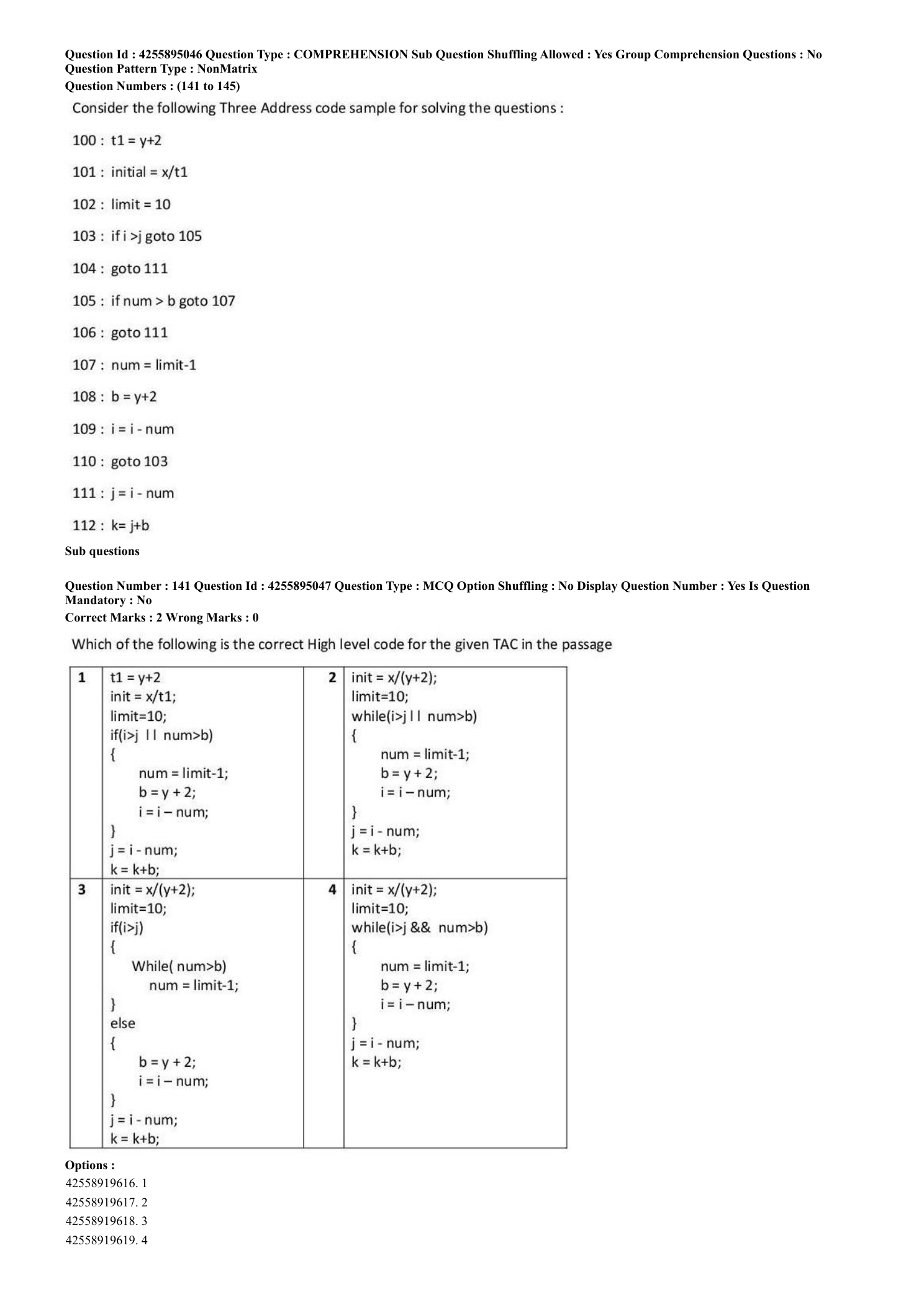
Three-address code and its four high-level-code alternatives.
- ASource code option 1
- BSource code option 2
- CSource code option 3
- D
init = x/(y+2); limit = 10; while (i > j && num > b) { num = limit-1; b = y+2; i = i-num; } j = i-num; k = j+b;
Answer: (D)
init = x/(y+2); limit = 10; while (i > j && num > b) { num = limit-1; b = y+2; i = i-num; } j = i-num; k = j+b;Explanation
Sign in to read the full explanationQuestion 92
What are the leaders for this three-address code?
100: t1 = y + 2 101: initial = x / t1 102: limit = 10 103: if i > j goto 105 104: goto 111 105: if num > b goto 107 106: goto 111 107: num = limit - 1 108: b = y + 2 109: i = i - num 110: goto 103 111: j = i - num 112: k = j + b- A100, 102, 103, 104, 105, 107, 110
- B100, 103, 105, 107, 111, 112
- C100, 103, 105, 106, 107, 111
- D100, 103, 104, 105, 106, 107, 111
Answer: (D) 100, 103, 104, 105, 106, 107, 111
Explanation
Sign in to read the full explanationQuestion 93
Which displayed flow graph is correct for the given three-address code?
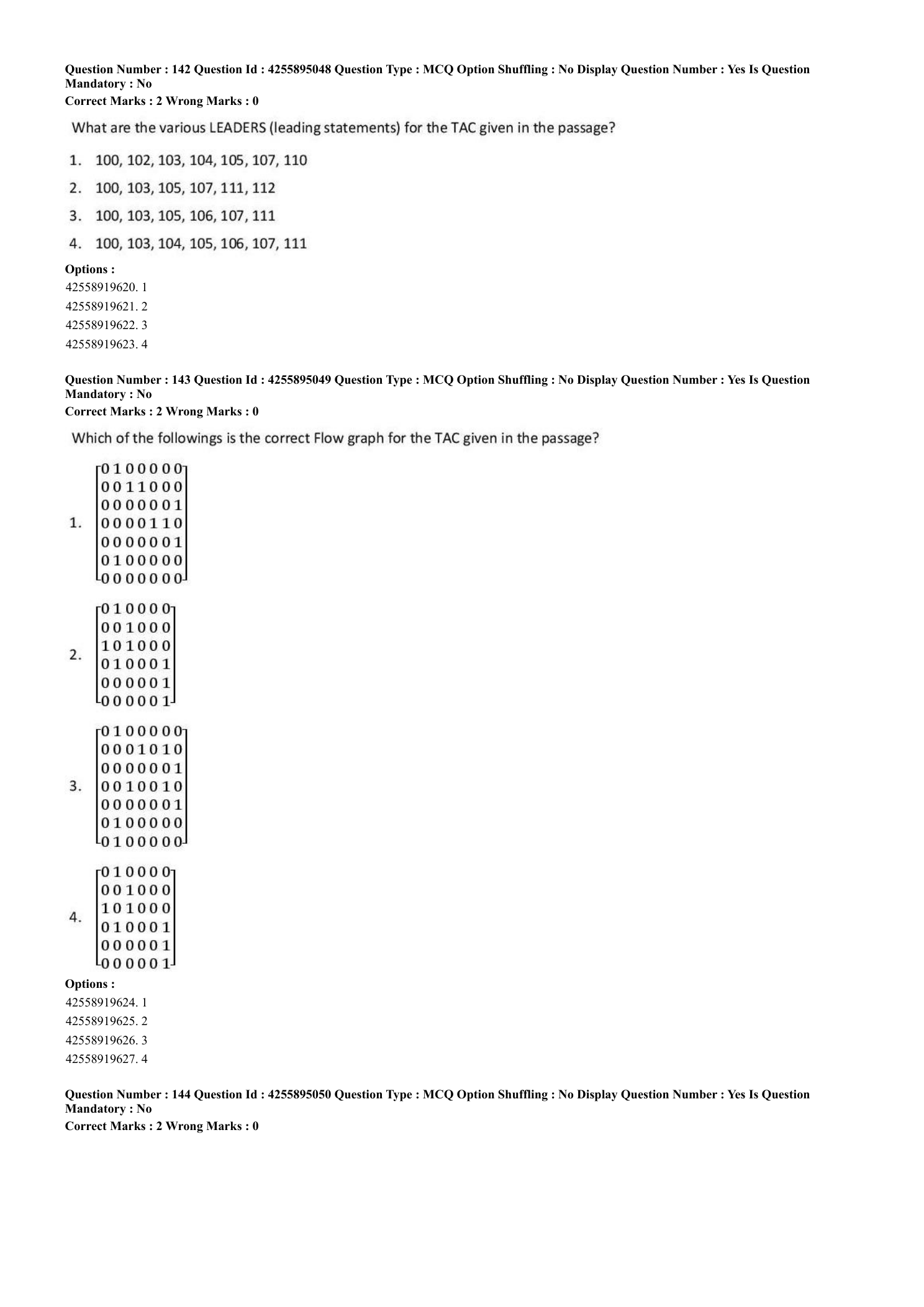
Four adjacency-matrix flow-graph alternatives for the three-address code.
- AAdjacency-matrix option 1
- BAdjacency-matrix option 2
- CAdjacency-matrix option 3
- DAdjacency-matrix option 4
Answer: (A) Adjacency-matrix option 1
Explanation
Sign in to read the full explanationQuestion 94
In the flow graph for the given three-address code, which blocks are dominated by Block 3 and Block 5?
- ABlock 3: 3; Block 5: 5
- BBlock 3: 3, 4, 5, 6; Block 5: 5, 6
- CBlock 3: 3, 7; Block 5: 5, 7
- DBlock 3: 3, 4, 7; Block 5: 5, 6, 7
Answer: (A) Block 3: 3; Block 5: 5
Explanation
Sign in to read the full explanationQuestion 95
Editorially repaired version of an NTA-dropped item. Consider this three-address code. Assume
yis not reassigned between lines 100 and 108. Which single change is a semantics-preserving common-subexpression elimination?100: t1 = y + 2 101: initial = x / t1 102: limit = 10 103: if i > j goto 105 104: goto 111 105: if num > b goto 107 106: goto 111 107: num = limit - 1 108: b = y + 2 109: i = i - num 110: goto 103 111: j = i - num 112: k = j + b- AReplace only line 108 with
b = t1. - BMove
num = limit - 1before the test at line 105. - CReplace lines 111–112 with
k = i + b. - DReplace line 109 with
i = i - limit - 1.
Answer: (A) Replace only line 108 with
b = t1.Explanation
Sign in to read the full explanation- AReplace only line 108 with
Question 96
Using FCFS disk scheduling, what is the total head movement for request queue 45, 81, 185, 33, 175, 99, 150, 77 with initial head location 58?
- A536
- B594
- C647
- D700
Answer: (C) 647
Explanation
Sign in to read the full explanationQuestion 97
Using SSTF disk scheduling, what is the total head movement for request queue 45, 81, 185, 33, 175, 99, 150, 77 with initial head location 58?
- A160
- B124
- C177
- D240
Answer: (C) 177
Explanation
Sign in to read the full explanationQuestion 98
For SCAN moving left from initial head location 58, what is the second request processed for queue 45, 81, 185, 33, 175, 99, 150, 77?
- A81
- B45
- C33
- D175
Answer: (C) 33
Explanation
Sign in to read the full explanationQuestion 99
For C-SCAN moving right from initial head location 58, what is the total head movement for queue 45, 81, 185, 33, 175, 99, 150, 77?
- A327
- B307
- C525
- D385
Answer: (D) 385
Explanation
Sign in to read the full explanationQuestion 100
For C-LOOK moving right from initial head location 58, what is the second request processed for queue 45, 81, 185, 33, 175, 99, 150, 77?
- A81
- B45
- C77
- D33
Answer: (A) 81
Explanation
Sign in to read the full explanation
Frequently asked questions
How many questions were in the UGC NET Computer Science & Applications June 2025 exam?
Paper 1 had 50 questions and Paper 2 (Computer Science & Applications) had 100 questions, for 150 in total across 3 hours.
Is there negative marking in UGC NET?
No. Each correct answer earns 2 marks and there is no penalty for a wrong answer, so leaving a question blank is never better than attempting it.
Are the June 2025 answers on this page official?
Answers follow the official NTA answer key for this session. If you spot a discrepancy, use the report option inside the practice test and we will review it.
Can I attempt the June 2025 paper as a timed mock test?
Yes. Every paper on this page has an "Attempt this paper" button that opens the same questions in the timed test interface, with instant scoring and weak-area analysis afterwards.
Want the full mock experience?
Attempt Paper 1 + Paper 2 (Computer Science & Applications) together in a single timed session.
Every Computer Science & Applications PYQ on one topic
More Computer Science & Applications practice
Practice Paper 1 from other subjects
Every subject's exam sitting has its own Paper 1 (General Aptitude) set — more real PYQs to solve.